Please select a subject first
Advertisements
Advertisements
Given below is a list of six micro-organisms. State their usefulness to humans.
- Nucleopolyhedrovirus
- Saccharomyces cerevisiae
- Monascus purpureus
- Trichoderma polysporum
- Penicillium notatum
- Propionibacterium sharmanii
Concept: Microbes as Biocontrol Agents
Explain the significant role of the genus Nucleopolyhedrovirus in an ecological sensitive area.
Concept: Microbes as Biocontrol Agents
How do methanogens help to generate biogas?
Concept: Microbes in Production of Biogas
Organic farmers prefer the biological control of diseases and pests to the use of chemicals for the same purpose. Justify
Concept: Microbes as Biocontrol Agents
Can we use slurry of human excreta instead of cowdung slurry to produce biogas in a typical biogas plant? Support your answer giving reasons.
Concept: Microbes in Production of Biogas
Study the given diagram of the Sewage Treatment Plant (S.T.P.) and answer the question that follows:
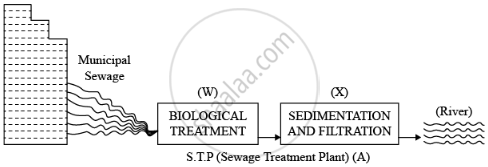
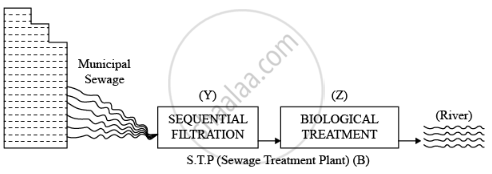
- Which one of the two 'S.T.P.' (A) or (B) will be more effective in treating the human excreta in municipal waste?
- Write the steps followed in carrying the treatment of the sewage in step (Z), once the BOD of sewage is reduced significantly till it is passed on to the "anaerobic sludge digesters".
Concept: Microbes in Sewage Treatment
Name the drug a patient who has undergone a successful organ transplant, has to take all his/her life.
Concept: Microbes in Industrial Products
Farmers are often suggested to use the following organism in their crop land so as to improve the soil fertility. Explain.
Rhizobium
Concept: Microbes as Biofertilizers
Farmers are often suggested to use the following organism in their crop land so as to improve the soil fertility. Explain.
Anabaena
Concept: Microbes as Biofertilizers
Given below are the list of the commercially important products and their source organisms. Select the option that gives the correct matches.
| List A | List B | ||
| S. No. | Bioactive Products | S. No. |
Microbes (Source Organism) |
| (A) | Cyclosporin - A | (i) | Streptococcus |
| (B) | Statins | (ii) | Trichoderma polysporum |
| (C) | Streptokinase | (iii) | Penicillium notatum |
| (D) | Penicillin | (iv) | Monascus purpureus |
Concept: Microbes in Industrial Products
Retroviruses have no DNA. However, the DNA of the infected host cell does possess viral DNA. How is it possible?
Concept: Principles of Processes of Biotechnology
Rearrange the following in the correct sequence to accomplish an important biological reaction:
(a) In vitro synthesis of copies of DNA of interest
(b) Chemically synthesized oligonucleotides
(c) Enzyme DNA-polymerase
(d) Complementary region of DNA
(e) Genomic DNA template
(f) Nucleotides provided
(g) Primers
(h) Thermostable DNA-polymerase (from Thermus aquaticus)
(i) Denaturation of ds-DNA
Concept: Principles of Processes of Biotechnology
Mention the type of host cells suitable for the gene guns to introduce an alien DNA.
Concept: Tools of Recombinant DNA Technology >> Competent Host (For Transformation with Recombinant DNA)
Suggest a technique to a researcher who needs to separate fragments of DNA.
Concept: Tools of Recombinant DNA Technology >> Restriction Enzymes
Suggest and describe a technique to obtain multiple copies of a gene of interest in vitro.
Concept: Processes of Recombinant DNA Technology
Draw a labelled sketch of sparged-stirred-tank bioreactor. Write its application.
Concept: Processes of Recombinant DNA Technology
Name the enzymes that are used for the isolation of DNA from bacterial and fungal cells for recombinant DNA technology.
Concept: Tools of Recombinant DNA Technology >> Restriction Enzymes
How does a restriction nuclease function? Explain
Concept: Tools of Recombinant DNA Technology >> Restriction Enzymes
Name and describe the technique that helps in separating the DNA fragments formed by the use of restriction endonuclease
Concept: Tools of Recombinant DNA Technology >> Restriction Enzymes
Write the steps you would suggest to be undertaken to obtain a foreign-gene-product.
Concept: Tools of Recombinant DNA Technology >> Competent Host (For Transformation with Recombinant DNA)
