Definitions [2]
The two mutually perpendicular number lines intersecting each other at their zeroes are called rectangular axes or coordinate axes, or axes of reference.
The position of a point in a plane is expressed by a pair of numbers, one concerning the x-axis and the other concerning the y-axis. called co-ordinates.
-
x → distance from y-axis (abscissa)
-
y → distance from x-axis (ordinate)
Formulae [3]
The distance between P(x1, y1) and Q(x2, y2) is
\[\sqrt{(x_2-x_1)^2+(y_2-y_1)^2}\]
The distance of a point P(x, y) from the origin is
\[\sqrt{x^2+y^2}\]
\[P\left(\frac{m_1x_2+m_2x_1}{m_1+m_2},\frac{m_1y_2+m_2y_1}{m_1+m_2}\right)\]
\[M\left(\frac{x_1+x_2}{2},\frac{y_1+y_2}{2}\right)\]
The point of concurrence (centroid) divides the median in the ratio 2:1.
Theorems and Laws [6]
If the points p (x, y) is point equidistant from the points A (5, 1)and B (–1, 5), Prove that 3x = 2y
As per the question, we have
AP = BP
`⇒ sqrt((x -5)^2 +(y-1)^2) = sqrt((x+1)^2 +(y-5)^2)`
`⇒(x-5)^2 +(y-1)^2 = (x+1)^2 +(y-5)^2` (Squaring both sides)
`⇒x^2 - 10x +25 + y^2 -2y +1 = x^2 +2x +1+y^2 -10y+25`
⇒ –10x – 2y = 2x – 10y
⇒ 8y = 12x
⇒ 3x = 2y
If the point (x, y) is equidistant from the points (a + b, b – a) and (a – b, a + b), prove that bx = ay.
Let P(x, y), Q(a + b, b – a) and R (a – b, a + b) be the given points. Then
PQ = PR ...(Given)
⇒ `sqrt({x - (a + b)}^2 + {y - (b - a)}^2) = sqrt({x - (a - b)}^2 + {y - (a + b)}^2`
⇒ `{x - (a + b)}^2 + {y - (b - a)}^2 = {x - (a - b)}^2 + {y - (a + b)}^2`
⇒ x2 – 2x(a + b) + (a + b)2 + y2 – 2y(b – a) + (b – a)2 = x2 + (a – b)2 – 2x(a – b) + y2 – 2(a + b) + (a + b)2
⇒ –2x(a + b) – 2y(b – a) = –2x(a – b) – 2y(a + b)
⇒ ax + bx + by – ay = ax – bx + ay + by
⇒ 2bx = 2ay
⇒ bx = ay
Let `A(bara)` and `B(barb)` be any two points in the space and `R(barr)` be the third point on the line AB dividing the segment AB externally in the ratio m : n, then prove that `barr = (mbarb - nbara)/(m - n)`.
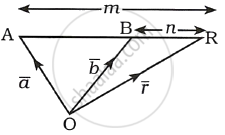
As the point R divides the line segment AB externally, we have either A-B-R or R-A-B.
Assume that A-B-R and `bar(AR) : bar(BR)` = m : n
∴ `(AR)/(BR) = m/n` so n(AR) = m(BR)
As `n(bar(AR))` and `m(bar(BR))` have same magnitude and direction,
∴ `n(bar(AR)) = m(bar(BR))`
∴ `n(barr - bara) = m(barr - barb)`
∴ `nbarr - nbara = mbarr - mbarb`
∴ `mbarr - nbarr = mbarb - nbara`
∴ `(m - n)barr = mbarb - nbara`
∴ `barr = (mbarb - nbara)/(m - n)`
Hence proved.
Let `A(bara)` and `B(barb)` are any two points in the space and `R(barr)` be a point on the line segment AB dividing it internally in the ratio m : n, then prove that `barr = (mbarb + nbara)/(m + n)`.
R is a point on the line segment AB(A – R – B) and `bar(AR)` and `bar(RB)` are in the same direction.
Point R divides AB internally in the ratio m : n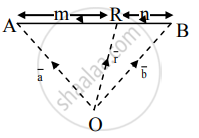
∴ `(AR)/(RB) = m/n`
∴ n(AR) = m(RB)
As `n(bar(AR))` and `m(bar(RB))` have same direction and magnitude,
`n(bar(AR)) = m(bar(RB))`
∴ `n(bar(OR) - bar(OA)) = m(bar(OB) - bar(OR))`
∴ `n(vecr - veca) = m(vecb - vecr)`
∴ `nvecr - nveca = mvecb - mvecr`
∴ `mvecr + nvecr = mvecb + nveca`
∴ `(m + n)vecr = mvecb + nveca`
∴ `vecr = (mvecb + nveca)/(m + n)`
By vector method prove that the medians of a triangle are concurrent.

Let A, B and C be vertices of a triangle.
Let D, E and F be the mid-points of the sides BC, AC and AB respectively.
Let `bara, barb, barc, bard, bare` and `barf` be position vectors of points A, B, C, D, E and F respectively.
Therefore, by mid-point formula,
∴ `bard = (barb + barc)/2, bare = (bara + barc)/2` and `barf = (bara + barb)/2`
∴ `2bard = barb + barc, 2bare = bara + barc` and `2barf = bara + barb`
∴ `2bard + bara = bara + barb + barc`, similarly `2bare + barb = 2barf + barc = bara + barb + barc`
∴ `(2bard + bara)/3 = (2bare + barb)/3 = (2barf + barc)/3 = (bara + barb + barc)/3 = barg` ...(Say)
Then we have `barg = (bara + barb + barc)/3 = ((2)bard + (1)bara)/(2 + 1) = ((2)bare + (1)barb)/(2 + 1) = ((2)barf + (1)barc)/(2 + 1)`
If G is the point whose position vector is `barg`, then from the above equation it is clear that the point G lies on the medians AD, BE, CF and it divides each of the medians AD, BE, CF internally in the ratio 2 : 1.
Therefore, three medians are concurrent.
If D, E, F are the midpoints of the sides BC, CA, AB of a triangle ABC, prove that `bar(AD) + bar(BE) + bar(CF) = bar0`.
Let `bara, barb, barc, bard, bare, barf` be the position vectors of the points A, B, C, D, E, F respectively.
Since D, E, F are the midpoints of BC, CA, AB respectively, by the midpoint formula
`bard = (barb + barc)/2, bare = (barc + bara)/2, barf = (bara + barb)/2`
∴ `bar(AD) + bar(BE) + bar(CF) = (bard - bara) + (bare - barb) + (barf - barc)`
= `((barb + barc)/2 - bara) + ((barc + bara)/2 - barb) + ((bara + barb)/2 - barc)`
= `1/2barb + 1/2barc - bara + 1/2barc + 1/2bara - barb + 1/2bara + 1/2barb - barc`
= `1/2(barb + barc - 2bara + bar c + bara - 2barb + bara + barb - 2barc)`
= `(bara + barb + barc) - (bara + barb + barc) = bar0`.
Key Points
Sign Convention
-
Right of y-axis → +x
-
Left of y-axis → −x
-
Above x-axis → +y
-
Below x-axis → −y
Standard Line Results
-
x = 0 → y-axis
-
y = 0 → x-axis
-
x = a → line parallel to the y-axis
-
y = b → line parallel to the x-axis
Quadrant Reminder
| Quadrant | Sign of (x, y) |
|---|---|
| I | (+, +) |
| II | (−, +) |
| III | (−, −) |
| IV | (+, −) |
Important Questions [52]
- Assertion (A): Mid-point of a line segment divides the line segment in the ratio 1 : 1 Reason (R): The ratio in which the point (−3, k) divides the line segment joining the points (− 5, 4)
- Prove that the points (3, 0), (6, 4) and (-1, 3) are the vertices of a right-angled isosceles triangle.
- The Base Bc of an Equilateral Triangle Abc Lies on Y-axis. the Coordinates of Point C Are (0, -3). Origin is the Midpoint of Base , Find the Coordinates of Another Point D Such that Abcd is a Rhombus.
- The Midpoint P of the Line Segment Joining Points A(-10, 4) and B(-2, 0) Lies on Line Segment Joining the Points C(-9, -4) and D(-4, Y). Find Ratio in Which P Divides Cd. Also, Find the Value of Y.
- If the Vertices of δAbc Be A(1, -3) B(4, P) and C(-9, 7) and Its Area is 15 Square Units, Find the Values of P
- Find the Coordinates of the Points of Trisection of the Line Segment Joining the Points (3, –2) and (–3, –4) ?
- Find the Ratio in Which the Point (−3, K) Divides the Line-segment Joining the Points (−5, −4) and (−2, 3). Also Find the Value of K ?
- Show that the Points (−2, 3), (8, 3) and (6, 7) Are the Vertices of a Right Triangle ?
- If P ( a 2 , 4 ) is the Mid-point of the Line-segment Joining the Points a (−6, 5) and B(−2, 3), Then the Value of a is
- Point P(X, 4) Lies on the Line Segment Joining the Points A(−5, 8) and B(4, −10). Find the Ratio in Which Point P Divides the Line Segment Ab. Also Find the Value of X.
- Find the Area of the Quadrilateral Abcd, Whose Vertices Are A(−3, −1), B (−2, −4), C(4, − 1) and D (3, 4).
- If the distance between the points (4, p) and (1, 0) is 5, then p is equal to ______.
- Find the Point on the Y-axis Which is Equidistant from the Points (S, - 2) and (- 3, 2).
- The Line Segment Joining the Points A(2, 1) and B (5, - 8) is Trisected at the Points P and Q Such that P is Nearer to A. If P Also Lies on the Line Given By 2x - Y + K= 0 Find the Value of K.
- Find the Coordinates of Point A, Where Ab is a Diameter of the Circle with Centre (–2, 2) and B is the Point with Coordinates (3, 4).
- Find the Point on the Y-axis Which is Equidistant from the Points (5, −2) and (−3, 2).
- The Point R Divides the Line Segment Ab, Where A(−4, 0) and B(0, 6) Such that Ar = 3/4ab. Find the Coordinates Of R.
- The distance of the point (–6, 8) from x-axis is ______.
- The distance of the point (–4, 3) from y-axis is ______.
- The coordinates of the point where the line 2y = 4x + 5 crosses x-axis is ______.
- The distance of the point (–1, 7) from x-axis is ______.
- Assertion (A): The point (0, 4) lies on y-axis. Reason (R): The x-coordinate of a point on y-axis is zero.
- Distance of the point (6, 5) from the y-axis is ______.
- Ryan, from a very young age, was fascinated by the twinkling of stars and the vastness of space. He always dreamt of becoming an astronaut one day.
- A Line Intersects The Y-axis And X-axis at the Points P and Q Respectively. If (2, –5) is the Mid-point of Pq, Then Find the Coordinates of P and Q.
- If the Points A(K + 1, 2k), B(3k, 2k + 3) and C(5k − 1, 5k) Are Collinear, Then Find the Value of K
- If A(–2, 1), B(a, 0), C(4, b) and D(1, 2) are the vertices of a parallelogram ABCD, find the values of a and b. Hence find the lengths of its sides
- Find the points on the x-axis, each of which is at a distance of 10 units from the point A(11, –8).
- Point a Lies on the Line Segment Pq Joining P(6, -6) and Q(-4, -1) in Such a Way that `(Pa)/( Pq)=2/5` . If that Point a Also Lies on the Line 3x + K( Y + 1 ) = 0, Find the Value of K.
- Points P, Q, R and S Divide the Line Segment Joining the Points A(1,2) and B(6,7) in Five Equal Parts. Find the Coordinates of the Points P,Q and R
- If the point P(x, y) is equidistant from the points A(a + b, b – a) and B(a – b, a + b). Prove that bx = ay.
- The x-coordinate of a point P is twice its y-coordinate. If P is equidistant from Q(2, –5) and R(–3, 6), find the coordinates of P.
- If A(5, 2), B(2, −2) and C(−2, t) are the vertices of a right angled triangle with ∠B = 90°, then find the value of t.
- If the point A(0, 2) is equidistant from the points B(3, p) and C(p, 5), find p. Also find the length of AB.
- If the point P(2, 2) is equidistant from the points A(−2, k) and B(−2k, −3), find k. Also find the length of AP.
- In a classroom, 4 friends are seated at the points A, B, C and D as shown in the following figure. Champa and Chameli walk into the class and after observing for a few minutes
- If the Distance Between the Points (4, K) and (1, 0) is 5, Then What Can Be the Possible Values of K?
- If A≠B≠0, Prove that the Points (A, A2), (B, B2) (0, 0) Will Not Be Collinear
- The Long and Short Hands of a Clock Are 6 Cm and 4 Cm Long Respectively. Find the Sum of the Distances Travelled by Their Tips in 24 Hours. (Use π = 3.14) ?
- If the Distances of P(X, Y) from A(5, 1) and B(–1, 5) Are Equal, Then Prove that 3x = 2y
- Read the following passage: Use of mobile screen for long hours makes your eye sight weak and give you headaches. Children who are addicted to play "PUBG" can get easily stressed out.
- Find the Distance of a Point P(X, Y) from the Origin.
- Find the Distance Between the Points (A, B) and (−A, −B).
- If a and B Are the Points (−6, 7) and (−1, −5) Respectively, Then the Distance 2ab is Equal to
- Find the Value of Y for Which the Distance Between the Points a (3, −1) and B (11, Y) is 10 Units.
- The distance between the points (0, 5) and (–3, 1) is ______.
- In What Ratio Does the Point P(−4, Y) Divide the Line Segment Joining the Points A(−6, 10) and B(3, −8) ? Hence Find the Value of Y.
- The distance of the point P(–6, 8) from the origin is ______.
- The points (– 4, 0), (4, 0), (0, 3) are the vertices of a ______.
- The distance of the point (5, 0) from the origin is ______.
- If A(4, 3), B(-1, y) and C(3, 4) are the vertices of a right triangle ABC, right-angled at A, then find the value of y.
- For What Values of K Are the Points (8, 1), (3, –2k) and (K, –5) Collinear ?
