English

In a classroom, 4 friends are seated at the points A, B, C and D as shown in the following figure. Champa and Chameli walk into the class and after observing for a few minutes - Mathematics

Advertisements
Advertisements

Question

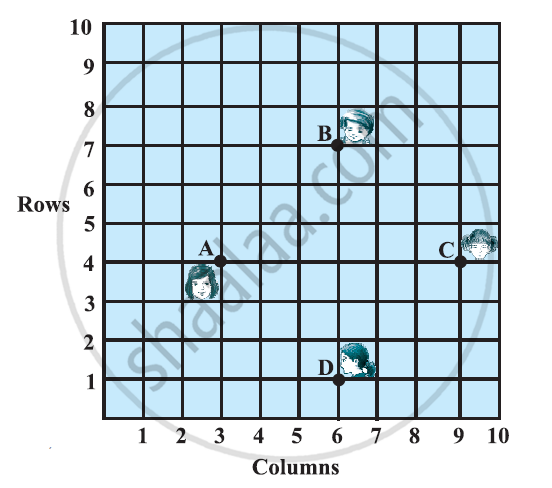
In a classroom, 4 friends are seated at the points A, B, C and D as shown in the following figure. Champa and Chameli walk into the class and after observing for a few minutes, Champa asks Chameli, “Don’t you think ABCD is a square?” Chameli disagrees.

Using distance formula, find which of them is correct.
Sum
Advertisements

Solution

It can be observed that A (3, 4), B (6, 7), C (9, 4), and D (6, 1) are the positions of these 4 friends.

AB = `sqrt((3-6)^2+(4-7)^2)`

= `sqrt((-3)^2+(-3)^2)`

= `sqrt(9+9)`

= `sqrt18`

= `3sqrt2`

BC = `sqrt((6-9)^2+(7-4)^2) `

= `sqrt((-3)^2+(3)^2)`

= `sqrt(9+9)`

= `sqrt18`

= `3sqrt2`

CD = `sqrt((9-6)^2+(4-1)^2)`

= `sqrt((3)^2+(3)^2)`

= `sqrt(9+9)`

= `sqrt18`

= `3sqrt2`

AD = `sqrt((3-6)^2+(4-1)^2)`

= `sqrt((-3)^2 + (3)^2)`

= `sqrt(9+9)`

= `sqrt18`

= `3sqrt2`

Diagonal AC = `sqrt((3-9)^2+(4-4)^2)`

= `sqrt((-6)^2)`

= 6

Diagonal BD = `sqrt((6-6)^2+(7-1)^2)`

= `sqrt((6)^2)`

= 6
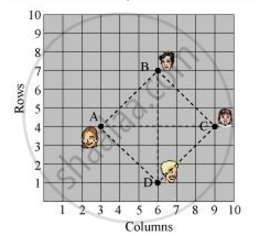
It can be observed that all sides of this quadrilateral ABCD are of the same length and also the diagonals are of the same length.

Therefore, ABCD is a square and hence, Champa was correct.

shaalaa.com
  Is there an error in this question or solution?
Chapter 7: Coordinate Geometry - Exercise 7.1 [Page 161]

APPEARS IN

NCERT Mathematics [English] Class 10
Chapter 7 Coordinate Geometry
Exercise 7.1 | Q 5 | Page 161

Video TutorialsVIEW ALL [1]

RELATED QUESTIONS

If P and Q are two points whose coordinates are (at2 ,2at) and (a/t2 , 2a/t) respectively and S is the point (a, 0). Show that `\frac{1}{SP}+\frac{1}{SQ}` is independent of t.


Prove that the points (–3, 0), (1, –3) and (4, 1) are the vertices of an isosceles right angled triangle. Find the area of this triangle


Find the distance between the following pairs of points:

(−5, 7), (−1, 3)


Show that the points A (1, −2), B (3, 6), C (5, 10) and D (3, 2) are the vertices of a parallelogram.


Prove that the points A(1, 7), B (4, 2), C(−1, −1) D (−4, 4) are the vertices of a square.


Show that the quadrilateral whose vertices are (2, −1), (3, 4) (−2, 3) and (−3,−2) is a rhombus.


Find the distance between the points

A(-6,-4) and B(9,-12)


Distance of point (−3, 4) from the origin is ______.


Find the value of a if the distance between the points (5 , a) and (1 , 5) is 5 units .


Find the coordinates of the points on the y-axis, which are at a distance of 10 units from the point (-8, 4).


Find a point on the y-axis which is equidistant from the points (5, 2) and (-4, 3).


The length of line PQ is 10 units and the co-ordinates of P are (2, -3); calculate the co-ordinates of point Q, if its abscissa is 10.


Calculate the distance between the points P (2, 2) and Q (5, 4) correct to three significant figures.


Find the distance of the following points from origin.
(a cos θ, a sin θ).


Seg OA is the radius of a circle with centre O. The coordinates of point A is (0, 2) then decide whether the point B(1, 2) is on the circle?


Case Study -2

A hockey field is the playing surface for the game of hockey. Historically, the game was played on natural turf (grass) but nowadays it is predominantly played on an artificial turf.

It is rectangular in shape - 100 yards by 60 yards. Goals consist of two upright posts placed equidistant from the centre of the backline, joined at the top by a horizontal crossbar. The inner edges of the posts must be 3.66 metres (4 yards) apart, and the lower edge of the crossbar must be 2.14 metres (7 feet) above the ground.

Each team plays with 11 players on the field during the game including the goalie. Positions you might play include -

  • Forward: As shown by players A, B, C and D.
  • Midfielders: As shown by players E, F and G.
  • Fullbacks: As shown by players H, I and J.
  • Goalie: As shown by player K.

Using the picture of a hockey field below, answer the questions that follow:

What are the coordinates of the position of a player Q such that his distance from K is twice his distance from E and K, Q and E are collinear?


If (– 4, 3) and (4, 3) are two vertices of an equilateral triangle, find the coordinates of the third vertex, given that the origin lies in the interior of the triangle.


The points A(–1, –2), B(4, 3), C(2, 5) and D(–3, 0) in that order form a rectangle.


A point (x, y) is at a distance of 5 units from the origin. How many such points lie in the third quadrant?


Tharunya was thrilled to know that the football tournament is fixed with a monthly timeframe from 20th July to 20th August 2023 and for the first time in the FIFA Women’s World Cup’s history, two nations host in 10 venues. Her father felt that the game can be better understood if the position of players is represented as points on a coordinate plane.

  1. At an instance, the midfielders and forward formed a parallelogram. Find the position of the central midfielder (D) if the position of other players who formed the parallelogram are :- A(1, 2), B(4, 3) and C(6, 6)
  2. Check if the Goal keeper G(–3, 5), Sweeper H(3, 1) and Wing-back K(0, 3) fall on a same straight line.
    [or]
    Check if the Full-back J(5, –3) and centre-back I(–4, 6) are equidistant from forward C(0, 1) and if C is the mid-point of IJ.
  3. If Defensive midfielder A(1, 4), Attacking midfielder B(2, –3) and Striker E(a, b) lie on the same straight line and B is equidistant from A and E, find the position of E.

Share
Notifications

Englishहिंदीमराठी


      Forgot password?
Use app×