Definitions [12]
If two variables x and y both vary with respect to a third variable t (like time), you can find the rate of change of y with respect to x using:
(Note: This is only valid if \[\frac{dx}{dt} \neq 0\]).
If a quantity y varies with another quantity x based on a rule y = f(x), then the derivative \[\frac{dy}{dx}\] (or f'(x)) represents the rate of change of y with respect to x.
Evaluating the derivative at a specific point, \[\left.\frac{dy}{dx}\right|_{x=x_0}\], gives the instantaneous rate of change at exactly \[x = x_0\].
A function f(x) is said to be an increasing function on (a, b) if x₁ < x₂ ⇒ f(x₁) ≤ f(x₂)
Strictly Increasing Function:
- If x₁ < x₂ ⇒ f(x₁) < f(x₂)
A function f(x) is said to be a decreasing function on (a, b) if x₁ < x₂ ⇒ f(x₁) ≥ f(x₂)
Strictly Decreasing Function:
- If x₁ < x₂ ⇒ f(x₁) > f(x₂)
A function f is said to be monotonic in an interval if it is either increasing or decreasing in that interval.
A function f is said to be constant on I if f(x) = c for every x ∈ I, where c is a constant.
Let x₀ be a point in the domain of a real-valued function f.
The function f is said to be increasing at x₀ if there exists an open interval containing x₀ in which f is increasing.
Similarly, f is said to be decreasing at x₀ if there exists an open interval containing x₀ in which f is decreasing.
A point in the domain of a function is called a critical point if either the derivative is zero there or the derivative does not exist there. Critical points are checked while locating possible maxima or minima.
The points where a function changes from decreasing to increasing or from increasing to decreasing are called turning points.
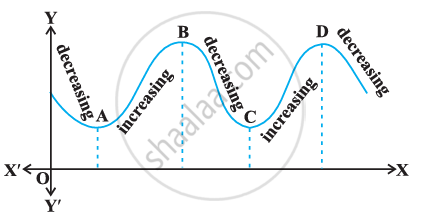
Let f be a function defined on an interval I.
Maximum value: f has a maximum value at c ∈ I if \[ \boxed{f(c) \geq f(x) \quad \text{for all } x \in I} \]
The value f(c) is called the maximum value and c is called a point of maximum.
Minimum value: f has a minimum value at c ∈ I if \[ \boxed{f(c) \leq f(x) \quad \text{for all } x \in I} \]
The value f(c) is called the minimum value and c is called a point of minimum.
Extreme value: A maximum or minimum value of f is called an extreme value.
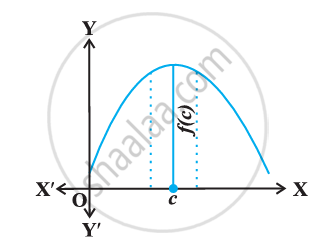
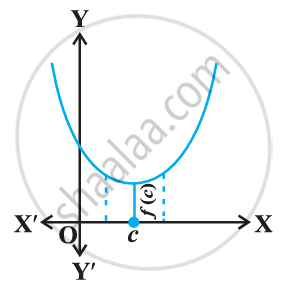
Maximum value Minimum value
Absolute Maximum: The greatest value of a function on the entire given interval is called its absolute maximum value or global maximum value.
Absolute Minimum: The least value of a function on the entire given interval is called its absolute minimum value or global minimum value.
Theorems and Laws [4]
Assume f'(c) = 0 and the second derivative exists at c:
-
Local Maximum: f''(c) < 0
-
Local Minimum: f''(c) > 0
-
Test Fails: f''(c) = 0. If this happens, you must go back and use the First Derivative Test to check if it is a maxima, minima, or point of inflection.
Let c be a critical point of a continuous function f:
-
Local Maximum: If f'(x) changes sign from positive to negative as x passes through c, then cc is a point of local maximum.
-
Local Minimum: If f'(x) changes sign from negative to positive then c is a point of local minimum.
-
Point of Inflection: f'(x) does not change sign as x passes through c (it is neither a maxima nor a minima).
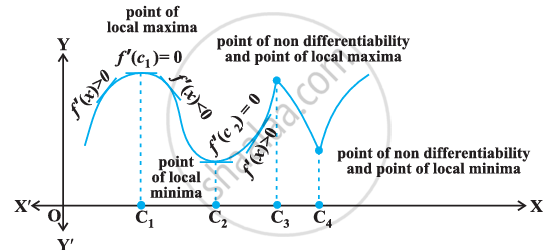
If a differentiable function has an absolute max or min at an interior point c of the interval, then its derivative at that point is zero (f'(c) = 0).
A continuous function on a closed interval [a, b] will attain its absolute maximum and absolute minimum value at least once in that interval.
Key Points
-
Derivative gives instantaneous rate of change.
-
Positive derivative means the quantity is increasing.
-
Negative derivative means the quantity is decreasing.
-
In related rates, first connect the variables by an equation, then differentiate.
-
Always substitute the given value only after differentiation.
-
Do not forget units in the final answer.
-
Marginal cost and marginal revenue are applications of derivatives in economics.
- Increasing means output does not decrease as input increases.
- Strictly increasing means output always increases.
- Decreasing means output does not increase as input increases.
- Monotonic means either increasing or decreasing on an interval.
- f′(x) > 0 implies increasing, f′(x) < 0 implies decreasing, and f′(x) = 0 on an interval implies constant behaviour.
- If \[ f'(x) = 0 \] throughout an interval, the function is constant on that interval.
- A single point where \[ f'(x) = 0 \] does not necessarily make the function constant.
- To find intervals of increase or decrease, find the zeros of f'(x), divide the domain into intervals, and check the sign of f'(x).
- A function that is increasing or decreasing on an interval is called monotonic on that interval.
- A function may be increasing on one interval and decreasing on another; in that case it is not monotonic on its entire domain.
-
Maxima and minima are extreme values of a function.
-
Critical points occur where \(f'(x)=0\) or \(f'(x)\) is not defined.
-
If \(f'(x)\) changes from positive to negative, the function has a local maximum.
-
If \(f'(x)\) changes from negative to positive, the function has a local minimum.
-
If \(f''(c) < 0\), there is a local maximum at \(x=c\).
-
If \(f''(c) > 0\), there is a local minimum at \(x=c\).
-
For absolute extrema on \([a,b]\), compare values at critical points and endpoints.
-
Not every critical point gives a maximum or minimum.
-
The second derivative test is quick, but the first derivative test is often more reliable in detailed reasoning.
-
Continuity on a closed interval guarantees existence of absolute extrema.
-
Differentiability at an interior extremum implies \(f'(c)=0\).
-
Endpoints must always be checked in closed interval problems.
-
Local extrema and absolute extrema are not always the same.
-
A critical point occurs when \(f'(x)=0\) or \(f'(x)\) is undefined.
-
Optimisation problems in calculus are applications of maxima and minima.
Important Questions [46]
- A particle moves along the curve 3y = ax3 + 1 such that at a point with x-coordinate 1, y-coordinate is changing twice as fast at x-coordinate. Find the value of a.
- The Volume of Cube is Increasing at the Rate of 9 Cm 3/S. How Fast is Its Surfacee Area Increasing When the Length of an Edge is 10 Cm?
- The median of an equilateral triangle is increasing at the ratio of 23 cm/s. Find the rate at which its side is increasing.
- The total cost C(x) in rupees associated with the production of x units of an item is given by C(x) = 0.007x3 – 0.003x2 + 15x + 4000. Find the marginal cost when 17 units are produced
- The Total Cost C(X) Associated with the Production Of X Units of an Item is Given by C(X) = 0.005x3 – 0.02x2 + 30x + 5000. Find the Marginal Cost When 3 Units Are Produced, Whereby Marginal Cost We Mean the Instantaneous Rate of Change of Total Cost at Any Level of Output.
- The Volume of a Sphere is Increasing at the Rate of 3 Cubic Centimeter per Second. Find the Rate of Increase of Its Surface Area, When the Radius is 2 Cm
- The Volume of a Sphere is Increasing at the Rate of 8 Cm3/S. Find the Rate at Which Its Surface Area is Increasing When the Radius of the Sphere is 12 Cm.
- If equal sides of an isosceles triangle with fixed base 10 cm are increasing at the rate of 4 cm/sec, how fast is the area of triangle increasing at an instant when all sides become equal?
- A ladder 13 m long is leaning against a vertical wall. The bottom of the ladder is dragged away from the wall along the ground at the rate of 2 cm/sec. How fast is the height on the wall decreasing
- If the circumference of circle is increasing at the constant rate, prove that rate of change of area of circle is directly proportional to its radius.
- Find the intervals in which the function f(x) = 3x4 − 4x3 − 12x2 + 5 is
- The amount of pollution content added in air in a city due to x-diesel vehicles is given by P(x) = 0.005x^3 + 0.02x^2 + 30x.
- Find the intervals in which f(x) = sin 3x – cos 3x, 0 < x < π, is strictly increasing or strictly decreasing.
- The side of an equilateral triangle is increasing at the rate of 2 cm/s. At what rate is its area increasing when the side of the triangle is 20 cm ?
- Find the value(s) of x for which y = [x(x − 2)]2 is an increasing function.
- Find the Value of C in Rolle'S Theorem for the Function F(X)=X3−3x in -sqrt3,0
- Show that the Function `F(X) = Xcuberoot3 - 3xsqrt2 + 6x - 100` is Increasing on R
- Show that the Function F(X) = 4xcube3 - 18xsquare2 + 27x - 7 Is Always Increasing On R.
- Find the Intervals in Which the Function `F(X) = X^4/4 - X^3 - 5x^2 + 24x + 12`Is (A) Strictly Increasing, (B) Strictly Decreasing
- Show that the Function F Given by F(X) = Tan–1 (Sin X + Cos X) is Decreasing for All X ∈ ( π 4 , π 2 ) .
- The Radius R of a Right Circular Cylinder is Increasing Uniformly at the Rate of 0·3 Cm/S and Its Height H is Decreasing at the Rate of 0·4 Cm/S.
- Find the Intervals in Which the Function F ( X ) = 3 2 X 4 − 4 X 3 − 45 X 2 + 51 is (A) Strictly Increasing (B) Strictly Decreasing
- Find the Intervals in Which Function F Given by F(X) = 4x3 - 6x2 - 72x + 30 is (A) Strictly Increasing, (B) Strictly Decresing .
- Prove that the Function F : N → N, Defined by F(X) = X2 + X + 1 is One-one but Not Onto. Find Inverse of F : N → S, Where S is Range of F.
- Find the Intervals in Which the Function F ( X ) = 4 Sin X 2 + Cos X − X ; 0 ≤ X ≤ 2 π is Strictly Increasing Or Strictly Decreasing.
- Read the following passage: The use of electric vehicles will curb air pollution in the long run. The use of electric vehicles is increasing every year
- The interval in which the function f(x) = 2x3 + 9x2 + 12x – 1 is decreasing is ______.
- The function f(x) = x3 + 3x is increasing in interval ______.
- Show that a Cylinder of a Given Volume, Which is Open at the Top, Has Minimum Total Surface Area When Its Height is Equal to the Radius of Its Base.
- Show that the Height of a Cylinder, Which is Open at the Top, Having a Given Surface Area and Greatest Volume, is Equal to the Radius of Its Base.
- Find the point on the curve y^2 = 4x, which is nearest to the point (2, 1).
- Read the following passage: Engine displacement is the measure of the cylinder volume swept by all the pistons of a piston engine. The piston moves inside the cylinder bore.
- Sum of two numbers is 5. If the sum of the cubes of these numbers is least, then find the sum of the squares of these numbers.
- If the sum of lengths of hypotenuse and a side of a right angled triangle is given, show that area of triangle is maximum, when the angle between them is π/3.
- Show that the height of the cylinder of maximum volume, that can be inscribed in a sphere of radius R is 2R3. Also, find the maximum volume.
- Find the dimensions of the rectangle of perimeter 36 cm which will sweep out a volume as large as possible, when revolved about one of its sides. Also, find the maximum volume.
- Show that the Surface Area of a Closed Cuboid with Square Base and Given Volume is Minimum, When It is a Cube.
- The maximum value of (1x)x is ______.
- A Metal Box with a Square Base and Vertical Sides is to Contain 1024 Cm3. the Material for the Top and Bottom Costs Rs 5 per Cm2 and the Material for the Sides Costs Rs 2.50 per Cm2. Find the Least Cost of the Box
- A window is in the form of a rectangle surmounted by a semicircular opening. The total perimeter of the window is 10 m. Find the dimensions of the window to admit maximum light
- Show that the Altitude of the Right Circular Cone of Maximum Volume that Can Be Inscribed in a Sphere of Radius R Is (4r)/3.
- An Open Tank with a Square Base and Vertical Sides is to Be Constructed from a Metal Sheet So as to Hold a Given Quantity of Water. Show that the Cost of Material Will Be Least When Depth of the Tank is Half of Its Width. If the Cost is to Be Borne by Nearby Settled Lower Income Families, for Whom Water Will Be Provided, What Kind of Value is Hidden in this Question?
- Prove that the Semi-vertical Angle of the Right Circular Cone of Given Volume and Least Curved Surface is Cot − 1 ( √ 2 ) .
- Show that height of the cylinder of greatest volume which can be inscribed in a right circular cone of height h and semi-vertical angle α is one-third that of the cone
- Find the absolute maximum and absolute minimum values of the function f given by f(x)=sin^2 x-cosx,x ∈ (0,π)
- Find the local maxima and local minima, of the function f(x) = sin x − cos x, 0 < x < 2π.
