Advertisements
Advertisements
प्रश्न
Write short note on the following.
Any five principles of management.
Explain the following principle of management:
Initiative
Explain the following principle of management:
Order
Explain the following principle of management:
Unity of direction
Explain the following principle of management:
Subordination of individual interest to general interest
Explain the following principle of management:
Esprit de corps
Advertisements
उत्तर
Introduction: Henry Fayol was a French mining engineer. He worked as the director of mines also. After conducting many experiments in management, he developed 14 principles of management. These principles are explained in his famous book 'General and Industrial Administration'. Due to his contribution to management, he is called 'the father of Modern Management'.
The Principles laid down by Fayol are explained below:
- Principle of Division of Work: According to this principle, the total work should be divided into small sub-parts. The divided work should be assigned to different employees, as per their capacities, skills and interests. Fayol says the division of work leads to specialization.
- Principle of Authority and Responsibility: When the work is assigned to a person, he should be given proper authority to carry out that work. E.g. a manager should be given authority is always accompanied by responsibility. When a person is given the authority, he should be held responsible for the same task. Authority and responsibility always go hand in hand. If the manager is given the authority to complete the task within a given time, he should be held responsible if he does not do that in time.
- Principle of Discipline: According to Fayol, discipline is the most essential thing in the organization. Employees must obey and respect the rules that govern the organization. Discipline helps to achieve the goals set in the organization. Good discipline is the result of effective leadership. For that, there must be a clear understanding between the management and workers regarding the organization's rules.
- Principle of Unity of Command: In any organization, every employee should receive orders from the superior (boss) only. This is applicable from top management to bottom. The principle of unit of command tries to avoid confusion. If an employee receives orders from more than one superior, he will be confused and will not be able to work with concentration. The work will not be performed properly. Whereas, if he gets orders from only one person, he will finish his work accurately.
- Principle of Unity of Direction: Unity of command explains a single person getting directions from a single person. But the unity of direction explains a group working with the same objective under the directions of a single person. According to this principle, each group in the organization should have the same objective. The group should be directed by one manager using one plan. Thus, this principle explains about group working in the organization.
- Principle of subordination of individual interest to general interest: According to this principle, the interest of an individual must be given less importance than the interest of the whole organization. While making decisions in the organization, the manager should always consider the interest of the whole group rather than the interest of a single employee. Similarly, the employee should also protect the interest of the organization and consider his interest subordinate. If the organization prospers automatically, the employee will prosper.
- Principle of Remuneration: This Principle states that the employees must be paid a fair wage for their services. While paying remuneration, the skill, expertise, knowledge, tenure, etc. of the employee should be taken into account. When the employees are paid fair remuneration, they show greater productivity and give more output.
- Principle of Centralization: Centralization refers to the concentration of power or authority. In some organizations, this power is vested in one hand or a few hands. This situation occurs in small organizations. However, if the size of the organization is large, then centralization becomes difficult. According to this principle, there must be a proper balance between centralization and decentralization in the organization. This is to be done according to the size of the organization, the nature of the activity, etc.
- Principle of Scalar Chain: Usually, in the organization, there is a particular system of communication. It is through a chain, e.g. the manager will inform about a decision to the departmental head, the departmental head will inform the supervisor, the supervisor will inform the foreman and the foreman will inform the workers. On the other hand, the communication can flow from the worker to the manager in the upward direction. It is known as a scalar chain.
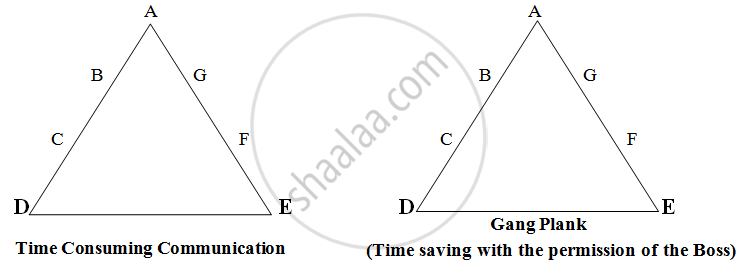
However, this type of communication is very time-consuming. Therefore, sometimes cross-communication, i.e. communication not exactly following the chain, should be allowed. This is known as 'Gang Plank'. It avoids delays; Gang Plank must be done with the proper permission of the authorities.
- Principle of Order: According to this principle, people and materials should be in the right place at the right time. It means there must be a proper arrangement of material. It must have the right place. Similarly, there must be proper placement of personnel. They must be appointed to do the right work at the right place. This principle emphasizes the proper utilization of physical and human resources.
- Principle of Equity: This principle is about fair and equal treatment of all employees. Managers should be kind and fair to their subordinates. There should not be any discrimination between the employees. E.g. the employees working on the same level but in different departments should be paid the same wages. Their wages should not depend on the department but on the level at which they are working.
- Principle of Stability of Tenure: While appointing an employee, the manager should ensure the stability of tenure or job security for the employee. This creates a sense of belonging among the employees. There should not be any uncertainty in the minds of the employees regarding the stability of the job.
- Principle of Initiative: Initiative refers to taking the first step. It also means thinking of new ideas. According to this principle, the manager should encourage the employees to take initiative. The employees should come up with new ideas, and the manager should welcome their ideas. This principle creates a sense of belonging to the organization in the minds of the employees.
- Principle of Esprit de Corps: Esprit de corps means the union is strength. Management is a group activity. Human resources is a great asset of the organization. The manager should create a spirit of teamwork among the employees. The manager should build a sense of togetherness among the employees. If the workers work with unity, the goal can be achieved easily.
Notes
Students can refer to the answer according to their questions.
APPEARS IN
संबंधित प्रश्न
Explain briefly Unity of Direction and Order as principles of general management.
'Aapka Vidyalaya' believes in holistic development of students and encourages team building through a mix of curricular, co-curricular and sports activities. On its founders day, a stage performance had to be put up. A committee of ten prefects was constituted to plan different aspects of the function. They all decided to use recycled paper for decoration. There was a spirit of unity and harmony and all members supported each other. With mutual trust and belongingness, the programme was systematically planned and executed. Kartik, one of the prefects realised that unknowingly the group had applied one of the principles of management while planning and executing the programme. He was so inspired by the success of the function that he asked his father to apply the same principle in his business. His father replied that he was already using this principle
a. Identify the principle of management applied to the success of the programme.
b. State any two features of management highlighted in the above para.
c. Identify any two values which 'Aapka Vidyalaya' communicated to the society.
Explain the following principles of management:
Subordination of Individual Interest to General Interest.
Explain the following principle of management.
Authority and Responsibility
Explain the following principles of management:
Co-operation, not Individualism
State with reasons, whether the following statement is True or False:
Principles of management improve the efficiency of employees.
The principle of management relates to justice and kindness.
State the features of disaster management.
Name the principle that is an extension of the "harmony, not discord".
A production manager at top level in a reputed corporate, Mr. Rathore holds the responsibility for ordering raw material for the firm. While deciding on the supplier for the financial year 2017-18, he gave the order to his cousin at
a higher price per unit instead of the firm’s usual supplier who was willing to lower the rates for the order. Which principle of management was violated by Mr. Rathore? What are the positive impacts of following the above identified principle?
Explain the technique of ‘Functional Foremanship’ and the concept of ‘Mental Revolution’ as enunciated by Taylor.
Select the proper option from the options given below and rewrite completed Sentence.
Concentration of power of authority is stated in the principle of ________.
Select the proper option from the options given below and rewrite completed Sentence.
F.W. Taylor is called as the father of ________ management.
Write a word or phrase or a term which can substitute the following.
The principle of management which says unity is strength.
Write a word or phrase or a term which can substitute the following.
The principle of management explaining the importance of fair payment to workers.
Write a word or phrase or a term which can substitute the following.
The principle of scientific management which explains the use of scientific methods to determine the activity performed by the employee.
Write a word or phrase or a term which can substitute the following.
The statements of fundamental truth of management.
Write short note on the following.
Nature of management.
Write short note on the following.
Principle of scalar chain
State with reasons whether the following statement true or false:
Principles of management improve the efficiency of employees.
Explain the nature of principles of management.
Answer the following question.
Appliances India Ltd. is engaged in the manufacturing and distribution of home appliances since 1987. It has a good name in the market as the company is producing good quality appliances. It has separate departments for manufacturing, finance, sales maintenance services, and technical services to achieve specialization.
Since the areas of operations of the company have increased and customers have become more demanding, the company decided to modify the existing principle of management to meet the changing requirements of the environment.
State the general principle of management which the company wants to modify to meet the changing requirements.
Match the pairs.
| Group A |
Group B |
| A) Henry Fayol |
1) Eight Foremen |
|
B) Principle of Unity of Direction |
2) F.W. Taylor |
|
C) Principle of Management |
3) Proper division of all activities |
|
D) Scientific Management Theory |
4) General guidelines |
|
E) Functional Organization |
5) A place for everything and everything in its place |
|
6) One head-one plan |
|
|
7) Low wage rate |
|
|
8) Harmony between the employee and management |
|
|
9) German engineer |
|
|
10) Modern Management |
Correct the underlined word and rewrite the following sentence.
Management techniques are applied differently under different conditions.
What is principle management?
Arrange in proper order.
Coordinating, Staffing, Directing.
|
After completing her Bachelors in Fashion Designing from a well-known college in France, Aditi has opened a boutique in a posh market in Kolkata. She has divided the work in smaller units and each employee is well trained to perform his/her task efficiently. The sales persons are allowed to close a deal with a buyer by giving a maximum of 5 percent discount, whereas the decision to give any further discount rests with Aditi as the final authority. In the earlier period of her business venture, employees were asked to put in extra hours of work. In return she had promised to give them a special incentive within a year. Therefore, when the business was doing well, she honour her commitment by giving bonus to her employees. She also instructed her employees that communication from top to bottom should follow the official lines of command. However, she tends to be more biased towards her female employees, when it comes to solve the conflicts among employees. |
“The sales persons are allowed to close a deal with a buyer by giving a maximum of 5 percent discount, whereas the decision to give any further discount rests with Aditi as the final authority.” Identify the principle of Management being followed here:
Which of the following statements is false with respect to principles of management?
Why is management required in organisations?
What is a principle?
How are principles of management described in relation to pure science?
Principles are different from which two concepts?
