Advertisements
Advertisements
प्रश्न
Write preparation, properties, and uses of Teflon.
Advertisements
उत्तर
Preparation of Teflon:
- The monomer used in the preparation of Teflon is tetrafluoroethylene (CF2 = CF2), which is a gas at room temperature.
- Tetrafluoroethylene is polymerized by using free-radical initiators such as hydrogen peroxide or ammonium persulphate at high pressure to produce polytetrafluoroethylene (Teflon).
\[\ce{\underset{Tetrafluoroethylene}{{n} CF2 = CF2} ->[Polymerization][Peroxide]\underset{Teflon}{[-CF2 - CF2 -]}_{n}}\]
Properties of Teflon:
- Teflon is tough, chemically inert, and resistant to heat and attack by corrosive reagents.
- C – F bond is very difficult to break and remains unaffected by corrosive alkali and organic solvents.
Uses: Teflon is used in making non-stick cookware, oil seals, gaskets, etc.
संबंधित प्रश्न
Based on molecular forces, what type of polymer is neoprene?
Write the structures of the monomers used for getting the following polymers
Melamine – formaldehyde polymer
Write the monomers of the following polymer :
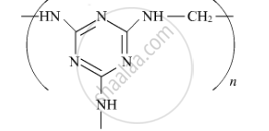
Choose the correct option from the given alternatives.
Which of the following is made up of polyamides?
Answer the following in one sentence.
Define the term: Vulcanization
Answer the following.
Write the reaction of the formation of Nylon 6.
Answer the following.
Write structure of natural rubber and neoprene rubber along with the name and structure of their monomers.
Answer the following.
Match the following pairs:
| Name of polymer | Monomer |
| 1. Teflon | a. CH2 = CH2 |
| 2. PVC | b. CF2 = CF2 |
| 3. Polyester | c. CH2 = CHCl |
| 4. Polythene | d. C6H5OH and HCHO |
| 5. Bakelite | e. Dicarboxylic acid and polyhydoxyglycol |
Draw the structures of polymers formed from the following monomers
\[\ce{n HOOC–R–COOH + n HO–R'–OH}\]
Answer the following.
Draw the structures of polymers formed from the following monomers
H2N–(CH2)5 – COOH
Answer the following.
Write name and formula of raw material from which bakelite is made.
Identify condensation polymers and addition polymers from the following.
\[\begin{array}{cc}\ce{-(CH2 - CH -)_{n}}\\
\phantom{....}|\\\ce{\phantom{.......}C6H5}
\end{array}\]
Attempt the following:
Explain the vulcanisation of rubber. Which vulcanizing agents are used for the following synthetic rubber?
a. Neoprene
b. Buna-N
Answer the following.
Is synthetic rubber better than natural rubber? If so, in what respect?
Answer the following.
Write main specialities of Buna-S, Neoprene rubber?
Nylon 6, 6 is a condensation polymer of hexamethylenediamine and _____________
Monomer used for preparation of polyacrylonitrile is _____________
Monomers ethylene glycol and terephthalic acid undergo condensation polymerization to give polymer called ___________
write the structure of the monomer used in natural rubber.
Write chemical reaction for preparation of the following.
Buna-S
Write the name of one example of each polymer in which following repeating units.
\[\begin{array}{cc}
\ce{(-CF2-CF2-), -[NH-(CH2)5-CO] -, -(CH2-CH-), (-CH2-CH2-)}\\
\phantom{............................}|\\
\phantom{..............................}\ce{CN}
\end{array}\]
Write chemical reactions for the preparation of high-density polythene.
The following structure represents the polymer:
\[\begin{array}{cc}
\ce{[-C-CH2-NH-C-(-CH2)5 NH -]_{{n}}}\\
\phantom{}||\phantom{.............}||\phantom{................}\\
\phantom{}\ce{O}\phantom{.............}\ce{O}\phantom{................}
\end{array}\]
Which among the following polymers is used for making handles of cooker?
Identify the INCORRECT match.
Which of the following polymers is obtained from chloroprene?
Novolac is obtained from ____________.
Which of the following polymers is a heteropolymer?
Identify the polymer obtained by polymerization of n moles of acrylonitrile.
Which of the following compounds is used to prepare orlon?
Which among the following monomers is used to prepare Teflon?
Which among the following polymers is an example of addition polymer?
Which among the following is an example of addition polymer?
Name the polymers used in laminated sheets and give the name of monomeric units involved in its formation.
Which of the following products is formed when benzaldehyde is treated with CH3MgBr and the addition product so obtained is subjected to acid hydrolysis?
Which one of the following polymers are prepared by addition polymerization?
Nylon threads are made of ______.
Which of the following polymers do not involve cross linkages?
Which of the following polymer is used for manufacturing of buckets, dustbins, pipes, etc?
Which of the foolowing polymer is used in the manufacture of insulators.
Answer the following.
Write the structure of isoprene and the polymer obtained from it.
Answer the following.
Write the structure of isoprene and the polymer obtained from it.
Name and draw the structure of the repeating unit in natural rubber.
Name and draw the structure of the repeating unit in natural rubber.
Write the structure of isoprene and the polymer obtained from it.
Match the following pairs:
| Polymer | Monomer | ||
| (i) | Teflon | (a) | CH2 = CH2 |
| (ii) | PVC | (b) | CF2 = CF2 |
| (iii) | Natural rubber | (c) | Isoprene |
| (iv) | Polythene | (d) | H2C=CHCl |
The monomer used in preparation of teflon is ______.
Write the structure of isoprene and the polymer obtained from it.
Name and draw the structure of the repeating unit in natural rubber.
Name and draw structure of the repeating unit in natural rubber.
Write the structure of isoprene and the polymer obtained from it.
Write the structure of isoprene and the polymer obtained from it.
Write the structure of isoprene and the polymer obtained from it.
Name and draw structure of the repeating unit in natural rubber.
Write the structure of isoprene and the polymer obtained from it.
Which from following statements is NOT true regarding neoprene?
