Advertisements
Advertisements
प्रश्न
Name and draw structure of the repeating unit in natural rubber.
Advertisements
उत्तर
Repeating unit in natural rubber is obtained from the monomer isoprene.
Structure of repeating unit is:
\[\begin{bmatrix}\begin{array}{cc}\ce{H\phantom{............}}\ce{H}\\
|\phantom{.............}|\\\ce{- C - C = C - C -}\\
|\phantom{....}|\phantom{....}|\phantom{....}|\\
\phantom{.}\ce{H}\phantom{...}\ce{CH3}\phantom{.}\ce{H}\phantom{...}\ce{H}\phantom{.}\\
\end{array}\end{bmatrix}_\text{n}\]
APPEARS IN
संबंधित प्रश्न
Write the reactions involved in the preparation of PVC
Write the chemical reaction to prepare novolac polymer.
Bakelite is the polymer of:
(a) Benzaldchyde and phenol
(b) Acetaldehyde and phenol
(c) Formaldehyde and phenol
(d) Formaldehyde and benzyl alcohol
Write the monomers of the following polymer :
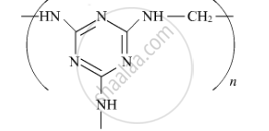
Answer the following in one sentence.
Identify 'A' in the following reaction:

Answer the following in one sentence.
Identify 'B' in the following reaction:
\[\ce{H2N -(CH2)6 - NH2 + HOOC - (CH2)4 - COOH ->[N2][533 K]}\]'B'
Answer the following.
Write structure of natural rubber and neoprene rubber along with the name and structure of their monomers.
Answer the following.
Write name and formula of raw material from which bakelite is made.
Answer the following.
Is synthetic rubber better than natural rubber? If so, in what respect?
Answer the following.
Write main specialities of Buna-S, Neoprene rubber?
Monomer of natural rubber is __________
Write chemical reaction for preparation of the following.
Buna-S
Write chemical reaction for preparation of the following.
Neoprene
Write the name of one example of each polymer in which following repeating units.
\[\begin{array}{cc}
\ce{(-CF2-CF2-), -[NH-(CH2)5-CO] -, -(CH2-CH-), (-CH2-CH2-)}\\
\phantom{............................}|\\
\phantom{..............................}\ce{CN}
\end{array}\]
Write chemical reactions for the preparation of high-density polythene.
Explain the reactions involved in the preparation of viscose rayon.
Which of the following is used as a substitute for wool?
The following structure represents the polymer:
\[\begin{array}{cc}
\ce{[-C-CH2-NH-C-(-CH2)5 NH -]_{{n}}}\\
\phantom{}||\phantom{.............}||\phantom{................}\\
\phantom{}\ce{O}\phantom{.............}\ce{O}\phantom{................}
\end{array}\]
Which of the following polymer is used in paints?
Identify additional polymers from the following.
I. \[\begin{array}{cc}
\ce{-(CH2 - CH -)_{{n}}}\\
\phantom{....}|\\
\phantom{.......}\ce{C6H5}
\end{array}\]
II. \[\ce{-(CH2 - CH = CH - CH2 -)_{{n}}}\]
III. \[\ce{-(CO(CH2)4 - CONH(CH2)6NH -)_{{n}}}\]
IV.

Identify the INCORRECT match.
Novolac is obtained from ____________.
Which of the following polymers is a heteropolymer?
Identify the polymer obtained by polymerization of n moles of acrylonitrile.
Which of the following catalysts is used in preparation of terylene?
Which of the following compounds is used to prepare orlon?
Which among the following catalysts is used in the preparation of dacron?
Which of the following polymers is prepared by using phenol?
Which among the following polymers is an example of addition polymer?
Which among the following is an example of addition polymer?
Which of the following is not a semisynthetic polymer?
Match the polymers given in Column I with the type of linkage present in them given in Column II.
| Column I | Column II |
| (i) Terylene | (a) Glycosidic linkage |
| (ii) Nylon | (b) Ester linkage |
| (iii) Cellulose | (c) Phosphodiester linkage |
| (iv) Protein | (d) Amide linkage |
| v) RNA |
Phenol and formaldehyde undergo condensation to give a polymar (A) which on heating with formaldehyde gives a thermosetting polymer (B). Name the polymers. Write the reactions involved in the formation of (A). What is the structural difference between two polymers?
The monomer of Teflon is ______.
Which of the following polymer has ester linkage?
Trans - form of poly isoprene is:-
Which one of the following polymers are prepared by addition polymerization?
Which of the following is an example of polyester?
Polymer used in bullet proof glass is ______.
Write the preparation of viscose rayon.
Write the structure and name of the monomer of Nylon-6.
Name and draw the structure of the repeating unit in natural rubber.
Write the structure of isoprene and the polymer obtained from it.
Name and draw the structure of the repeating unit in natural rubber.
Write the structure of isoprene and the polymer obtained from it.
Write the structure of isoprene and the polymer obtained from it.
Name and draw structure of the repeating unit in natural rubber.
Write the structure of isoprene and the polymer obtained from it.
Name and draw structure of the repeating unit in natural rubber.
Write the structure of isoprene and the polymer obtained from it.
Which from following statements is NOT true regarding neoprene?
