Advertisements
Advertisements
प्रश्न
Attempt the following:
What is meant by LDP and HDP? Mention the basic difference between the same with suitable examples.
Advertisements
उत्तर
LDP is a branched polymer of ethene with polymeric chains loosely held. Hence, even though it is tough, it is extremely flexible. Therefore, LDP is used in producing extruded films, sheets, mainly for packaging and household uses like in preparation of squeeze bottles, attractive containers, etc. where low tensile strength and flexibility are required.
On the other hand, HDP is a linear polymer of ethene with closely packed polymeric chains. Hence, it is much stiffer than LDP and has high tensile strength and hardness. Therefore, HDP is used in the manufacture of toys and other household articles like buckets, dustbins, bottles, pipes, laboratory wares, and other objects where high tensile strength and stiffness are required.
APPEARS IN
संबंधित प्रश्न
Write the reactions involved in the preparation of PVC
Based on molecular forces, what type of polymer is neoprene?
Write the structure of melamine.
Write the monomers of the following polymer :
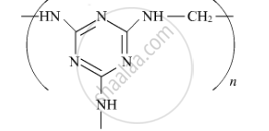
Answer the following in one sentence.
Define the term: Vulcanization
Answer the following in one sentence.
What type of intermolecular force leads to high-density polymer?
Answer the following in one sentence.
Identify thermoplastic and thermosetting plastic from the following:
- PET
- Urea formaldehyde resin
- Polythene
- Phenol formaldehyde resin
Draw the structures of polymers formed from the following monomers
\[\ce{n HOOC–R–COOH + n HO–R'–OH}\]
Identify condensation polymers and addition polymers from the following.
\[\begin{array}{cc}\ce{-(CH2 - CH -)_{n}}\\
\phantom{....}|\\\ce{\phantom{.......}C6H5}
\end{array}\]
Identify condensation polymers and addition polymers from the following.
-(CO(CH2)4 - CONH(CH2)6NH-)n
Attempt the following:
Write the chemical reactions involved in the manufacture of Nylon 6,6.
Write preparation, properties, and uses of Teflon.
Answer the following.
Write main specialities of Buna-S, Neoprene rubber?
Write the name of the catalyst used for preparation of high density polythene polymer.
Monomer of natural rubber is __________
write the structure of the monomer used in natural rubber.
Mention two uses of LDP.
Explain vulcanization of rubber.
The following structure represents the polymer:
\[\begin{array}{cc}
\ce{[-C-CH2-NH-C-(-CH2)5 NH -]_{{n}}}\\
\phantom{}||\phantom{.............}||\phantom{................}\\
\phantom{}\ce{O}\phantom{.............}\ce{O}\phantom{................}
\end{array}\]
Which of the following polymer is used in paints?
The INCORRECT match for the polymer with its application is:
Identify the INCORRECT match.
Which of the following is the monomer of neoprene?
\[\ce{{n} CH2 = CH2 ->[333 K - 343 K][6 - 7 atm, catalyst] X}\]
Which of the following is CORRECT about polymer 'X'?
Identify the polymer obtained by polymerization of n moles of acrylonitrile.
Which among the following polymers can NOT be remoulded?
Which of the following compounds is used to prepare orlon?
Which among the following catalysts is used in the preparation of dacron?
Identify the catalyst used in the manufacture of high density polythene.
Which among the following polymers is an example of addition polymer?
Identify addition polymer from the following.
Which among the following is an example of addition polymer?
Name the polymers used in laminated sheets and give the name of monomeric units involved in its formation.
Match the polymers given in Column I with the type of linkage present in them given in Column II.
| Column I | Column II |
| (i) Terylene | (a) Glycosidic linkage |
| (ii) Nylon | (b) Ester linkage |
| (iii) Cellulose | (c) Phosphodiester linkage |
| (iv) Protein | (d) Amide linkage |
| v) RNA |
The monomer of Teflon is ______.
Which of the following is an example of polyester?
Which of the following polymers is synthesized using a free radical polymerisation technique?
The catalyst used for the polymerisation of olefins is ______.
Which of the following is a polymer of enzyme?
Answer the following.
Name and draw structure of the repeating unit in natural rubber.
Answer the following.
Write the structure of isoprene and the polymer obtained from it.
Name and draw the structure of the repeating unit in natural rubber.
Name the compound which reacts with formaldehyde to produce ethyl alcohol.
Write the structure and name of monomer of natural rubber.
Write the structure of isoprene and the polymer obtained from it.
Write the structure of isoprene and the polymer obtained from it.
Name and draw structure of the repeating unit in natural rubber.
Name and draw structure of the repeating unit in natural rubber.
Name and draw structure of the repeating unit in natural rubber.
Write the structure of isoprene and the polymer obtained from it.
Name and draw structure of the repeating unit in natural rubber.
Which from following statements is NOT true regarding neoprene?
