Advertisements
Advertisements
प्रश्न
What happens when BF3 is reacted with ammonia?
Advertisements
उत्तर
BF3 (a Lewis acid) reacts with NH3 (a Lewis base) to form an adduct. This results in a complete octet around B in BF3
\[\ce{F_3B + :NH_3 -> F_3B <- :NH_3}\]
संबंधित प्रश्न
How can you explain higher stability of BCl3 as compared to TlCl3?
Aluminium trifluoride is insoluble in anhydrous HF but dissolves on the addition of NaF. Aluminium trifluoride precipitates out of the resulting solution when gaseous BF3 is bubbled through. Give reasons.
The exhibition of highest co-ordination number depends on the availability of vacant orbitals in the central atom. Which of the following elements is not likely to act as central atom in \[\ce{MF^{3-}6}\]?
In the structure of diborane ______.
A compound X, of boron reacts with NH3 on heating to give another compound Y which is called inorganic benzene. The compound X can be prepared by treating BF3 with Lithium aluminium hydride. The compounds X and Y are represented by the formulas.
The most commonly used reducing agent is ______.
Dry ice is ______.
Which of the following statements are correct. Answer on the basis of Figure.
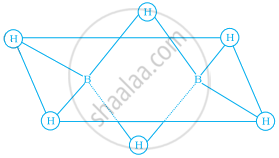
(i) The two birdged hydrogen atoms and the two boron atoms lie in one plane;
(ii) Out of six B – H bonds two bonds can be described in terms of 3 centre 2-electron bonds.
(iii) Out of six B – H bonds four B – H bonds can be described in terms of 3 centre 2 electron bonds;
(iv) The four-terminal B – H bonds are two centre-two electron regular bonds.
Explain the following:
Electron gain enthalpy of chlorine is more negative as compared to fluorine.
Identify the compounds A, X and Z in the following reactions:
\[\ce{A + 2HCl + 5H2O -> 2NaCl + X}\]
Identify the compounds A, X and Z in the following reactions:
\[\ce{X ->[Δ][370 K] HBO2 ->[Δ][> 370 K] Z}\]
Match the species given in Column I with the properties mentioned in Column II.
| Column I | Column II |
| (i) \[\ce{BF^{-}4}\] | (a) Oxidation state of central atom is +4 |
| (ii) AICI3 | (b) Strong oxidising agent |
| (iii) SnO | (c) Lewis acid |
| (iv) PbO2 | (d) Can be further oxidised |
| (e) Tetrahedral shape |
Describe the general trends in the following properties of the elements in Groups 13 and 14.
Atomic size
Describe the general trends in the following properties of the elements in Groups 13 and 14.
Nature of halides
Account for the following observations:
Though fluorine is more electronegative than chlorine yet BF3 is a weaker Lewis acid than BCl3
Account for the following observations:
PbO2 is a stronger oxidising agent than SnO2
Taking stability as the factor, which one of the following represents the correct relationship?
