Advertisements
Advertisements
प्रश्न
Use ruler and compasses only for this question. Draw a circle of radius 4 cm and mark two chords, AB and AC, of the circle of length 6 cm and 5 cm respectively.
- Construct the locus of points, inside the circle, that are equidistant from A and C. Prove your construction.
- Construct the locus of points, inside the circle, that are equidistant from AB and AC.
Advertisements
उत्तर १
- Draw PQ, the perpendicular bisector of chord AC. PQ is the required locus, which is the diameter of the circle.
Reason: We know each point on the perpendicular bisector of AB is equidistant from A and B. Also, the perpendicular bisector of a chord passes through the centre of the circle, and any chord passing through the centre of the circle is its diameter.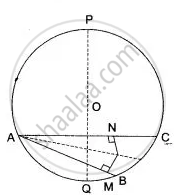
∴ PQ is the diameter of the circle. - Chords AB and AC intersect at M and N is a moving point such that LM = LN, where LM ⊥ AB and LN ⊥ AC
In right ΔALN and ΔALB
∠ANL = ∠ABL ...(90° each)
AL = AL ...(Common)
NL = BL ...[Given]
∴ ΔALN = ΔALB ...[R.H.S.]
Hence ∠MAL = ∠BAL ...c.p.c.t.
Thus, L lies on the bisector of ∠BAC.
Hence proved.
उत्तर २
Draw a circle of radius 4 cm whose center is O. Take a point A on the circumference of this circle.
With A as the center and a radius of 6 cm, draw an arc to cut the circumference at B. Join AB.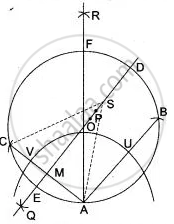
Then AB is the chord of the circle of length 6 cm.
With A as the center and a radius of 5 cm, draw another arc to cut the circumference at C. Join AC; then AC is the chord of the circle of length 5 cm.
With A as the center and a suitable radius, draw two arcs on opposite sides of AC.
With C as the center and the same radius, draw two arcs on opposite sides of AC to intersect the former arcs at P and Q.
Join PQ and produce to cut the circle at D and E.
Join DE. Then chord DE is the locus of points inside the circle that Ls equidistant from A and C.
As chord DE passes through the center O of the circle, it is a diameter. To prove the construction, take any point S inside the circle on DE.
APPEARS IN
संबंधित प्रश्न
On a graph paper, draw the line x = 6. Now, on the same graph paper, draw the locus of the point which moves in such a way that its distantce from the given line is always equal to 3 units
O is a fixed point. Point P moves along a fixed line AB. Q is a point on OP produced such that OP = PQ. Prove that the locus of point Q is a line parallel to AB.
Without using set squares or protractor, construct a quadrilateral ABCD in which ∠ BAD = 45°, AD = AB = 6 cm, BC= 3.6 cm and CD=5 cm. Locate the point P on BD which is equidistant from BC and CD.
In Δ PQR, s is a point on PR such that ∠ PQS = ∠ RQS . Prove thats is equidistant from PQ and QR.
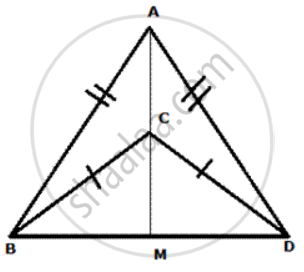
In given figure 1 ABCD is an arrowhead. AB = AD and BC = CD. Prove th at AC produced bisects BD at right angles at the point M
Draw and describe the lorus in the following cases:
The locus of points at a distance of 4 cm from a fixed line.
Draw and describe the locus in the following case:
The locus of a point in the rhombus ABCD which is equidistant from the point A and C.
Construct a triangle BPC given BC = 5 cm, BP = 4 cm and .
i) complete the rectangle ABCD such that:
a) P is equidistant from AB and BCV
b) P is equidistant from C and D.
ii) Measure and record the length of AB.
Without using set squares or protractor.
(i) Construct a ΔABC, given BC = 4 cm, angle B = 75° and CA = 6 cm.
(ii) Find the point P such that PB = PC and P is equidistant from the side BC and BA. Measure AP.
Given ∠BAC (Fig), determine the locus of a point which lies in the interior of ∠BAC and equidistant from two lines AB and AC.
