Advertisements
Advertisements
प्रश्न
State the locus of a point in a rhombus ABCD, which is equidistant
- from AB and AD;
- from the vertices A and C.
Advertisements
उत्तर
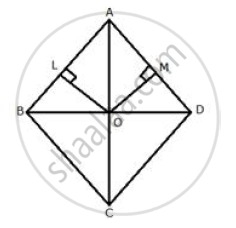
Steps of construction:
i. In rhombus ABCD, draw angle bisector of ∠A which meets in C.
ii. Join BD, which intersects AC at O.
O is the required locus.
iii. From O, draw OL ⊥ AB and OM ⊥ AD
In ΔAOL and ΔAOM
∠OLA = ∠OMA = 90°
∠OAL = ∠OAM ...(AC is bisector of angle A)
AO = OA ...(Common)
By Angle-Angle – side criterion of congruence,
ΔAOL ≅ ΔAOM ...(AAS Postulate)
The corresponding parts of the congruent triangles are congruent
`=>` OL = OM ...(C.P.C.T.)
Therefore, O is equidistant from AB and AD.
Diagonal AC and BD bisect each other at right angles at O.
Therefore, AO = OC
Hence, O is equidistant from A and C.
संबंधित प्रश्न
On a graph paper, draw the line x = 6. Now, on the same graph paper, draw the locus of the point which moves in such a way that its distantce from the given line is always equal to 3 units
Describe the locus of vertices of all isosceles triangles having a common base.
Without using set squares or protractor, construct a quadrilateral ABCD in which ∠ BAD = 45°, AD = AB = 6 cm, BC= 3.6 cm and CD=5 cm. Locate the point P on BD which is equidistant from BC and CD.
Construct a rhombus ABCD whose diagonals AC and BD are 8 cm and 6 cm respectively. Find by construction a point P equidistant from AB and AD and also from C and D.
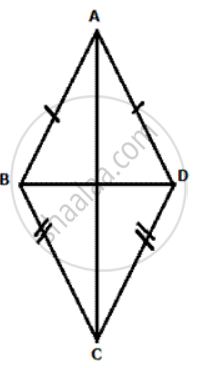
In given figure, ABCD is a kite. AB = AD and BC =CD. Prove that the diagona AC is the perpendirular bisector of the diagonal BD.
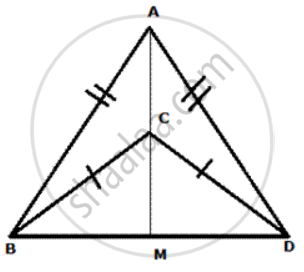
In given figure 1 ABCD is an arrowhead. AB = AD and BC = CD. Prove th at AC produced bisects BD at right angles at the point M
Describe completely the locus of a point in the following case:
Centre of a circle of radius 2 cm and touching a fixed circle of radius 3 cm with centre O.
Construct a triangle BPC given BC = 5 cm, BP = 4 cm and .
i) complete the rectangle ABCD such that:
a) P is equidistant from AB and BCV
b) P is equidistant from C and D.
ii) Measure and record the length of AB.
State and draw the locus of a swimmer maintaining the same distance from a lighthouse.
Given ∠BAC (Fig), determine the locus of a point which lies in the interior of ∠BAC and equidistant from two lines AB and AC.
