Advertisements
Advertisements
प्रश्न
Given ∠BAC (Fig), determine the locus of a point which lies in the interior of ∠BAC and equidistant from two lines AB and AC.
Advertisements
उत्तर
Given: ∠BAC and an interior point P lying in the interior of ∠BAC such that PM = PN.
Construction: Join Ao and produced it to X.
Proof: In right Δs APM and APN we have
PM = PN ...[Given]
AP = AP ...[Common]
So, by RHS criterion of congruence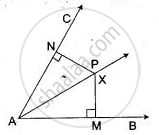
ΔAPM = ΔAPN
⇒ ∠PAM = ∠PAN ...[∵ Corresponding parts of congruent triangle are equal]
⇒ AP is the bisector of ∠BAC
⇒ P lies on the bisector of ∠BAC
Hence, the locus of P is the bisector of ∠BAc.
Now, we shall show that every point on the bisector of ∠BAC is equidistant from AB and AC.
So, let P be a point on the bisector AX of ∠BAC and PM ⊥ AB and PN ⊥ AC. Then, we have to prove that Pm = PN.
In Δs PAM and PAN, we have
∠PAM = ∠PAN ...[∵ AX is the bisector of ∠A]
∠PMA = ∠PNA ...[Each equal to 90°]
and AP = AP ...[Common]
So, by AAS criterion of congruence
ΔPAM = ΔPAN
⇒ PM = PN ...[∵ Corresponding parts of congruent triangles are equal]
Hence, the locus of point P is the ray AX which is the bisector of ∠BAC.
APPEARS IN
संबंधित प्रश्न
Construct a triangle ABC with AB = 5.5 cm, AC = 6 cm and ∠BAC = 105°
Hence:
1) Construct the locus of points equidistant from BA and BC
2) Construct the locus of points equidistant from B and C.
3) Mark the point which satisfies the above two loci as P. Measure and write the length of PC.
On a graph paper, draw the line x = 6. Now, on the same graph paper, draw the locus of the point which moves in such a way that its distantce from the given line is always equal to 3 units
Describe the locus of a point P, so that:
AB2 = AP2 + BP2,
where A and B are two fixed points.
Construct a triangle ABC, with AB = 6 cm, AC = BC = 9 cm. Find a point 4 cm from A and equidistant from B and C.
Plot the points A(2, 9), B(–1, 3) and C(6, 3) on graph paper. On the same graph paper draw the locus of point A so that the area of ΔABC remains the same as A moves.
Without using set squares or protractor, construct a quadrilateral ABCD in which ∠ BAD = 45°, AD = AB = 6 cm, BC= 3.6 cm and CD=5 cm. Locate the point P on BD which is equidistant from BC and CD.
Construct a Δ XYZ in which XY= 4 cm, YZ = 5 cm and ∠ Y = 1200. Locate a point T such that ∠ YXT is a right angle and Tis equidistant from Y and Z. Measure TZ.
Draw and describe the locus in the following case:
The locus of points inside a circle and equidistant from two fixed points on the circle.
Describe completely the locus of a point in the following case:
Point in a plane equidistant from a given line.
Use ruler and compasses only for this question. Draw a circle of radius 4 cm and mark two chords, AB and AC, of the circle of length 6 cm and 5 cm respectively.
- Construct the locus of points, inside the circle, that are equidistant from A and C. Prove your construction.
- Construct the locus of points, inside the circle, that are equidistant from AB and AC.
