Advertisements
Advertisements
Question
Given ∠BAC (Fig), determine the locus of a point which lies in the interior of ∠BAC and equidistant from two lines AB and AC.
Advertisements
Solution
Given: ∠BAC and an interior point P lying in the interior of ∠BAC such that PM = PN.
Construction: Join Ao and produced it to X.
Proof: In right Δs APM and APN we have
PM = PN ...[Given]
AP = AP ...[Common]
So, by RHS criterion of congruence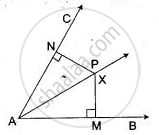
ΔAPM = ΔAPN
⇒ ∠PAM = ∠PAN ...[∵ Corresponding parts of congruent triangle are equal]
⇒ AP is the bisector of ∠BAC
⇒ P lies on the bisector of ∠BAC
Hence, the locus of P is the bisector of ∠BAc.
Now, we shall show that every point on the bisector of ∠BAC is equidistant from AB and AC.
So, let P be a point on the bisector AX of ∠BAC and PM ⊥ AB and PN ⊥ AC. Then, we have to prove that Pm = PN.
In Δs PAM and PAN, we have
∠PAM = ∠PAN ...[∵ AX is the bisector of ∠A]
∠PMA = ∠PNA ...[Each equal to 90°]
and AP = AP ...[Common]
So, by AAS criterion of congruence
ΔPAM = ΔPAN
⇒ PM = PN ...[∵ Corresponding parts of congruent triangles are equal]
Hence, the locus of point P is the ray AX which is the bisector of ∠BAC.
APPEARS IN
RELATED QUESTIONS
On a graph paper, draw the lines x = 3 and y = –5. Now, on the same graph paper, draw the locus of the point which is equidistant from the given lines.
On a graph paper, draw the line x = 6. Now, on the same graph paper, draw the locus of the point which moves in such a way that its distantce from the given line is always equal to 3 units
Describe the locus of a point P, so that:
AB2 = AP2 + BP2,
where A and B are two fixed points.
Without using set squares or protractor, construct a quadrilateral ABCD in which ∠ BAD = 45°, AD = AB = 6 cm, BC= 3.6 cm and CD=5 cm. Locate the point P on BD which is equidistant from BC and CD.
Construct a rhombus ABCD with sides of length 5 cm and diagonal AC of length 6 cm. Measure ∠ ABC. Find the point R on AD such that RB = RC. Measure the length of AR.
Construct a ti.PQR, in which PQ=S. 5 cm, QR=3. 2 cm and PR=4.8 cm. Draw the locus of a point which moves so that it is always 2.5 cm from Q.
In Δ ABC, B and Care fixed points. Find the locus of point A which moves such that the area of Δ ABC remains the same.
Without using set squares or protractor construct a triangle ABC in which AB = 4 cm, BC = 5 cm and ∠ABC = 120°.
(i) Locate the point P such that ∠BAp = 90° and BP = CP.
(ii) Measure the length of BP.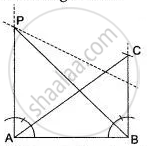
State and draw the locus of a point equidistant from two given parallel lines.
Ruler and compasses only may be used in this question. All construction lines and arcs must be clearly shown, and be of sufficient length and clarity to permit assessment.
(i) Construct a ΔABC, in which BC = 6 cm, AB = 9 cm and ∠ABC = 60°.
(ii) Construct the locus of the vertices of the triangles with BC as base, which are equal in area to ΔABC.
(iii) Mark the point Q, in your construction, which would make ΔQBC equal in area to ΔABC, and isosceles.
(iv) Measure and record the length of CQ.
