Advertisements
Advertisements
प्रश्न
Without using set squares or a protractor, construct:
- Triangle ABC, in which AB = 5.5 cm, BC = 3.2 cm and CA = 4.8 cm.
- Draw the locus of a point which moves so that it is always 2.5 cm from B.
- Draw the locus of a point which moves so that it is equidistant from the sides BC and CA.
- Mark the point of intersection of the loci with the letter P and measure PC.
Advertisements
उत्तर
- Draw a triangle by given measurements.
- The locus of a point which moves so that it is always 2.5 cm from B is a circle, as shown in the figure.
- The locus of a point is the bisector of ∠ACB.
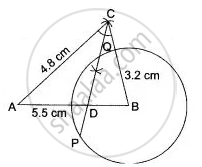
- The circle and bisector intersect in two points PD = 0·9 cm and PC = 3.4 cm.
APPEARS IN
संबंधित प्रश्न
Construct a triangle ABC with AB = 5.5 cm, AC = 6 cm and ∠BAC = 105°
Hence:
1) Construct the locus of points equidistant from BA and BC
2) Construct the locus of points equidistant from B and C.
3) Mark the point which satisfies the above two loci as P. Measure and write the length of PC.
On a graph paper, draw the lines x = 3 and y = –5. Now, on the same graph paper, draw the locus of the point which is equidistant from the given lines.
O is a fixed point. Point P moves along a fixed line AB. Q is a point on OP produced such that OP = PQ. Prove that the locus of point Q is a line parallel to AB.
State the locus of a point in a rhombus ABCD, which is equidistant
- from AB and AD;
- from the vertices A and C.
Plot the points A(2, 9), B(–1, 3) and C(6, 3) on graph paper. On the same graph paper draw the locus of point A so that the area of ΔABC remains the same as A moves.
Construct a triangle BCP given BC = 5 cm, BP = 4 cm and ∠PBC = 45°.
- Complete the rectangle ABCD such that:
- P is equidistant from AB and BC.
- P is equidistant from C and D.
- Measure and record the length of AB.
Draw and describe the locus in the following case:
The locus of points inside a circle and equidistant from two fixed points on the circle.
Describe completely the locus of a point in the following case:
Centre of a circle of varying radius and touching the two arms of ∠ ABC.
Using ruler and compasses construct:
(i) a triangle ABC in which AB = 5.5 cm, BC = 3.4 cm and CA = 4.9 cm.
(ii) the locus of point equidistant from A and C.
(iii) a circle touching AB at A and passing through C.
Use ruler and compasses only for the following questions:
Construct triangle BCP, when CB = 5 cm, BP = 4 cm, ∠PBC = 45°.
Complete the rectangle ABCD such that :
(i) P is equidistant from AB and BC and
(ii) P is equidistant from C and D. Measure and write down the length of AB.
