Advertisements
Advertisements
प्रश्न
Draw and describe the locus in the following case:
The locus of points inside a circle and equidistant from two fixed points on the circle.
Advertisements
उत्तर
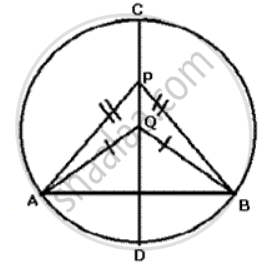
The locus of the points inside the circle that are equidistant from the fixed points on the circle will be the diameter, which is the perpendicular bisector of the line joining the two fixed points on the circle.
संबंधित प्रश्न
Construct a triangle ABC with AB = 5.5 cm, AC = 6 cm and ∠BAC = 105°
Hence:
1) Construct the locus of points equidistant from BA and BC
2) Construct the locus of points equidistant from B and C.
3) Mark the point which satisfies the above two loci as P. Measure and write the length of PC.
Describe the locus of vertices of all isosceles triangles having a common base.
Ruler and compasses may be used in this question. All construction lines and arcs must be clearly shown and be of sufficient length and clarity to permit assessment.
- Construct a ΔABC, in which BC = 6 cm, AB = 9 cm and angle ABC = 60°.
- Construct the locus of all points inside triangle ABC, which are equidistant from B and C.
- Construct the locus of the vertices of the triangles with BC as base and which are equal in area to triangle ABC.
- Mark the point Q, in your construction, which would make ΔQBC equal in area to ΔABC, and isosceles.
- Measure and record the length of CQ.
Draw two intersecting lines to include an angle of 30°. Use ruler and compasses to locate points which are equidistant from these Iines and also 2 cm away from their point of intersection. How many such points exist?
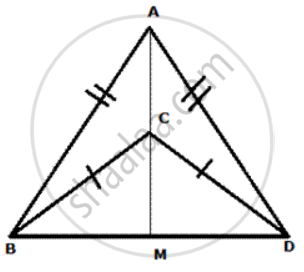
In given figure 1 ABCD is an arrowhead. AB = AD and BC = CD. Prove th at AC produced bisects BD at right angles at the point M
In Δ ABC, B and Care fixed points. Find the locus of point A which moves such that the area of Δ ABC remains the same.
Draw and describe the lorus in the following cases:
The Iocus of the mid-points of all parallel chords of a circle.
Draw and describe the locus in the following case:
The locus of a point in rhombus ABCD which is equidistant from AB and AD.
Using only a ruler and compass construct ∠ABC = 120°, where AB = BC = 5 cm.
(i) Mark two points D and E which satisfy the condition that they are equidistant from both ABA and BC.
(ii) In the above figure, join AD, DC, AE and EC. Describe the figures:
(a) AECB, (b) ABD, (c) ABE.
Use ruler and compasses only for this question. Draw a circle of radius 4 cm and mark two chords, AB and AC, of the circle of length 6 cm and 5 cm respectively.
- Construct the locus of points, inside the circle, that are equidistant from A and C. Prove your construction.
- Construct the locus of points, inside the circle, that are equidistant from AB and AC.
