Advertisements
Advertisements
प्रश्न
Describe the locus of a point P, so that:
AB2 = AP2 + BP2,
where A and B are two fixed points.
Advertisements
उत्तर
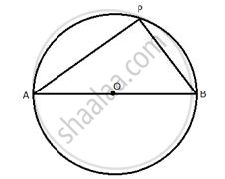
The locus of the point P is the circumference of a circle with AB as diameter and satisfies the condition AB2 = AP2 + BP2
APPEARS IN
संबंधित प्रश्न
State the locus of a point in a rhombus ABCD, which is equidistant
- from AB and AD;
- from the vertices A and C.
Plot the points A(2, 9), B(–1, 3) and C(6, 3) on graph paper. On the same graph paper draw the locus of point A so that the area of ΔABC remains the same as A moves.
Construct a triangle BCP given BC = 5 cm, BP = 4 cm and ∠PBC = 45°.
- Complete the rectangle ABCD such that:
- P is equidistant from AB and BC.
- P is equidistant from C and D.
- Measure and record the length of AB.
Construct a ti.PQR, in which PQ=S. 5 cm, QR=3. 2 cm and PR=4.8 cm. Draw the locus of a point which moves so that it is always 2.5 cm from Q.
A and B are fixed points while Pis a moving point, moving in a way that it is always equidistant from A and B. What is the locus of the path traced out by the pcint P?
Describe completely the locus of a point in the following case:
Midpoint of radii of a circle.
Construct a triangle ABC, such that AB= 6 cm, BC= 7.3 cm and CA= 5.2 cm. Locate a point which is equidistant from A, B and C.
Draw and describe the locus in the following case:
The locus of a point in the rhombus ABCD which is equidistant from the point A and C.
Using ruler and compasses construct:
(i) a triangle ABC in which AB = 5.5 cm, BC = 3.4 cm and CA = 4.9 cm.
(ii) the locus of point equidistant from A and C.
(iii) a circle touching AB at A and passing through C.
Use ruler and compasses only for this question. Draw a circle of radius 4 cm and mark two chords, AB and AC, of the circle of length 6 cm and 5 cm respectively.
- Construct the locus of points, inside the circle, that are equidistant from A and C. Prove your construction.
- Construct the locus of points, inside the circle, that are equidistant from AB and AC.
