Advertisements
Advertisements
प्रश्न
Ruler and compasses only may be used in this question. All construction lines and arcs must be clearly shown and be of sufficient length and clarity to permit assessment.
- Construct a triangle ABC in which BC = 6 cm, AB = 9 cm, and ∠ABC = 60°.
- Construct the locus of all points, inside A ABC, which are equidistant from B and C.
- Construct the locus of the vertices of the triangles with BC as base, which are equal in area to ΔABC.
- Mark the point Q in your construction which would make A QBC equal in area to A ABC and isosceles.
- Measure and record the length of CQ.
भौमितिक रेखाचित्रे
बेरीज
Advertisements
उत्तर
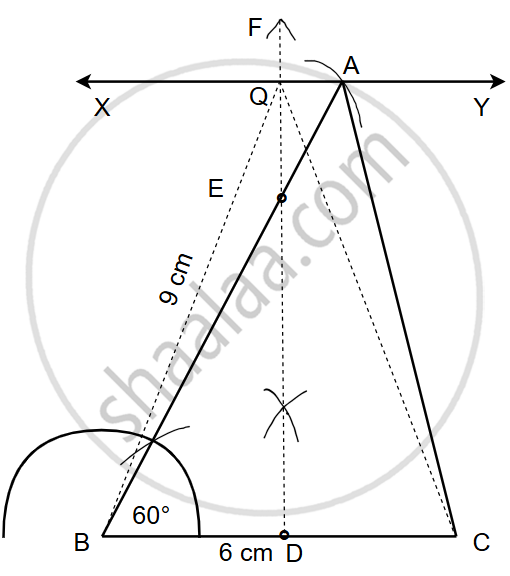
Step-by-step solution:
- Draw BC = 6 cm.
- At B, construct a 60° angle.
- From B along the 60° ray, mark A such that AB = 9 cm.
- Join A and C.
- Construct the perpendicular bisector of BC.
- Draw a line parallel to BC through A (height line).
- Q is the intersection of the perpendicular bisector of BC and the parallel line through A. Join Q to B and C.
- 8.2 cm approximately.
shaalaa.com
या प्रश्नात किंवा उत्तरात काही त्रुटी आहे का?
