Advertisements
Advertisements
प्रश्न
Predict the number of unpaired electrons in the square planar [Pt(CN)4]2− ion.
Advertisements
उत्तर
Oxidation state of Pt in [Pt(CN)4]2− hybridisation is required for the availability of one d-orbital. Hence, there should be no unpaired electrons in the [Pt(CN)4]2− ion.
Pt (Z = 78) ⇒ 5d8 6s2
Pt2+ ⇒ 5d8
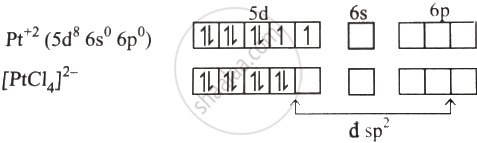
Since Cl− is a weak ligand, pairing of 3d electrons should not occur, but in a square-planar complex (dsp2) hybridisation, pairing of electrons in the 2 half-filled 5d orbitals occurs.
APPEARS IN
संबंधित प्रश्न
[NiCl4]2− is paramagnetic, while [Ni(CO)4] is diamagnetic, though both are tetrahedral. Why? (Atomic number of Ni = 28)
Discuss the nature of bonding in the following coordination entity on the basis of valence bond theory:
[Fe(CN)6]4−
[Cr(NH3)6]3+ is paramagnetic while [Ni(CN)4]2− is diamagnetic. Explain why?
Discuss the nature of bonding in the following coordination entity on the basis of valence bond theory:
[FeF6]3−
Discuss the nature of bonding in the following coordination entity on the basis of valence bond theory:
[Co(C2O4)3]3−
Write the hybridisation and number of unpaired electrons in the complex `[CoF_6]^(3-)`. (Atomic No. of Co = 27)
[NiCl4]2- is paramagnetic while [Ni(CO)4] is diamagnetic though both are tetrahedral. Why? (Atomic no. Ni = 28)
Using valence bond theory, explain the following in relation to the complexes given below:
\[\ce{[Co(NH3)6]^{3+}}\]
(i) Type of hybridisation.
(ii) Inner or outer orbital complex.
(iii) Magnetic behaviour.
(iv) Spin only magnetic moment value.
In a coordination entity, the electronic configuration of the central metal ion is t2g3 eg1
Is the coordination compound a high spin or low spin complex?
Which of the statement given below is incorrect about H2O2?
As the s-character of hybridised orbital increases, the bond angle
Which of the following has square planar structures?
What is the no. of possible isomers for the octahedral complex [Co(NH3)2(C2O4)2]?
Using valence bond theory, predict the hybridization and magnetic character of the following:
[CoF6]3– [Atomic number of Co = 27]
According to the valence bond theory, the hybridization of central metal atom is dsp2 for which one of the following compounds?
[Ni(CO)4] has tetrahedral geometry while [Ni(CN)4]2− has square planar, yet both exhibit diamagnetism. Explain.
[Atomic number: Ni = 28]
The geometry and magnetic behaviour of the complex [Ni(CO)4] are ______.
Given below are two statements:
Statement I: Both [Co(NH3)6]3+ and [CoF6]3− complexes are octahedral but differ in their magnetic behavior.
Statement II: [Co(NH3)6]3+ is diamagnetic whereas [CoF6]3− is paramagnetic.
In the light of the above statements, Choose the correct answer form the options given below:
