Advertisements
Advertisements
प्रश्न
Explain [Co(NH3)6]3+ is an inner orbital complex, whereas [Ni(NH3)6]2+ is an outer orbital complex.
[At. No.: Co = 27, Ni = 28]
Advertisements
उत्तर
[Co(NH3)6]3+ is an inner orbital complex.
Co = [Ar]3d7 4s2 (os of Co = 3+)
Co3+ = [Ar] 3d 4s0
The electronic configuration of Co3+ is:
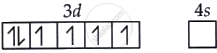
In this instance, ammonia functions as a potent field ligand due to the +3 oxidation state of cobalt, with six pairs of electrons from the ammonia molecule occupying the six hybrid orbitals.
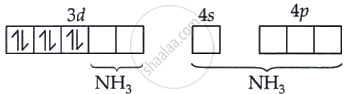
Thus, forming a d2sp3 hybridisation. Here, the 3d orbital is involved in hybridisation, so it is called an inner-orbital complex or a low-spin complex. In [Ni(NH3)c]2+, the electronic configuration of Ni is [Ar] 3d4s2.

Ammonia in this case acts as a weak-field ligand due to the +2 oxidation state of Ni.
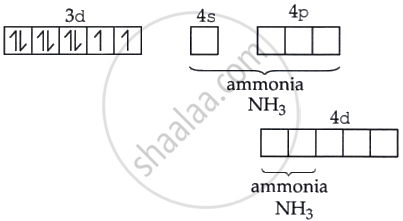
It undergoes sp3d2 hybridisation. As the outer d-orbitals are involved, it is an outer-orbital complex.
संबंधित प्रश्न
For the complex [Fe(H2O)6]+3, write the hybridisation, magnetic character and spin of the complex. (At, number : Fe = 26)
For the complex [Fe(CN)6]3–, write the hybridization type, magnetic character and spin nature of the complex. (At. number : Fe = 26).
Write the hybridization and shape of the following complexe : [CoF6]3–
(Atomic number : Co = 27, Ni = 28)
Write the hybridization and shape of the following complexe : [Ni(CN)4]2–
(Atomic number : Co = 27, Ni = 28)
[NiCl4]2− is paramagnetic while [Ni(CO)4] is diamagnetic though both are tetrahedral. Why?
Write down the IUPAC name of the following complex and indicate the oxidation state, electronic configuration and coordination number. Also, give the stereochemistry and magnetic moment of the complex:
K[Cr(H2O)2(C2O4)2].3H2O
Why is [NiCl4]2− paramagnetic while [Ni(CN)4]2− is diamagnetic? (Atomic number of Ni = 28)
Write the hybridization type and magnetic behaviour of the complex [Ni(CN)4]2−. (Atomic number of Ni = 28)
Which of the following options are correct for \[\ce{[Fe(CN)6]^{3-}}\] complex?
(i) d2sp3 hybridisation
(ii) sp3d2 hybridisation
(iii) paramagnetic
(iv) diamagnetic
Magnetic moment of \[\ce{[MnCl4]^{2-}}\] is 5.92 BM. Explain giving reason.
Explain why \[\ce{[Fe(H2O)6]^{3+}}\] has magnetic moment value of 5.92 BM whereas \[\ce{[Fe(CN)6]^{3-}}\] – has a value of only 1.74 BM.
Why do compounds having similar geometry have different magnetic moment?
[Ti(H2O6]3+ T is paramagnetic is nature due to
Low oxidation state of metals in their complexes are common when ligands ______.
Explain [Fe(CN)6]3− is an inner orbital complex, whereas [FeF6]3− is an outer orbital complex.
[Atomic number: Fe = 26]
Given below are two statements:
Statement I: Ferromagnetism is considered as an extreme form of paramagnetism.
Statement II: The number of unpaired electrons in a Cr2+ ion (Z = 24) is the same as that of a Nd3+ ion (Z = 60).
In the light of the above statements, choose the correct answer from the options given below:
