Advertisements
Advertisements
प्रश्न
Explain [Fe(CN)6]3− is an inner orbital complex, whereas [FeF6]3− is an outer orbital complex.
[Atomic number: Fe = 26]
Advertisements
उत्तर
[Fe(CN)6]3−
Fe = 3 oxidation state
i.e., electronic configuration = 3d5
CNΘ = strong field ligand
i.e., Δ0 > P pairing will take place
Electronic configuration of Fe3+ = 3d5
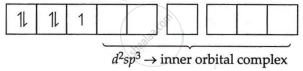
[FeF6]3−
Fe = +3 oxidation state
F− = Weak field ligand Δ0 < P `->` Pairing will not take place.

APPEARS IN
संबंधित प्रश्न
For the complex [Fe(H2O)6]+3, write the hybridisation, magnetic character and spin of the complex. (At, number : Fe = 26)
Write the hybridization and magnetic behaviour of the complex [Ni(CO)4].
(At.no. of Ni = 28)
Write the hybridization and shape of the following complexe : [CoF6]3–
(Atomic number : Co = 27, Ni = 28)
[Fe(H2O)6]3+ is strongly paramagnetic whereas [Fe(CN)6]3− is weakly paramagnetic. Explain.
Write down the IUPAC name of the following complex and indicate the oxidation state, electronic configuration and coordination number. Also, give the stereochemistry and magnetic moment of the complex:
K[Cr(H2O)2(C2O4)2].3H2O
Write the hybridisation and magnetic character of [Co(C2O4)3]3–.
(At. no. of Co = 27)
Write the hybridization and magnetic character of the following complexes:
[Fe(CO)5]
(Atomic no. of Fe = 26)
Explain why \[\ce{[Fe(H2O)6]^{3+}}\] has magnetic moment value of 5.92 BM whereas \[\ce{[Fe(CN)6]^{3-}}\] – has a value of only 1.74 BM.
Why do compounds having similar geometry have different magnetic moment?
Low oxidation state of metals in their complexes are common when ligands ______.
