Advertisements
Advertisements
Question
Explain [Fe(CN)6]3− is an inner orbital complex, whereas [FeF6]3− is an outer orbital complex.
[Atomic number: Fe = 26]
Advertisements
Solution
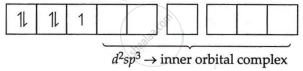
[Fe(CN)6]3−
Fe = 3 oxidation state
i.e., electronic configuration = 3d5
CNΘ = strong field ligand
i.e., Δ0 > P pairing will take place
Electronic configuration of Fe3+ = 3d5
[FeF6]3−
Fe = +3 oxidation state
F− = Weak field ligand Δ0 < P `->` Pairing will not take place.

APPEARS IN
RELATED QUESTIONS
Write the hybridization and shape of the following complexe : [CoF6]3–
(Atomic number : Co = 27, Ni = 28)
Write the hybridization and shape of the following complexe : [Ni(CN)4]2–
(Atomic number : Co = 27, Ni = 28)
[Fe(H2O)6]3+ is strongly paramagnetic whereas [Fe(CN)6]3− is weakly paramagnetic. Explain.
Write the hybridization type and magnetic behaviour of the complex [Ni(CN)4]2−. (Atomic number of Ni = 28)
Write the hybridization and magnetic character of the following complexes:
[Fe(CO)5]
(Atomic no. of Fe = 26)
Explain why \[\ce{[Fe(H2O)6]^{3+}}\] has magnetic moment value of 5.92 BM whereas \[\ce{[Fe(CN)6]^{3-}}\] – has a value of only 1.74 BM.
Why do compounds having similar geometry have different magnetic moment?
Assertion: \[\ce{[Fe(CN)6]^{3-}}\] ion shows magnetic moment corresponding to two unpaired electrons.
Reason: Because it has d2sp3 type hybridisation.
[Ti(H2O6]3+ T is paramagnetic is nature due to
The correct order of magnetic moment (spin only value in B.m.) is:
