Advertisements
Advertisements
प्रश्न
In your opinion, does Boori Ma, the main protagonist of the story A Real Durwan, deserve the life that she meets at the end of the story? Give reasons for your answer.
Advertisements
उत्तर
'A Real Durwan’ is a short story written by Jhumpa Lahiri. The story ‘A Real Durwan’ focuses on the life of Boori Ma, a frail, sixty-four-year-old woman who is the doorkeeper (durwan) to an apartment building in Calcutta, Southern India. Boori Ma is introduced as a refugee victim of the Partition, the event that led to the creation of Pakistan from India. characterisation has effectively been used by Jhumpa Lahiri to give her characters indirect and direct characteristics. The use of direct characterisation in this story tells the readers that Boori Ma does her job well as a gatekeeper in ensuring the stairwell is kept spotless and that unknown or suspicious people are kept out of the residential area. Boori Ma is indirectly characterised to be a victim of the harsh and underprivileged means of life. Boori Ma’s story reflects how life is not always fair and joyous for everyone. This was clearly shown how Boori Ma never really had the chance to live a better life after separation from her family. After getting a job as a durwan, the author made it seem that life would gradually improve for Boori Ma despite her hardships. Unfortunately, life for Boori Ma does not end well as she loses her job, home, and life savings. Boori Ma’s story is indifferently ironic. The criticism and sufferings she suffered were because of the people in her locality and its because of them she was referred to a refugee. In the end, she was accused of failing and not being real 'durwan' there were many allegations as she also denied her duty. Ideally, if we believe in humanity she did not deserve such a fate that she meets in the story and as humans make mistakes she could have given one more chance.
APPEARS IN
संबंधित प्रश्न
Fill in the blank with the suitable word.
To every one’s surprise, he turned _____________ at the party.
What are the fears of the caged bird? Answer with examples from Maya Angelou’s poem.
Who won the race and how? Explain in about 50 words.
(A) We did not know that Mr. Francis was retiring and leaving for Ooty.
(B) Little……………………………
(A) He knew the culprit but refused to admit it.
(B) Although………………………..
Join the following sentence to make one complete sentence without using and, but or so.
Mala is not in the classroom. Mala is not in the library.
Join the following sentence to make one complete sentence without using and, but or so.
Mumbai is densely populated. It is one of the major cities in the country.
Given below is an interesting combination of words. Explain why they have been used together.
casket grey
Notice the following sentence patterns.
For song…duly with love returns
Rewrite the above sentences in prose.
Write a letter to the Editor of a magazine describing a dance performance you have seen or an art gallery you have visited.
Find out the information about the qualification and eligibility required in the profession related to wild life such as:
Wildlife photographer
Multinational companies expect a different type of Professional CV. Browse through the net to gather information about it.
Which is your favourite ‘Nature’ poem from your mother tongue? Write the poem and try to translate it into English. Your translation can be in the form of a poem or a paraphrase.
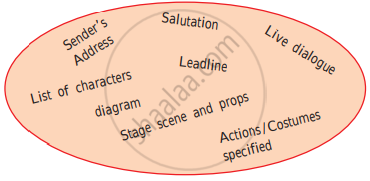
The diagram below encircles the various features that make the script of a skit/ play. List the other words and mention the form of writing of which it is a feature.
Write 3 to 5 sentences about the following character.
The Aunt
Write an imaginary dialogue contesting opposite views on a topic of your choice, e.g., ‘Girls should learn to do all the housework and not boys.’
Write the reason in your own words.
After the song, Ostad had vanished.
Imagine you are Dorothy and write about the day’s events in 5-8 lines in your (Dorothy’s) diary.
Prepare attractive advertisement using the hints given below.
Mobile Galaxy – Smartphones – accessories – SIM cards – Recharge – Free Power banks on Mobile purchase – No.1, Toll gate, Trichy
Create a pamphlet for the following.
Make a pamphlet on the latest gadgets (Mention the variety of models, uses, needs, and availability).
The word in the sentence is jumbled. Write them in order.
was island the inhabited.
Make opposites with the words –
| dis ______ in______ |
| respect | |
| able | |
| efficient | |
| own | |
| capable | |
| secure |
‘Means should justify the end.’ Explain this adage with reference to O. Henry’s story
Rearrange the sentences given below and write a summary of the story in a paragraph. Begin with:
Philip Sletherby was travelling by train to Brill Manor.
- The young man introduced himself as Bertie, the son of Saltpen Jago.
- Bertie needed three pounds desperately and asked Sletherby to lend it to him.
- All the time Sletherby was gazing at the door panel of the car, on which were the two crests – a demi-lion and a greyhound courant.
- He was received by Claude People. K.C., who had kept on talking about various things.
- Bertie had left his purse behind, after sealing an envelope with the crest on the purse.
- Bertie stated that it was the Jago crest. He further added that his mother’s hair was dark brown similar to his.
- While describing the appearance of Honario Saltpen-Jago, K.C. referred to her altered hairstyle.
- Sletherby realized that Bertie had not lied to him, but that he had mistaken him for fraud.
- He explained that the Saltpen crest was that of a demi-lion.
- Sletherby sat dumbstruck on learning that Mrs. Honario Saltpen Jago had changed her dark brown hair to a blonde, just five weeks ago.
- Sletherby pointed out to him that his mother’s letter had a greyhound courant crest.
- His companion in the train was a young man who was searching for something frantically
- Suspecting foul play, Sletherby did not give him any money, as he knew Mrs. Saltpen-Jago was a blonde.
How did Sletherby’s judgment of Bertie turn out to be a wrong one?
Bring out the significance of what Leacock was reading at the photographers.
The narrator was frustrated as ______.
Write letter to your father asking permission to go on a educational tour.
Write a composition (300-350 words) of the following:
Describe the locality in which you live. Give details of the things you see and hear as you walk around your locality. What do you especially like about the place?
Write a composition (in approximately 400 – 450 words) on any one of the following subjects.
You become what you read. Present your reflections on this statement.
