Advertisements
Advertisements
प्रश्न
How do m-RNA, t-RNA and ribosomes help in the process of translation?
Advertisements
उत्तर
Role of m-RNA, t-RNA and ribosomes in protein synthesis:
(i) m-RNA: The messenger RNA brings coded information from DNA and takes part in its translation by bringing amino acids in a particular sequence during the synthesis of a polypeptide. The same m-RNA can be reused many times.
(ii) t-RNA: They transfer RNAs which pick up particular amino acids in the process called charging, and they carry them to m-RNA over particular codons corresponding to their anticodons. Each t-RNA has an area for coming in contact with ribosome and the enzyme amino acyl tRNA synthetase.
(iii) Ribosomes: Ribosomes are protein factories. Each ribosome has two subunits— smaller and larger subunits. The larger subunit has a groove for pushing out the newly formed polypeptide and for protecting the same from cellular enzymes. The smaller subunit fits like a cap over the larger one and leaves a tunnel for m-RNA. The smaller subunit has a point for recognising m-RNA and binding area for initiation factors.
APPEARS IN
संबंधित प्रश्न
Transcription is the transfer of genetic code from a DNA molecule to ______.
Initiation codon of protein synthesis in Eukaryotes is ______.
Explain the mechanism of transcription in a prokaryotic cell.
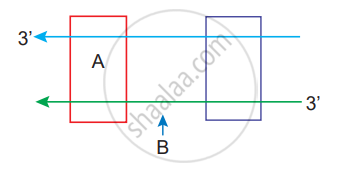
Name the parts marked ‘A’ and ‘B’ in the given transcription unit:
Reverse transcriptase is ______.
Which nucleotide replaces thymine during the transcription process when RNA is synthesized?
How many DNA strands serve as the template strand during transcription?
What is the direction of the template strand during transcription?
How many stages does transcription occur in?
What happens during the initiation stage of transcription?
