Advertisements
Advertisements
प्रश्न
Find the interval in which the following function are increasing or decreasing f(x) = x4 − 4x3 + 4x2 + 15 ?
Advertisements
उत्तर
\[\text { When } \left( x - a \right)\left( x - b \right)>0 \text { with }a < b, x < a \text { or }x>b.\]
\[\text { When } \left( x - a \right)\left( x - b \right)<0 \text { with } a < b, a < x < b .\]
\[f\left( x \right) = x^4 - 4 x^3 + 4 x^2 + 15\]
\[f'\left( x \right) = 4 x^3 - 12 x^2 + 8x\]
\[ = 4x \left( x^2 - 3x + 2 \right)\]
\[ = 4x \left( x - 1 \right)\left( x - 2 \right)\]
\[\text { Here, 0, 1 and 2 are the critical points }.\]
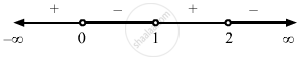
\[\text { The possible intervals are }\left( - \infty , 0 \right),\left( 0, 1 \right),\left( 1, 2 \right)\text { and }\left( 2, \infty \right). ...(1)\]
\[\text { For f(x) to be increasing, we must have}\]
\[f'\left( x \right) > 0\]
\[ \Rightarrow 4x \left( x - 1 \right)\left( x - 2 \right) > 0 \left[ \text { Since } 4 > 0, 4x \left( x - 1 \right)\left( x - 2 \right) > 0 \Rightarrow x \left( x - 1 \right)\left( x - 2 \right) > 0 \right]\]
\[ \Rightarrow x \left( x - 1 \right)\left( x - 2 \right) > 0\]
\[ \Rightarrow x \in \left( 0, 1 \right) \cup \left( 2, \infty \right) \left[ \text { From eq }. (1) \right]\]
\[\text { So },f(x)\text { is increasing on x } \in \left( 0, 1 \right) \cup \left( 2, \infty \right) . \]

\[\text { For }f(x) \text { to be decreasing, we must have }\]
\[f'\left( x \right) < 0\]
\[ \Rightarrow 4x \left( x - 1 \right)\left( x - 2 \right) < 0 \left[ \text { Since } 4 > 0, 4x \left( x - 1 \right)\left( x - 2 \right) < 0 \Rightarrow x \left( x - 1 \right)\left( x - 2 \right) < 0 \right]\]
\[ \Rightarrow x \left( x - 1 \right)\left( x - 2 \right) < 0\]
\[ \Rightarrow x \in \left( - \infty , 0 \right) \cup \left( 1, 2 \right) \left[ \text { From eq. } (1) \right]\]
\[\text { So,}f(x)\text { is decreasing on x } \in \left( - \infty , 0 \right) \cup \left( 1, 2 \right) .\]
APPEARS IN
संबंधित प्रश्न
Price P for demand D is given as P = 183 +120D - 3D2 Find D for which the price is increasing
Find the intervals in which the function f given by f(x) = 2x2 − 3x is
- strictly increasing
- strictly decreasing
Find the intervals in which the following functions are strictly increasing or decreasing:
10 − 6x − 2x2
Find the intervals in which the following functions are strictly increasing or decreasing:
−2x3 − 9x2 − 12x + 1
Find the intervals in which the following functions are strictly increasing or decreasing:
6 − 9x − x2
Show that y = `log(1+x) - (2x)/(2+x), x> - 1`, is an increasing function of x throughout its domain.
Prove that y = `(4sin theta)/(2 + cos theta) - theta` is an increasing function of θ in `[0, pi/2]`
Which of the following functions are strictly decreasing on `(0, pi/2)`?
- cos x
- cos 2x
- cos 3x
- tan x
Prove that f(x) = ax + b, where a, b are constants and a < 0 is a decreasing function on R ?
Show that f(x) = cos2 x is a decreasing function on (0, π/2) ?
Show that f(x) = sin x − cos x is an increasing function on (−π/4, π/4)?
Find the set of values of 'a' for which f(x) = x + cos x + ax + b is increasing on R ?
Write the set of values of a for which the function f(x) = ax + b is decreasing for all x ∈ R ?
Let f(x) = x3 + ax2 + bx + 5 sin2x be an increasing function on the set R. Then, a and b satisfy.
The function f(x) = x2 e−x is monotonic increasing when
If the function f(x) = x2 − kx + 5 is increasing on [2, 4], then
Find the intervals in which function f given by f(x) = 4x3 - 6x2 - 72x + 30 is (a) strictly increasing, (b) strictly decresing .
The total cost of manufacturing x articles is C = 47x + 300x2 − x4. Find x, for which average cost is increasing.
Find the values of x for which the function f(x) = x3 – 12x2 – 144x + 13 (a) increasing (b) decreasing
Prove that y = `(4sinθ)/(2 + cosθ) - θ` is an increasing function if `θ ∈[0, pi/2]`
Test whether the following function is increasing or decreasing.
f(x) = `7/"x" - 3`, x ∈ R, x ≠ 0
Show that the function f(x) = x3 + 10x + 7 for x ∈ R is strictly increasing
The price P for the demand D is given as P = 183 + 120D − 3D2, then the value of D for which price is increasing, is ______.
The total cost function for production of articles is given as C = 100 + 600x – 3x2, then the values of x for which the total cost is decreasing is ______
The function f(x) = `x - 1/x`, x ∈ R, x ≠ 0 is increasing
Show that the function f(x) = `(x - 2)/(x + 1)`, x ≠ – 1 is increasing
A man of height 1.9 m walks directly away from a lamp of height 4.75m on a level road at 6m/s. The rate at which the length of his shadow is increasing is
f(x) = `{{:(0"," x = 0 ), (x - 3"," x > 0):}` The function f(x) is ______
The sides of a square are increasing at the rate of 0.2 cm/sec. When the side is 25cm long, its area is increasing at the rate of ______
Given P(x) = x4 + ax3 + bx2 + cx + d such that x = 0 is the only real root of P'(x) = 0. If P(-1) < P(1), then in the interval [-1, 1] ______
For which interval the given function f(x) = 2x3 – 9x2 + 12x + 7 is increasing?
If f(x) = `x^(3/2) (3x - 10)`, x ≥ 0, then f(x) is increasing in ______.
Let `"f (x) = x – cos x, x" in "R"`, then f is ____________.
The interval in which `y = x^2e^(-x)` is increasing with respect to `x` is
If f(x) = `x - 1/x`, x∈R, x ≠ 0 then f(x) is increasing.
If f(x) = x3 + 4x2 + λx + 1(λ ∈ R) is a monotonically decreasing function of x in the largest possible interval `(–2, (–2)/3)` then ______.
The interval in which the function f(x) = `(4x^2 + 1)/x` is decreasing is ______.
If f(x) = `x/(x^2 + 1)` is increasing function then the value of x lies in ______.
As one moves from left to right on a graph, what do constant \[y\]-values indicate?
