Advertisements
Advertisements
प्रश्न
Find the interval in which the following function are increasing or decreasing f(x) = x4 − 4x3 + 4x2 + 15 ?
Advertisements
उत्तर
\[\text { When } \left( x - a \right)\left( x - b \right)>0 \text { with }a < b, x < a \text { or }x>b.\]
\[\text { When } \left( x - a \right)\left( x - b \right)<0 \text { with } a < b, a < x < b .\]
\[f\left( x \right) = x^4 - 4 x^3 + 4 x^2 + 15\]
\[f'\left( x \right) = 4 x^3 - 12 x^2 + 8x\]
\[ = 4x \left( x^2 - 3x + 2 \right)\]
\[ = 4x \left( x - 1 \right)\left( x - 2 \right)\]
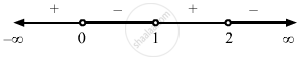
\[\text { Here, 0, 1 and 2 are the critical points }.\]
\[\text { The possible intervals are }\left( - \infty , 0 \right),\left( 0, 1 \right),\left( 1, 2 \right)\text { and }\left( 2, \infty \right). ...(1)\]
\[\text { For f(x) to be increasing, we must have}\]
\[f'\left( x \right) > 0\]
\[ \Rightarrow 4x \left( x - 1 \right)\left( x - 2 \right) > 0 \left[ \text { Since } 4 > 0, 4x \left( x - 1 \right)\left( x - 2 \right) > 0 \Rightarrow x \left( x - 1 \right)\left( x - 2 \right) > 0 \right]\]
\[ \Rightarrow x \left( x - 1 \right)\left( x - 2 \right) > 0\]
\[ \Rightarrow x \in \left( 0, 1 \right) \cup \left( 2, \infty \right) \left[ \text { From eq }. (1) \right]\]
\[\text { So },f(x)\text { is increasing on x } \in \left( 0, 1 \right) \cup \left( 2, \infty \right) . \]

\[\text { For }f(x) \text { to be decreasing, we must have }\]
\[f'\left( x \right) < 0\]
\[ \Rightarrow 4x \left( x - 1 \right)\left( x - 2 \right) < 0 \left[ \text { Since } 4 > 0, 4x \left( x - 1 \right)\left( x - 2 \right) < 0 \Rightarrow x \left( x - 1 \right)\left( x - 2 \right) < 0 \right]\]
\[ \Rightarrow x \left( x - 1 \right)\left( x - 2 \right) < 0\]
\[ \Rightarrow x \in \left( - \infty , 0 \right) \cup \left( 1, 2 \right) \left[ \text { From eq. } (1) \right]\]
\[\text { So,}f(x)\text { is decreasing on x } \in \left( - \infty , 0 \right) \cup \left( 1, 2 \right) .\]
APPEARS IN
संबंधित प्रश्न
The amount of pollution content added in air in a city due to x-diesel vehicles is given by P(x) = 0.005x3 + 0.02x2 + 30x. Find the marginal increase in pollution content when 3 diesel vehicles are added and write which value is indicated in the above question.
Find the intervals in which f(x) = sin 3x – cos 3x, 0 < x < π, is strictly increasing or strictly decreasing.
Find the intervals in which the following functions are strictly increasing or decreasing:
6 − 9x − x2
Prove that y = `(4sin theta)/(2 + cos theta) - theta` is an increasing function of θ in `[0, pi/2]`
On which of the following intervals is the function f given byf(x) = x100 + sin x –1 strictly decreasing?
Find the least value of a such that the function f given by f (x) = x2 + ax + 1 is strictly increasing on [1, 2].
Let I be any interval disjoint from (−1, 1). Prove that the function f given by `f(x) = x + 1/x` is strictly increasing on I.
Show that f(x) = \[\frac{1}{x}\] is a decreasing function on (0, ∞) ?
Show that f(x) = \[\frac{1}{1 + x^2}\] decreases in the interval [0, ∞) and increases in the interval (−∞, 0] ?
Find the interval in which the following function are increasing or decreasing f(x) = x2 + 2x − 5 ?
Find the interval in which the following function are increasing or decreasing f(x) = 2x3 − 15x2 + 36x + 1 ?
Determine the values of x for which the function f(x) = x2 − 6x + 9 is increasing or decreasing. Also, find the coordinates of the point on the curve y = x2 − 6x + 9 where the normal is parallel to the line y = x + 5 ?
Show that the function f(x) = cot \[-\] l(sinx + cosx) is decreasing on \[\left( 0, \frac{\pi}{4} \right)\] and increasing on \[\left( 0, \frac{\pi}{4} \right)\] ?
Show that f(x) = tan−1 x − x is a decreasing function on R ?
Find the set of values of 'b' for which f(x) = b (x + cos x) + 4 is decreasing on R ?
If g (x) is a decreasing function on R and f(x) = tan−1 [g (x)]. State whether f(x) is increasing or decreasing on R ?
Let \[f\left( x \right) = \tan^{- 1} \left( g\left( x \right) \right),\],where g (x) is monotonically increasing for 0 < x < \[\frac{\pi}{2} .\] Then, f(x) is
Function f(x) = x3 − 27x + 5 is monotonically increasing when ______.
If the function f(x) = kx3 − 9x2 + 9x + 3 is monotonically increasing in every interval, then
If the function f(x) = cos |x| − 2ax + b increases along the entire number scale, then
Prove that the function f : N → N, defined by f(x) = x2 + x + 1 is one-one but not onto. Find the inverse of f: N → S, where S is range of f.
Find the values of x for which the following functions are strictly increasing:
f(x) = 3 + 3x – 3x2 + x3
Prove that y = `(4sinθ)/(2 + cosθ) - θ` is an increasing function if `θ ∈[0, pi/2]`
Test whether the following function f(x) = 2 – 3x + 3x2 – x3, x ∈ R is increasing or decreasing
The slope of tangent at any point (a, b) is also called as ______.
A man of height 1.9 m walks directly away from a lamp of height 4.75m on a level road at 6m/s. The rate at which the length of his shadow is increasing is
In which interval is the given function, f(x) = 2x3 - 21x2 + 72x + 19 monotonically decreasing?
The values of k for which the function f(x) = kx3 – 6x2 + 12x + 11 may be increasing on R are ______.
Prove that the function f(x) = tanx – 4x is strictly decreasing on `((-pi)/3, pi/3)`
In case of decreasing functions, slope of tangent and hence derivative is ____________.
The interval in which the function f is given by f(x) = x2 e-x is strictly increasing, is: ____________.
Let x0 be a point in the domain of definition of a real valued function `f` and there exists an open interval I = (x0 – h, ro + h) containing x0. Then which of the following statement is/ are true for the above statement.
Let f(x) be a function such that; f'(x) = log1/3(log3(sinx + a)) (where a ∈ R). If f(x) is decreasing for all real values of x then the exhaustive solution set of a is ______.
If f(x) = x + cosx – a then ______.
Let f(x) = x3 – 6x2 + 9x + 18, then f(x) is strictly increasing in ______.
Let \[f\] be continuous on \[[a,b]\] and differentiable on \[(a,b)\]. If \[f'(x)\leq0\] for every \[x\in(a,b)\], what follows?
As one moves from left to right on a graph, what does a decrease in the \[y\]-values indicate?
After the domain has been divided into intervals, which quantity must be determined in each interval?
For \[f(x)=x^3-3x^2+4x\], what is \[f'(x)\]?
Which statement about \[f'(x)=0\] and constant behaviour is correct?
