Advertisements
Advertisements
प्रश्न
Explain the phenomenon of osmosis.
Advertisements
उत्तर
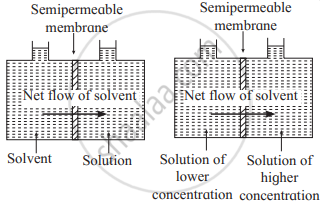
- The net spontaneous flow of solvent molecules into the solution or from a more dilute solution to a more concentrated solution through a semipermeable membrane is called osmosis.
- When a solution and pure solvent or two solutions of different concentrations are separated by a semipermeable membrane, the solvent molecules pass through the membrane. However, the rate of passage of solvent molecules into the solution or from a more dilute solution to a more concentrated solution is found to be greater than the rate in the reverse direction. This is favourable since the vapour pressure of the solvent is greater than that of the solution.
- As a result of osmosis, the amount of liquid on the pure solvent side or more dilute solution side decreases. Consequently, the amount of liquid on the other side increases. This results in a decrease of the concentration of the solution.
APPEARS IN
संबंधित प्रश्न
Determine the osmotic pressure of a solution prepared by dissolving 2.5 × 10⁻² g of K2SO4 in 2L of water at 25°C, assuming that it is completely dissociated.
(R = 0.0821 L atm K−1 mol−1, Molar mass of K2SO4 = 174 g mol−1)
Which of the following is not a colligative property?
At 300 K, 36 g of glucose present in a litre of its solution has an osmotic pressure of 4.98 bar. If the osmotic pressure of the solution is 1.52 bars at the same temperature, what would be its concentration?
Determine the osmotic pressure of a solution prepared by dissolving 25 mg of K2SO4 in 2 liter of water at 25°C, assuming that it is completely dissociated.
Which of the following 0.1 M aqueous solutions will exert the highest osmotic pressure?
Define Semipermeable membrane
Calculate the mass of NaCl (molar mass = 58.5 g mol−1) to be dissolved in 37.2 g of water to lower the freezing point by 2°C, assuming that NaCl undergoes complete dissociation. (Kf for water = 1.86 K kg mol−1)
Define the following term:
isotonic solution
Choose the most correct option.
In calculating osmotic pressure the concentration of solute is expressed in _______.
Choose the most correct option.
A living cell contains a solution which is isotonic with 0.3 M sugar solution. What osmotic pressure develops when the cell is placed in 0.1 M KCl solution at body temperature?
Choose the most correct option.
The osmotic pressure of blood is 7.65 atm at 310 K. An aqueous solution of glucose isotonic with blood has the percentage (by volume)________.
Answer the following in one or two sentences.
What is osmotic pressure?
Answer the following.
What are isotonic and hypertonic solutions?
Answer the following.
A solvent and its solution containing a nonvolatile solute are separated by a semipermeable membrane. Does the flow of solvent occur in both directions? Comment giving a reason.
Answer the following.
The osmotic pressure of CaCl2 and urea solutions of the same concentration at the same temperature are respectively 0.605 atm and 0.245 atm, calculate van’t Hoff factor for CaCl2.
Answer the following.
Explain reverse osmosis.
Answer the following.
How molar mass of a solute is determined by osmotic pressure measurement?
Which of the following statements is applicable for 0.1 M urea solution and 0.1 M sucrose solution?
Explain the osmotic pressure of a solution with the help of a thistle tube.
Define Osmosis.
Which of the following is a colligative property?
Two solutions have different osmotic pressures. The solution of higher osmotic pressure is called ____________.
The average osmotic pressure of human blood is 7.8 bar at 37°C. What is the concentration of an aqueous NaCl solution that could be used in the blood stream?
A solution containing 10 g per dm3 of urea (molar mass 60 g mol−1) is isotonic with 5% solution of non-volatile solute, MB of solute is:
The temperature at which 10% aqueous solution of (W/V) of glucose will show the osmotic pressure of 16.4 atoms is: (R = 0.082 L atom K−1 mol−1)
At a given temperature, osmotic pressure of a concentrated solution of a substance ______.
Isotonic solutions must have the same:
(i) solute
(ii) density
(iii) elevation in boiling point
(iv) depression in freezing point
In isotonic solutions:
(i) Solute and solvent both are same.
(ii) Osmotic pressure is same.
(iii) Solute and solvent may or may not be same.
(iv) Solute is always same solvent may be different.
Match the items given in Column I and Column II.
| Column I | Column II |
| (i) Saturated solution | (a) Solution having same osmotic pressure at a given temperature as that of given solution. |
| (ii) Binary solution | (b) A solution whose osmotic pressure is less than that of another. |
| (iii) Isotonic solution | (c) Solution with two components. |
| (iv) Hypotonic solution | (d) A solution which contains maximum amount of solute that can be dissolved in a given amount of solvent at a given temperature. |
| (v) Solid solution | (e) A solution whose osmotic pressure is more than that of another. |
| (vi) Hypertonic solution | (f) A solution in solid phase. |
Discuss biological and industrial importance of osmosis.
Osmotic pressure of a solution increases if
Which of the following colligative property can provide molar mass of proteins (or polymers or colloids) with greatest precision?
Isotonic solutions have same
Which one of the following is a colligative property?
In Isotonic solution
The vapour pressure of water is 12.3 k pa at 300 k. Calculated the vapour pressure of molal solution in it.
Osmotic pressure of a solution containing 2 g dissolved protein per 300 cm3 of solution is 20 mm of Hg at 27°C. The molecular mass of protein is ______.
The following solutions were prepared by dissolving 10 g of glucose (C6H12O6) in 250 ml of water (P1), 10 g of urea (CH4N2O) in 250 ml of water (P2) and 10 g of sucrose (C12H22O11) in 250 ml of water (P3). The right option for the decreasing order of osmotic pressure of these solutions is
Derive an expression to calculate molar mass of non-volatile solute by osmotic pressure measurement.
Assertion (A) : Osmotic pressure is a colligative property.
Reason (R) : Osmotic pressure is proportional to the molality.
Determine the osmotic pressure of a solution prepared by dissolving 2.32 × 10⁻² g of K2SO4 in 2L of solution at 25°C assuming that K2SO4 is completely dissociated.
(R = 0.082 L atm K−1 mol, Molar mass K2SO4 = 174 g mol−1)
Isotonic solutions are the solutions having the same ______.
Prove that: M2 = `(W_2RT)/(πV)`.
Arrange the following solutions in the order of increasing osmotic pressure (π) assuming complete ionization.
- 0.5M Li2 SO4
- 0.5M KCl
- 0.5M Al2 (SO4)3
- 0.1 M BaCl2
How will you determine molar mass of solute from osmotic pressure?
The 'X' g nonvolatile solute having molar mass 196 g mol-1 is dissolved in 3 dm³ water. Calculate the value of 'X' if resulting solution has osmotic pressure 0.8 atm at 300 К.
(R = 0.0821dm³ atm K-1 mol-1)
