Advertisements
Advertisements
प्रश्न
How can you remove the hard calcium carbonate layer of the egg without damaging its semiprermiable membrane? Can this egg be inserted into a bottle with a narrow neck without distorting its shape? Explain the process involved.
Advertisements
उत्तर
(i) When egg is placed in dilute mineral acid solution (preferably dilute \[\ce{HCl}\] solution), the hard external \[\ce{CaCO3}\] layer of the egg dissolves out/removed without damaging its semipermeable menbrane.
(ii) Yes, this egg can be inserted into a bottle with a narrow neck without distorting is shape.
This process invloved utilising phenomenon of osmosis is explained as below:
Egg is placed in mineral acid solution - after time egg is removed and placed in a hypertonic solution* - Size of the egg gradually decreases after some time and it shrivles due to osmasis. SInce the egg has shrivelled it can, now be inserted easily into a bottle with narrow mouth. The egg is, therefore, placed in a battle with narrow neck and then a hypotonic solution is filled into this bottle. On adding hypotonic solution**, egg regains shape due to osmosis.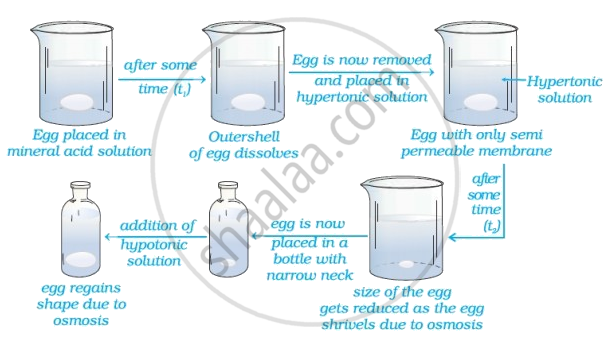
• Hypertonic solution - is a solution with higher salt concentration than that of the normal body cells so that the solvent/water is drawn out of the cell by osmosis; or any solution with higher osmotic pressure than another solution is called "Hypertonic solution".
• Hypotonic solution is a solution with lower salt concentration than that of the normal body cells so that water/solvent flows into the cell by osmosis; or - hypotonic solution is a solution which has lower osmotic pressure than the other solution.
APPEARS IN
संबंधित प्रश्न
Which of the following is not a colligative property?
Calculate the osmotic pressure in pascals exerted by a solution prepared by dissolving 1.0 g of polymer of molar mass 185,000 in 450 mL of water at 37°C.
Determine the osmotic pressure of a solution prepared by dissolving 25 mg of K2SO4 in 2 liter of water at 25°C, assuming that it is completely dissociated.
Define osmotic pressure.
Calculate the mass of a compound (molar mass = 256 g mol−1) to be dissolved in 75 g of benzene to lower its freezing point by 0.48 K (Kf = 5.12 K kg mol−1).
Define the following term:
isotonic solution
Answer the following.
A solvent and its solution containing a nonvolatile solute are separated by a semipermeable membrane. Does the flow of solvent occur in both directions? Comment giving a reason.
Answer the following.
How molar mass of a solute is determined by osmotic pressure measurement?
Which of the following statements is applicable for 0.1 M urea solution and 0.1 M sucrose solution?
Explain the phenomenon of osmosis.
Two solutions have different osmotic pressures. The solution of higher osmotic pressure is called ____________.
At constant temperature the osmotic pressure of a solution is ____________.
A solution containing 10 g per dm3 of urea (molar mass 60 g mol−1) is isotonic with 5% solution of non-volatile solute, MB of solute is:
At a given temperature, osmotic pressure of a concentrated solution of a substance ______.
Isotonic solutions must have the same:
(i) solute
(ii) density
(iii) elevation in boiling point
(iv) depression in freezing point
In isotonic solutions:
(i) Solute and solvent both are same.
(ii) Osmotic pressure is same.
(iii) Solute and solvent may or may not be same.
(iv) Solute is always same solvent may be different.
Match the items given in Column I and Column II.
| Column I | Column II |
| (i) Saturated solution | (a) Solution having same osmotic pressure at a given temperature as that of given solution. |
| (ii) Binary solution | (b) A solution whose osmotic pressure is less than that of another. |
| (iii) Isotonic solution | (c) Solution with two components. |
| (iv) Hypotonic solution | (d) A solution which contains maximum amount of solute that can be dissolved in a given amount of solvent at a given temperature. |
| (v) Solid solution | (e) A solution whose osmotic pressure is more than that of another. |
| (vi) Hypertonic solution | (f) A solution in solid phase. |
Isotonic solutions have same
Osmotic pressure of a solution containing 2 g dissolved protein per 300 cm3 of solution is 20 mm of Hg at 27°C. The molecular mass of protein is ______.
Define reverse osmosis.
