Advertisements
Advertisements
Question
How can you remove the hard calcium carbonate layer of the egg without damaging its semiprermiable membrane? Can this egg be inserted into a bottle with a narrow neck without distorting its shape? Explain the process involved.
Advertisements
Solution
(i) When egg is placed in dilute mineral acid solution (preferably dilute \[\ce{HCl}\] solution), the hard external \[\ce{CaCO3}\] layer of the egg dissolves out/removed without damaging its semipermeable menbrane.
(ii) Yes, this egg can be inserted into a bottle with a narrow neck without distorting is shape.
This process invloved utilising phenomenon of osmosis is explained as below:
Egg is placed in mineral acid solution - after time egg is removed and placed in a hypertonic solution* - Size of the egg gradually decreases after some time and it shrivles due to osmasis. SInce the egg has shrivelled it can, now be inserted easily into a bottle with narrow mouth. The egg is, therefore, placed in a battle with narrow neck and then a hypotonic solution is filled into this bottle. On adding hypotonic solution**, egg regains shape due to osmosis.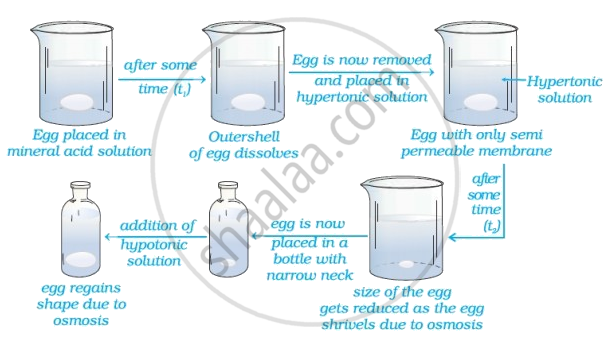
• Hypertonic solution - is a solution with higher salt concentration than that of the normal body cells so that the solvent/water is drawn out of the cell by osmosis; or any solution with higher osmotic pressure than another solution is called "Hypertonic solution".
• Hypotonic solution is a solution with lower salt concentration than that of the normal body cells so that water/solvent flows into the cell by osmosis; or - hypotonic solution is a solution which has lower osmotic pressure than the other solution.
APPEARS IN
RELATED QUESTIONS
Determine the osmotic pressure of a solution prepared by dissolving 25 mg of K2SO4 in 2 liter of water at 25°C, assuming that it is completely dissociated.
Define osmotic pressure.
Which of the following 0.1 M aqueous solutions will exert the highest osmotic pressure?
Calculate the mass of a compound (molar mass = 256 g mol−1) to be dissolved in 75 g of benzene to lower its freezing point by 0.48 K (Kf = 5.12 K kg mol−1).
Answer the following in one or two sentences.
What is osmotic pressure?
Which of the following statements is applicable for 0.1 M urea solution and 0.1 M sucrose solution?
Which of the following is a colligative property?
At constant temperature the osmotic pressure of a solution is ____________.
The temperature at which 10% aqueous solution of (W/V) of glucose will show the osmotic pressure of 16.4 atoms is: (R = 0.082 L atom K−1 mol−1)
Which of the following statements is false?
Give an example of a material used for making semipermeable membrane for carrying out reverse osmosis.
Match the items given in Column I and Column II.
| Column I | Column II |
| (i) Saturated solution | (a) Solution having same osmotic pressure at a given temperature as that of given solution. |
| (ii) Binary solution | (b) A solution whose osmotic pressure is less than that of another. |
| (iii) Isotonic solution | (c) Solution with two components. |
| (iv) Hypotonic solution | (d) A solution which contains maximum amount of solute that can be dissolved in a given amount of solvent at a given temperature. |
| (v) Solid solution | (e) A solution whose osmotic pressure is more than that of another. |
| (vi) Hypertonic solution | (f) A solution in solid phase. |
In Isotonic solution
The following solutions were prepared by dissolving 10 g of glucose (C6H12O6) in 250 ml of water (P1), 10 g of urea (CH4N2O) in 250 ml of water (P2) and 10 g of sucrose (C12H22O11) in 250 ml of water (P3). The right option for the decreasing order of osmotic pressure of these solutions is
Derive an expression to calculate molar mass of non-volatile solute by osmotic pressure measurement.
A solution containing 10 g glucose has osmotic pressure 3.84 atm. If 10 g more glucose is added to the same solution, what will be its osmotic pressure? (Temperature remains constant)
Arrange the following solutions in the order of increasing osmotic pressure (π) assuming complete ionization.
- 0.5M Li2 SO4
- 0.5M KCl
- 0.5M Al2 (SO4)3
- 0.1 M BaCl2
How will you determine molar mass of solute from osmotic pressure?
Write the condition of reverse osmosis.
The 'X' g nonvolatile solute having molar mass 196 g mol-1 is dissolved in 3 dm³ water. Calculate the value of 'X' if resulting solution has osmotic pressure 0.8 atm at 300 К.
(R = 0.0821dm³ atm K-1 mol-1)
