Advertisements
Advertisements
प्रश्न
Distinguish between SN1 and SN2 mechanism of substitution reaction.
Advertisements
उत्तर
| Factor | SN1 | SN2 |
| Kinetics | 1st order | 2nd order |
| Molecularity | Unimolecular | Bimolecular |
| Number of steps | Two steps | One step |
| Bond making and bond breaking | First the bond in the reactant breaks and then a new bond in the product is formed. | Simultaneous |
| Transition state | Two steps, two transition states | One step, one transition state |
| Direction of attack of nucleophile | Backside attack and frontside attack | Only back side attack |
| Stereochemistry | Racemisation (If the substrate is optically active) | Inversion of configuration (If the substrate is optically active) |
| Type of substrate | Mainly 3° substrates | Mainly 1° substrate |
| Polarity of solvent | Polar protic solvent favorable | Aprotic (non-polar) or solvent with low polarity favourable |
| Intermediate | Intermediate involved | No intermediate |
APPEARS IN
संबंधित प्रश्न
from the following pair would undergo SN2 faster from the other?
a. CH3CH2CH2I b. CH3CH2CH2Cl
Complete the following reaction giving major products.
\[\begin{array}{cc}\ce{CH3 - CH = CH3 ->[Red P/Br2] A ->[Ag2O/H2O]B}\\|\phantom{.........................}\\
\ce{OH\phantom{.......................}}\end{array}\]
Complete the following reaction giving major products.
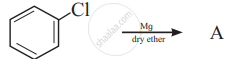
Name the reagent used to bring about the following conversion.
Ethyl bromide to ethyl isocyanide
Give reasons:
Haloarenes are less reactive than haloalkanes.
Convert the following:
Propene to propan-1-ol
Observe the following and answer the question given below.

Comment on the bond length of C–X bond in it.
Nucleophilic substitution reaction of 2, 4-dinitrochlorobenzene is faster than p-nitrochlorobenzene. Give reason.
Ethyl bromide undergoes the following reaction:
\[\ce{\underset{Ethyl bromide}{C2H5Br} + \underset{(aq.)}{KOH} ->[\Delta] \underset{Ethyl alcohol}{C2H5OH} + KBr}\]
Which of the following is a WRONG statement?
Nitroalkanes are obtained in laboratory from primary or secondary alkyl halides by the action of ______.
What type of hybridisation is present in carbocation formed during the alkaline hydrolysis of 1- bromo-1- phenyl ethane?
When C2H5Br is treated with excess of alc. NH3, the major product obtained is ____________.
Convert the following.
p-Nitrochlorobenzene to p-nitrophenol
The order of reactivities of the following alkyl halides for an SN2 reaction is ______.
With which halogen the reactions, of alkanes are explosive?
The compound that reacts the fastest with sodium methoxide is ______.
Explain the dehydrohalogenation reaction of 2-chlorobutane.
Complete the following reaction giving major products.
\[\begin{array}{cc}
\ce{CH3}\phantom{.......}\\
|\phantom{.........}\\
\ce{CH3 - c - CH2 - Cl ->[Na/dry ether]}\\
|\phantom{.........}\\
\ce{CH3}\phantom{.......}
\end{array}\]
Complete the following reaction giving a major product.
\[\begin{array}{cc}
\ce{CH3}\phantom{.................}\\
|\phantom{...................}\\
\ce{CH3 - C - CH2 - Cl->[Na/dry ether]A}\\
|\phantom{..................}\\
\ce{CH3}\phantom{................}
\end{array}\]
Complete the following reaction sequences by writing the structural formulae of the organic compounds 'A', 'B' and 'C'.
\[\ce{2-Bromobutan ->[alc. KOH] A ->[][Br2] B ->[][NANH2] C}\]
Define and explain the SN1 mechanism with a suitable example.
Identify the chiral molecule from the following.
Complete the following reaction giving major product.
\[\begin{array}{cc}
\ce{CH3}\phantom{...............}\\
|\phantom{..................}\\
\ce{CH3 - C - CH2 - Cl ->[Na/dry ether]A}\\
|\phantom{...................}\\
\ce{CH3}\phantom{.................}
\end{array}\]
Complete the following reaction giving major product.
\[\begin{array}{cc}
\ce{CH3}\phantom{.................}\\
|\phantom{...................}\\
\ce{CH3 - C - CH2 - Cl ->[Na/dry ether] A}\\
|\phantom{...................}\\
\ce{CH3}\phantom{.................}
\end{array}\]
Give a reason for the following:
Ethoxy ethane with conc. HI at 373 K gives C2H5OH and CH3I but not CH3OH and C2H5I.
Complete the following reaction giving major product.
\[\begin{array}{cc}
\ce{CH3}\phantom{.................}\\
|\phantom{...................}\\
\ce{CH3 - C - CH2 - Cl ->[Na/dry ether] A}\\
|\phantom{...................}\\
\ce{CH3}\phantom{.................}\\
\end{array}\]
Which among the following is NOT benzylic halide?
Which of the following reagent is used for conversion of alkyl halide into nitrile?
