


- Visual arts (Drik Kala) include painting and sculpture.
- Paintings are two-dimensional and made on rocks, walls, paper, canvas, and pots.
- Maratha painting style developed in the 17th century and was influenced by Rajput and European styles.
- Painting styles help us understand the lifestyle and culture of past periods.
- Rock paintings from the Stone Age are found in many parts of India, especially at Bhimbetka.
- Folk paintings developed from rock art and include wall and floor decorations and storytelling traditions.
- Classical, miniature, and later European styles of painting developed through ancient texts, royal patronage, and British influence.
Topics
Applied History
Working of the Constitution
Historiography : Development in the West
Geographical discoveries and colonization
- Concept for Geographical Discoveries and Colonization
Africa
- Imperialism - Africa
Asia: India, China, Japan
- Concept for Asia: India, China, Japan
Historiography : Indian Tradition
Working of the Indian Constitution
The Electoral Process
Dictatorships in Europe, Second World War and world
- Concept on Dictatorships in Europe
- Second World War (1939-1945 C.E.)
First world war
The League of Nations
Russian Revolution
- Concept for Russian Revolution
United Nations Organization
- Concept for United Nations Organization
Political Parties
Applied History
Africa
- Emancipation of Africa
Asia
- Emancipation of Asia
Social and Political Movements
History of Indian Arts
Globalization
- Globalization After World War II
Scientific and Technological Progress
- Scientific and Technological Progress After World War II
Cold war
- Formation of the Cold War
Challenges Faced by Indian Democracy
Mass Media and History
Social Diversity and Democracy
- Social Diversity
- Coccept for Caste/Race and Democracy
- Concept for Language and Democracy
- Cocnept for Religion and Democracy
- Concept for Gender and Democracy
- Concept for Democracy and Diversity
Challenges to Democracy Remedial Measures to the Challenges
- Concept for Challenges to Democracy Remedial Measures to the Challenges
Internal work
Democracy
- Democracy - Meaning, Types and Characteristics
Political Parties and Types
- Political Parties
- Importance of Political Parties
- Major National and Regional Parties in India/ Types of Political Parties
Entertainment and History
Sports and History
Tourism and History
Heritage Management
History - Imperialism
History - 20th Century Age of conflict
History - Emancipation of Asia and Africa
History - World after World War 2
Political Science
Maharashtra State Board: Class 10
Notes
Modern Indian Paintings:
- Around 1857, Indian art entered its modern era.
- The British considered fine art to be exclusively European. They believed that Indians lacked the training and the sensibility needed to create and admire fine art.
- An accurate portrayal of the painting's subject distinguishes the European style.
Evolution of Modern Indian Painting:
- Indian painting, as an extension of Indian miniature painting, began to decline toward the end of the nineteenth century. Only a few minor forms of artistic expression - the "Bazar" and "Company" styles of painting, as well as some folk arts throughout the nation - were still in existence during this time.
- By the mid and late nineteenth century, art schools were established in major cities like
Lahore, Calcutta (now, Kolkata), Bombay (now, Mumbai), and Madras (now, Chennai), to propagate Western values in art education and the colonial agenda.
- After 1857, John Griffiths and John Lockwood Kipling travelled to India; John Griffith served as the head of the Sir J. J. School of Art and was regarded as one of the best Victorian painters to visit the country, while Kipling later served as the head of the J. J. School of Art as well as the Mayo School of Arts, which was founded in Lahore in 1878.
- Traditional Indian crafts as well as academic and naturalist artwork that suited Victorian sensibilities were frequently promoted by these art schools. Even the Indian crafts that were supported were those that catered to European tastes and market demands.
- Nationalist art developed in opposition to this colonial prejudice, with the Bengal School of Art, as fostered by Abanindranath Tagore and E. B. Havell, serving as a shining example. Rabindranath Tagore, a poet, created the Visva-Bharati University in Shantiniketan, which included the first nationalist art school in India, Kala Bhavana.
Examples of Modern Indian Painting:
- When Savai Madhavrao Peshwe was in power, James Wales, a Scottish artist, founded an art school in Shaniwar Wada, a neighborhood in Pune. He had painted portraits of Nana Phadnavis and Savai Madhavrao.
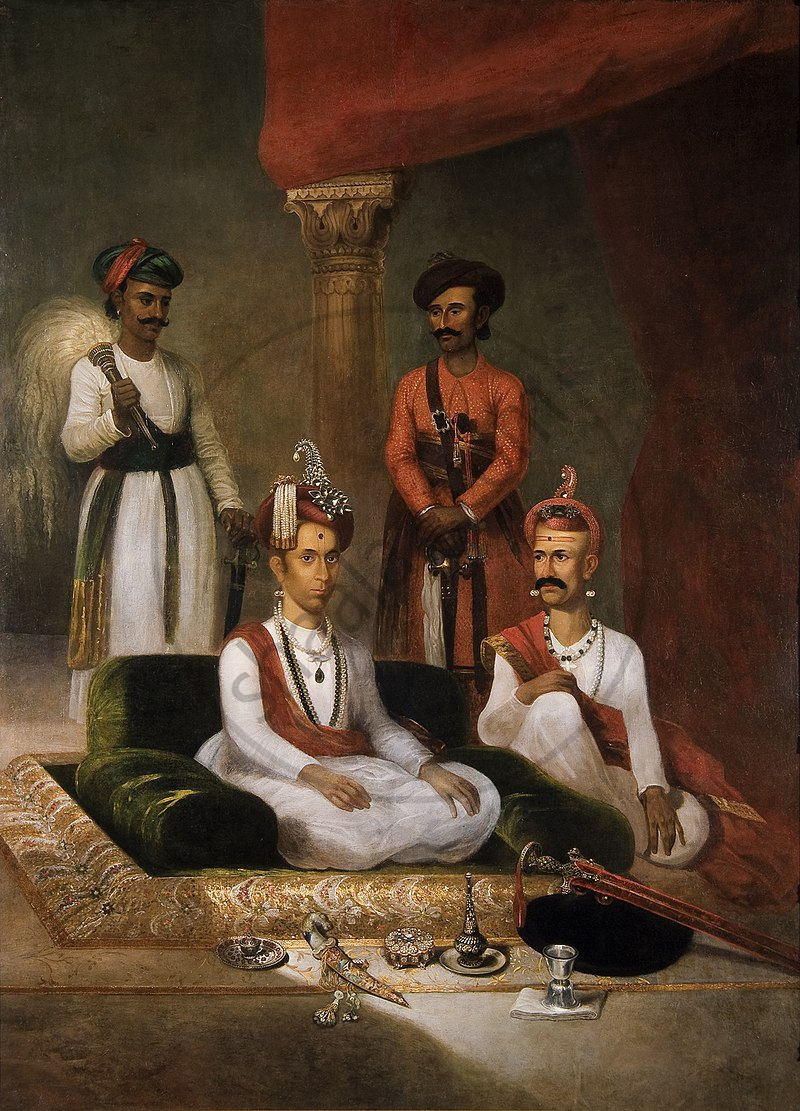
Savai Madhavrao and Nana Phadnavis
- The Marathi artist Gagaram Tambat, who collaborated with Wales, receives a special note in this context. The rock-cut caves at Karle and Verul have been captured in paintings by him. His sketches are archived in Yale University's Yale Centre of British Art.
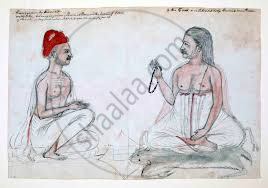
Gangaram Tambat with his Guru
- Replicas of Ajanta paintings were created by Pestonji Bomanji.
Lahore, Calcutta (now, Kolkata), Bombay (now, Mumbai), and Madras (now, Chennai), to propagate Western values in art education and the colonial agenda.
|
Savai Madhavrao and Nana Phadnavis |
Gangaram Tambat with his Guru |
Maharashtra State Board: Class 10
Notes
Prehistoric Paintings:
|
Prehistoric Painting |
- The term ‘Prehistory’ refers to the many thousand years when there was no existence of paper, language, or any written records in a given culture or society.
- Painting is one of the oldest forms which is practiced by humans to satisfy their aesthetic sensitivity and creative urges.
- Petroglyphs are prehistoric paintings that are typically created in caves on cave rocks.
- Excavations of Prehistoric sites give us fairly accurate knowledge about what happened and how people lived in prehistoric times.
- Prehistoric paintings can be found during the Paleolithic, Mesolithic, and Chalcolithic periods.
- The subjects of their drawings were human figures, human activities, geometric designs, and symbols.
- Prehistoric men's daily lives were frequently depicted in stick-like human figures.
- Ochre is a pigment mineral used as colour.
- Bhimbetka Caves and Narsingarh Caves in Madhya Pradesh, and Jogimara Caves in Chhattisgarh, are a few examples.
1. Bhimbetka Rock Paintings:
|
Group hunting in Bhimbetka Caves in MP |
- It is located south of Bhopal in Madhya Pradesh's Vindhyan ranges, with rock shelters containing over 500 rock paintings.
- V. S. Wakankar discovered the Bhimbetka caves in 1957-58.
- In 2003, it was designated a UNESCO World Heritage Site.
- The oldest paintings are thought to be 30,000 years old and have survived because of their location deep within the caves.
- Bhimbetka's paintings date from the Upper Paleolithic, Mesolithic, Chalcolithic, early historic, and medieval periods. However, the majority of the paintings date from the Mesolithic period.
- The themes of the paintings found here are of great variety. These include hunting, dancing, music, horse and elephant riders, animal fighting, honey collection, decoration of bodies, and other household scenes.
- Elephants, bison, deer, peacocks, and snakes are among the animals depicted.
- Natural resources are used to create colors such as red ochre, purple, brown, white, yellow, and green. For the red color, haematite ores were used, and the white color was most likely derived from limestone. Green made from Chalcedony, a green-colored rock. Plant fiber was used to make the brushes.
Notes
Mural Paintings and Cave Painting:
- A mural is a large painting that is painted or affixed directly on walls and rock surfaces like roofs and sides. More broadly, mural art also appears on ceilings or any other large permanent surface.
- Mural paintings usually have the distinguishing characteristic of having the architectural elements of the space they are painted on harmoniously incorporated into the picture by the common technique of fresco.
- Mural paintings have existed in India from the 2nd century BC to the 8-10th century AD.
- Mrunal paintings can be found in Ajanta, Bagh, Sittanavasal, Armamalai cave, Ravan Chhaya rock shelter, and Kailashnath temple in Ellora caves.
- The majority of the themes in these paintings are religious in nature, including Buddhism, Jainism, and Hinduism.
1. Ajanta Caves:
|
Padmapani painting in Ajanta cave, Maharashtra |
- In the 4th century AD, the Ajanta caves were carved out of volcanic rocks.
- Human values and social fabric are depicted in the paintings, as are period styles, clothing, and accessories.
- The female figures in the paintings are distinguished by their distinct hairstyles.
- These paintings' themes range from Jataka stories to Buddha's life to intricate flora and fauna decorative patterns.
- The painting medium was made up of vegetable and mineral dyes.
2. Ellora Caves:
 Mural painting in cave no 32 at Ellora |
- Excavated between the 8th and 10th centuries A.D. from the living rock
- The artworks depict all three religions (Buddhism, Jainism, and Hinduism).
- Ellora is a group of 34 caves – 17 Brahmanical, 12 Buddhist, and 5 Jain located in the Sahyadri ranges of Maharashtra.
- The most famous of which is the Kailasa temple which is a free-standing monolith structure that has several fragments of painting on the ceiling of the different parts of this temple.
Notes
Indian Traditions of Visual Arts (Drik Kala): Painting
- Indian Painting is one of the forms of art which is giving expression to human feelings and thoughts through colours, lines, and designs.
- The earliest Indian painting originated from a religious Hindu background, which was replaced by Buddhist art and later by Islamic art. After colonial rule, the British style of painting, Progressive art, and now Modern art emerged. Hence, Indian painting is one of the existing rich heritage.
- From the painting of the mural in Ajanta and Ellora caves to the multiple forms of classical paintings in various parts of the country. Indian painting paved versatile painting styles in the nation.
- Indian paintings have traditionally been classified according to a different Era, regional styles, or dynastic periods, with an emphasis on the contribution of different styles.
- Some of the styles of Indian painting:
- Prehistoric Painting
- Mural Painting and Cave Painting
- Folk Styles of Painting
- Classical Styles of Painting
- Miniature Painting in Manuscripts
- Western Style of Painting
Maharashtra State Board: Class 10
Notes
Classical Styles of Painting:
- Classical Painting is expressed within an established frame of consistent rules which is required a long period of training to master any form of classical art.
- The third Khanda of the Vishnudharmottara Purana, a fifth-century text has a chapter Chitrasutra, which should be considered a sourcebook of Indian art in general and painting specifically. It talks about the art of image making called Pratima Lakshana, which are canons of painting.
- The Khanda also deals with the techniques, tools, material(s), surface (wall), perception, perspective, and three-dimentionality of human figures.
Six Limbs of Indian Painting Shadanga:
- The word ‘SADANGA’ consists of two words, one is ‘Shad’ means ‘Six’ & the other is ‘Anga’ means ‘Part’. Sadanga consists of the six limbs, or canons of art, on which the whole art of painting depends.
- The Sadanga is an inevitable part of every great Indian masterpiece.
- India of the 1st century B.C. had seen the evolution of the ‘SADANGA’ or the SIX LIMBS OF THE PAINTING’ which are considered as the principles of the art even today.
The Six Limbs are:
“Roopabhedah pramanani bhava-lavanya-yojanam।
Sadrishyam Varnakabhangam iti chitram shadakam॥’’
1. Roop-bheda (variation of form):
- Rupa means form and Bheda means the variation in form.
- Rupa-bheda consists in the knowledge of special characteristics of things - natural or manmade; say, the differences in appearances among many types of men, women, or natural objects or other subjects of the painting.
Example: Padmapani, Cave No. 1, Ajanta, Maharastra
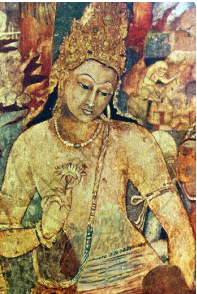
so many forms are shown. Padmapani, a representation of Buddha, stood beside the princess, attendants, musicians, kinnaras, and animals like monkeys and birds while carrying a blue lily and exuding the elegance and charm of a young king. With the architectural scene, trees, and plants in the background. as well as figures in stances and carrying out movements, each with a different colour complexion.
2. Pramanani (Proportion):
- In Indian philosophy, prama, which translates to "measure," refers to the process through which one gains accurate and reliable knowledge of the world (pram, pramiti). a character's basic dimensions and proportions in art.
- The Indian artist placed greater emphasis on measuring than on proportion. The proportions were frequently symbolic and suggestive measurements that helped viewers understand the artwork's focal point and supporting details.
Example - Trivikrama Painting
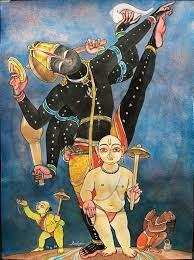
Lord Vishnu's fifth incarnation, is depicted in monumental size in the painting as he achieves victory over the three worlds with the help of his three feet, placing the first on swarga (heaven), the second on Prithvi earth, and the third on the head of the demon Bali to crush his conceit. He is therefore depicted as being enormous in height while the other characters are smaller because he is the winner of three worlds.
3. Bhava (Emotional Disposition):
- Bhava is a mental state that might be translated as feeling, emotion, mood, or devotion. paintings' ability to evoke strong emotions.
- This basically consists in drawing out the inner world of the subject; to help express its inner feelings.
Example - Durga mahishasura mardini painting by Tagore.

Goddess Kali and Lord Narasimha (a man-lion form of the god) create awe in the demons by horrified terror expressions in the picture of Durga Mahishasura mardini, where female hero Goddess Durga with power and proud present veer or victorious expressions.
Example - Shakuntala – Looks of Love by Raja Ravi Varma, 1870

Varma painted Shakuntala as she pretends to remove a thorn from her foot. Secretly, Shakuntala is looking for her lover, Dushyantha.
4. Lavanya – Yojanam (Gracefulness in Composition):
- It is the infusion of grace.
- Infusion of grace is planning to create a beautiful and graceful environment, along with the beauty of the character.
- The emotive and lyrically graceful portrayal of the painting as a work of art embodies grace, beauty, charm, and sensitivity while also illuminating its spectators.
- The motive is to bring about a sense of beauty in a dignified and organized manner.
- While pramanani is for stringent proportions, and the bhava is for expressing movement. But, Lavanya yojanam is for controlling the over expression of both.
Example: Radha & Krishna with gopis, Pahari miniature, India

The beauty and charm are rendered in the Pahari painting of Bhagavata series where the romance of Radha and Krishna flows in the woods and greens.
5. Sadrishyam (Similitude):
- This is perhaps the most challenging task of creating a painting.
- Sadrishya suggests the degree to which a depiction is similar to an artist's vision or the subject itself. In a way, it is also a way of depicting similitude.
- It enhances the character of any individual and makes him complete in itself.
Example - mriganayani (eyes like deer eyes), the nose should be like an elephant trunk, thighs should be like a banana trunk, fingers like lotus petals, lips like fresh busted flowers, etc.
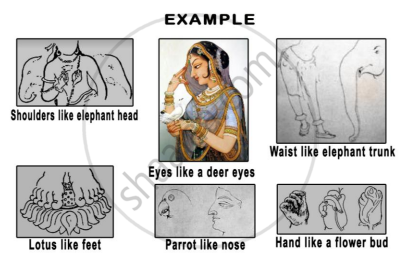
5. Varnakabhangam (Colour Differentiation):
- It is an artistic way of making use of the brush and colors.
- The term translated means the way a subject is being drawn and colored. So, obviously, there shall be the use of brush and pigments.
- What this principle focuses on, is the way the strokes are being applied to a canvas and the knowledge of the artist about the different colors.
- For example, Red is assigned with furious and yellow with heroic, white colour with comic, blue and black are associated with erotic and terrible.
Notes
Folk Styles of Paintings
- Folk styles of painting generally depict the lifestyle, culture, tradition, etc., of a particular place or region.
- The folk group is a function of shared community-based identity, not of individualism.
- They are pictorial expressions of village painters which are marked by the subjects chosen from the epics like Ramayana and Mahabharata, Bhagvat Purana as well as daily village life, birds and animals, and natural objects like sun, moon, plants, and trees.
- The tradition of folk art has a style that is very similar to that of rock art.
- Regional folk painting styles were influenced by practices like Rangawali, which involved decorating houses and courtyards with diverse figures and symbols or telling stories with panels of paintings.
Types of Folk styles of paintings:
1. Maratha Style Painting:
| Maratha Style Folk Painting | |
|
Durbar hall |
Coronation of Shivaji Maharaj |
- Maratha painting is an example of a type of art. The Maratha painting style emerged in the latter half of the 17th century C.E.
- This style comprises colored paintings that appear as murals as well as miniatures in manuscripts.
- Maratha-style murals can be found in old wadas in Maharashtra, such as Wai, Menavali, and Satara.
- The Rajput and European painting styles impacted the Maratha style.
2. Warli Style of Painting:
|
Warli Painting, Maharashtra |
- Warli painting is a form of tribal art mostly created by the tribal people from the North Sahyadri Range in Maharashtra with a large concentration in the district of Thane.
- The basic characters used in Warli paintings are a circle, a triangle, and a square placed at different angles. Triangles linked at the tip are used to depict humans, animal bodies, and other items.
- The Warli paintings portray the tribe's day-to-day activities and hence are largely based on harvest festivals, folk stories, celebrations in temples, marriage, and so on.
- The paintings were created on the red mud walls of huts. The ochre-colored walls are painted with a rice-and-water mixture. They drew the paintings with crooked bamboo sticks as paintbrushes.
- After 1970, Warli paintings were well-known throughout the world. Jivya Somya Mashe, the artist who popularised the artwork over the world, has been honored with Padma Shri in 2011 and many national and international awards. He died on May 15, 2018.
3. Chitrakathi Tradition:
|
Leather shadow puppets |
Picture stories |
- The Chitrakathi also known as Pinguli tradition is the name of an occupational caste whose traditional livelihood was to narrate stories aided with pictures of sojourning various places.
- "Chitra" means picture and "katha" means story and the exponent called Chitrakathi is the person who narrates the story with the aid of some visual support.
- They sing the tale while showing it visually using pictures. "Broadly speaking, Chitrakatha is identified in three forms, Leather shadow puppets, Stringed wooden puppets, and Picture stories.
- They made a series of single sheets of paintings. All paintings belonging to one story were kept in a bundle called "pothi".
- Chitrakathi artists are a community of storytellers found all over Maharashtra and some parts of Andhra Pradesh and Karnataka.
- This mostly depicts the gods and royals. The Theme of Chitrakathi paintings includes stories on local versions of Ramayana and Mahabharata and mythical themes.
- The Chalukya ruler Someshvara's book 'Manasollas’, also known as Abhilashitartha Chintamani, which was published in the 12th century C.E., mentions the tradition of Chitrakathi.

Stringed wooden puppets
- The Chitrakathi images are painted with natural-color paints on a piece of paper. The narration of one story is completed in 30-50 images. These photographs have been passed down from one generation to the next and are carefully preserved.
- The tradition, which is in danger of dying out, is being preserved by artists and the government.
Maharashtra State Board: Class 10
Notes
Miniature Paintings in Manuscripts:
- The term 'miniature' comes from the Latin word 'minimum,' which means 'red lead paint.'
- Manuscript illustrations were methodically conceived in thematic sets.
- Paintings from the medieval period have earned a generic name, for example, miniature paintings, owing to their relatively smaller size.
- These miniature paintings were hand-held and observed from a closer distance due to their minutiae.
- A large section of paintings is appropriately referred to as manuscript illustrations as they are pictorial translations of poetic verses from epics and various canonical, literary, bardic, or music texts (manuscripts), with verses handwritten on the topmost portion of the painting in clearly demarcated box-like space. Sometimes, one finds the text not in the front but behind the work of art.
- Early manuscripts contain miniature paintings that exhibit Persian influence.
1. The Mughal School of Miniature Painting:
- The birth of the Mughal School of Painting is seen as a turning point in Indian painting history.
- The Mughal School of painting emerged under the reign of Akbar in 1560 CE, when the Mughal empire was established.
- Two Persian masters, Mir Sayyed Ali and Abdul Samad Khan, who had previously worked for his father Humayun, were hired to run Nigaar Khana, a painting studio, at the start of his reign.
- The most skilled Persian and indigenous Indian artists of that time. This integrated composition of Indo-Persian artists led to the development of a unique style in this period.
- Paintings recorded and documented significant events, personalities, and interests of the emperors. These were meant to be seen by the royals only. The paintings were made to suit the sensitivity of the royals or were often made for intellectual stimulation. The paintings were a part of manuscripts and albums.
- Akbar envisioned cultural integration and commissioned the translation of several revered Hindu texts.
- The first piece of the Mughal School appears to be an illustrated manuscript of the Tutinama that is housed in the Cleveland Museum of Art in the United States.
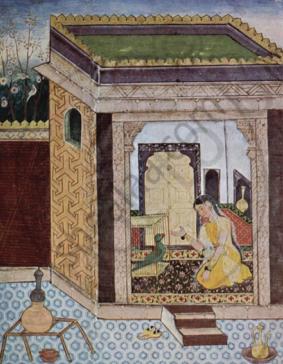
Tutinama: The Girl and the Parrot, 1580-1585, Chester Beatty Library, Dublin
- Mughal paintings reached their pinnacle during Jahangir's reign. The use of decorated margins around paintings was one of the distinct trends that emerged during this time period.
- The tone of Mughal art changed dramatically during Shah Jahan's reign. He discouraged artists from using charcoal in their drawings and instead encouraged them to draw and sketch with a pencil.
2. The Deccan School of Miniature Painting:
- The history of Deccani Painting can largely be constructed from the late sixteenth century until the 1680s - the time when the Mughals conquered the Deccan.
- A highly developed and distinctive school of court painting emerged in the kingdoms of Bijapur, Golconda, and Ahmadnagar.
- Its distinctive sensuality and vibrant colours are strongly reminiscent of local aesthetics. The school emphasised thick composition and made an effort to convey a romantic air, which always came over in an idiom that was eloquently natural and vibrant.
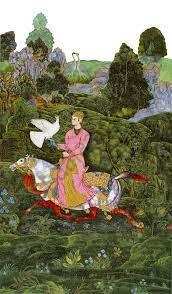
Sultan I brahim Adil Shah II Hawking
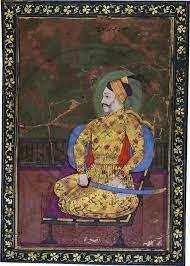
Sultan Abdullah Qutb Shah of Bijapur, National Museum, New Delhi, India.
|
Tutinama: The Girl and the Parrot, 1580-1585, Chester Beatty Library, Dublin |
|
Sultan I brahim Adil Shah II Hawking |
Sultan Abdullah Qutb Shah of Bijapur, National Museum, New Delhi, India. |
Maharashtra State Board: Class 10
Key Points: Indian Traditions of Visual Arts (Drik Kala)> Painting
Related QuestionsVIEW ALL [17]
Complete following concept maps.
| Temple Architecture |
Dravida | Hemadpanti |
| Characteristics |
..................................... ...................................... |
.................................. .................................. |
| Examples |
......................................... ......................................... |
..................................... ...................................... |
