Topics
Applied History
Working of the Constitution
Historiography : Development in the West
Geographical discoveries and colonization
- Concept for Geographical Discoveries and Colonization
Africa
- Imperialism - Africa
Asia: India, China, Japan
- Concept for Asia: India, China, Japan
Historiography : Indian Tradition
Working of the Indian Constitution
The Electoral Process
Dictatorships in Europe, Second World War and world
- Concept on Dictatorships in Europe
- Second World War (1939-1945 C.E.)
First world war
The League of Nations
Russian Revolution
- Concept for Russian Revolution
United Nations Organization
- Concept for United Nations Organization
Political Parties
Applied History
Africa
- Emancipation of Africa
Asia
- Emancipation of Asia
Social and Political Movements
History of Indian Arts
Globalization
- Globalization After World War II
Scientific and Technological Progress
- Scientific and Technological Progress After World War II
Cold war
- Formation of the Cold War
Challenges Faced by Indian Democracy
Mass Media and History
Social Diversity and Democracy
- Social Diversity
- Coccept for Caste/Race and Democracy
- Concept for Language and Democracy
- Cocnept for Religion and Democracy
- Concept for Gender and Democracy
- Concept for Democracy and Diversity
Challenges to Democracy Remedial Measures to the Challenges
- Concept for Challenges to Democracy Remedial Measures to the Challenges
Internal work
Democracy
- Democracy - Meaning, Types and Characteristics
Political Parties and Types
- Political Parties
- Importance of Political Parties
- Major National and Regional Parties in India/ Types of Political Parties
Entertainment and History
Sports and History
Tourism and History
Heritage Management
History - Imperialism
History - 20th Century Age of conflict
History - Emancipation of Asia and Africa
History - World after World War 2
Political Science
Notes
Rock-cut caves:
- Rock-cut architecture is the creation of structures, buildings, and sculptures by excavating solid rock where it naturally occurs.
- Temples, tombs, and cave dwellings were the three main uses of rock-cut architecture.
- The oldest rock-cut architecture is the Barabar caves in Bihar, which were built around the third century BC.
- Because India had many rocky mountains, rock-cut architecture was ideal, and structures excavated in stone were the most durable.
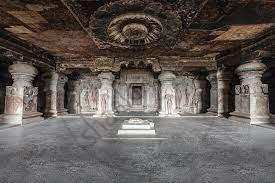
- Technically the entire composition of a rock-cut cave represents a union of architecture and sculptural art.
- Its entrances, interiors with its carved columns, and images are excellent specimens of sculptural art. The paintings on the walls and ceiling have survived in some of the caves till today.
Phases of Rock-cut architecture:
Phase 1: The first rock-cut caves were built by Ashoka and his grandson Dasaratha. The early Buddhist architecture spans the years 2nd century BC to 2nd century AD. This period's excavations are mostly made up of chaityas and viharas. They were mostly made of wood. Early Buddhist architecture can still be seen in Karla, Kanheri, Nasik, Bhaja, and Bedsa, as well as Ajanta.
Phase 2: In the fifth century AD, the second phase of rock-cut architecture began. This stage was distinguished by the removal of timber and the incorporation of the image of the Buddha as a dominant feature of the architectural design. Viharas underwent a slight change during this time, the inner cells inhabited by the monks alone, now housed the image of the Buddha as well.
Phase 3: The next, and possibly most dominant, phase in the rock-cut tradition is the Dravidian rock-cut style. The main characteristics of this style are mandapa and ratha. The mandapa is an open pavilion carved from rock. It's a simple columned hall with two or more cells in the back wall. The ratha is a single-stone shrine carved out of solid rock.
Examples of Rock-cut Architecture:
| Caves | Particulars |
|
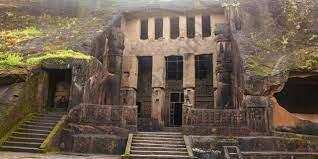
Kanheri Caves |
1. Kanheri Cave: Location: Mumbai
|
|
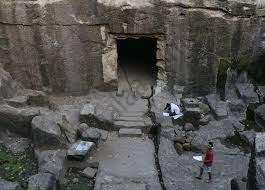
Jogeshwari caves |
2. Jogeshwari caves: Location: Salsette
|
|
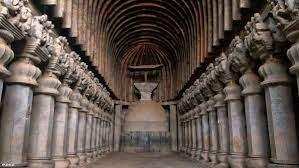
Karla caves Chaitya Hall, Karla Cave No.8 |
3. Karla caves:
|
|
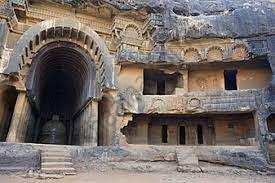
Bhaja caves Chaitya, Cave No. 12, Bhaja |
4. Bhaja caves: Location: near Pune
|
|
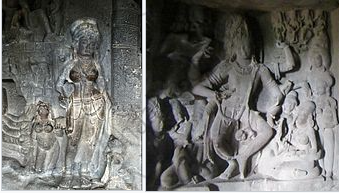
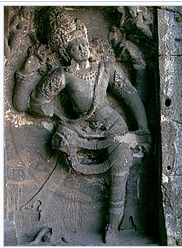
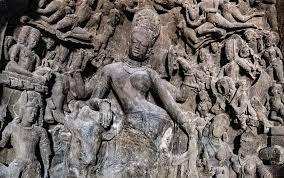
Ellora caves
Gajasur Shiva, Cave No.15, Ellora
Parvati and Dancing Shiva in an Ellora cave
Vishnu at the Dashavatara Ellora temple
|
5. Ellora caves: Location: Maharashtra
|
|
Ajanta caves |
6. Ajanta caves: Location: Aurangabad
|
|
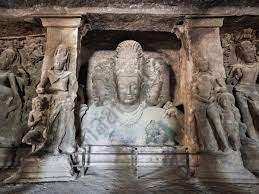
Elephanta caves Three-face image of Shiva
Ardhanariswara |
7. Elephanta caves: Location: Mumbai
|

Notes
Temple architecture:
- India's temple architecture started to take shape in the Gupta era, about the fourth century C.E. The only components of the early Gupta period temples were the Garbhagriha and a veranda with four columns.
- By the eighth century C.E., temple architecture in India had reached its pinnacle.
- The magnificent composition of Verul's Kailas temple testifies to this. By the medieval period, India had created a number of different temple architectural styles.

1. Nagara Style or North India Temple style:
 |
 |
| Nagara Indian Style Architecture | |
- The Nagara style of temple architecture became popular in northern India
- The entire temple is built on a single stone platform with steps leading up to it.
- Another unique characteristic is that it does not usually have elaborate boundary walls or gateways.
- Garbhagriha: It is always located directly under the tallest tower.
- Assembly halls or mandaps: It is present in front of the main deity.
- Earlier temples had one shikhara whereas the later temples had many.
- Another distinguishing feature of this temple style is the installation of Amalaka or Kalash on Shikhara.
- Examples of Nagara Style of Temples are Kandariya Mahadev Temple in Madhya Pradesh, Sun temple in Konark, and Sun temple at Modhera.
|
Kandariya Mahadev Temple |
Sun temple in Konark |


2. Dravida style of temple architecture:
|
|

- The Pallavas, who ruled in parts of Karnataka, Andhra Pradesh, and northern Tamil Nadu until the ninth century, pioneered the Dravidian style of temple architecture in South India.
- The Dravida temple is surrounded by a compound wall.
- A Gopuram, or entrance gateway, is located in the centre of the front wall.
- The main temple tower, known as vimana in Tamil Nadu, is shaped like a stepped pyramid that rises up geometrically, as opposed to the curving shikhara of North India.
- The term 'shikhara' is only used for the crowning element at the top of a South Indian temple, which is usually shaped like a small stupika or an octagonal cupola - this is equivalent to the amalak and kalasha of North Indian temples.
- The entrance to Garbhagriha is adorned with fierce Dvarapalas or temple doorkeepers.
- Within the complex, it is common to find a large water reservoir, also known as a temple tank.
- The Kailashnath temple in Ellora is a well-known example of a temple built entirely in the Dravidian style. Other well-known Dravidian temples in the south include Rajarajeswara or Brihadeshwara temple, Tiruvannamalai, Tamil Nadu's Annamalaiyar Temple, Meenakshi, and Airavatesvara temples.
|
Brihadeshwara Temple |
Annamalaiyar Temple |


3. Vesara style of temple architecture:
- Vesara is a hybridised architecture style that combines Nagara and Dravidian elements.
- Vesara is thought to be derived from the Sanskrit word vishra, which means a place to take a long walk.
- Vesara style originated in Karnataka.
- The Chalukyas of Badami started the trend by building temples in a Vesara style, which was refined by the Rashtrakutas of Manyakheta in Ellora, Chalukyas of Kalyani in Lakkundi, Dambal, Gadag, etc., and was epitomized by the Hoysalas.
- Ornamentation: The ornamentation of the temple walls and pillars on the Chalukyan temple shows indigenous quality.
- Transformation of Dravida tower: The Chalukyan builders altered the Dravida towers by reducing the height of each storey and arranging them in descending order of height from base to top, with much ornamentation in each storey.
- Transformation of Nagara tower: Instead of inclined storeys, the vertical shape of the tower has been modified.
- Mantapa: The roof of the mantapa is divided into two types: dome ceilings (the dome-like ceilings standing on four pillars are very attractive) and square ceilings (these are vigorously ornamented with mythological pictures).
- Pillars: The miniature decorative pillars of Chalukya temples have their own artistic value.
- Examples - Kallesvara temple, Kukkanur; Ramalingesvara temple, Gudur; Mahadeva temple, Ittagi; Kasivisvesvara temple, Lakkundi (and several other temples at Lakkundi); Brahmadeva temple, Savadi – notable for being fully stellate; Mallikarjuna temple, Sudi (and Joda-kalasha temple)
|
Kallesvara temple |
 Mahadeva temple |

4. Hemadpanti style of Temple:
- Temples in Maharashtra built in the 12th-13th centuries are known as Hemadpanti temples.
- Temples at Hemadpanti are constructed with star-shaped exterior walls. The outer walls of the temple have a zigzag pattern in the star-shaped plan. This produces an intriguing impression of shifting between light and shadow.
- The stonework of the Hemadpanti temple is a key feature. The walls are built without using any mortar, by locking the stones by using the technique of tenon and mortise joints.
- Among the best examples of the Hemadpanti style is the Ambreshwar temple at Ambarnath near Mumbai, the Gondeshwar temple at Sinnar near Nashik, and the Aundha Nagnath temple in the Hingoli district. Their strategy resembles a star. There are various locations in Maharashtra where you can find Hemadpanti temples.
|
Ambreshwar temple |
Gondeshwar temple |


Notes
Indian Visual Art - Architecture and Sculpture:

- Although the development, maturation, and improvement of Indian art are ongoing processes, it has been divided into a number of heads to facilitate comprehension and to identify key changes over time.
- Architecture is indeed the one of heads of visual art that shows the development of human civilization in India since the Stone Age. From the most basic forms of human habitation to magnificent temples, monuments, and palaces, Indian architecture has advanced greatly.
- By 1000 B.C. China and India had both created advanced civilizations that stood apart from and eventually outlasted those of their Mesopotamian and Egyptian counterparts.
- Though sculpture is the Indian art par excellence, it is in architecture that the national genius has shown its most unquestionable originality.
- The majority of the ancient and medieval architectural and artistic artefacts from India have a religious theme.
- That does not mean that people did not have art in their homes at those times, but domestic dwellings and the things in them were mostly made from materials like wood and clay which have perished.
- It can be clearly presumed that Indian culture is reflected through splendid archaeological styles.
Notes
Indo-Islamic architecture:
- The Islamic architecture of India was created throughout the medieval period when a variety of architectural styles, including Persian, Central Asian, Arabic, and pre-Islamic native Indian traditions, were combined under the patronage of Muslim sultanates. There have been many stunning structures built.
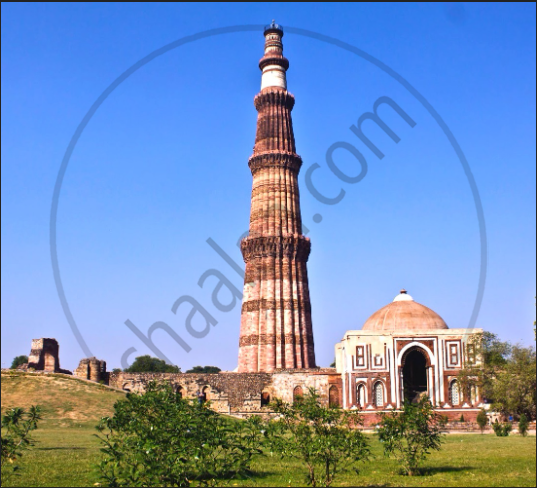
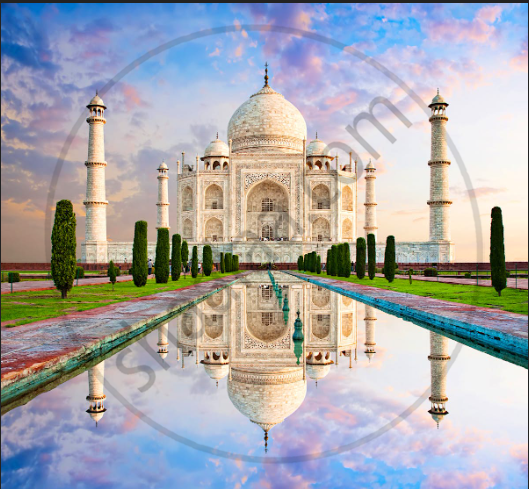
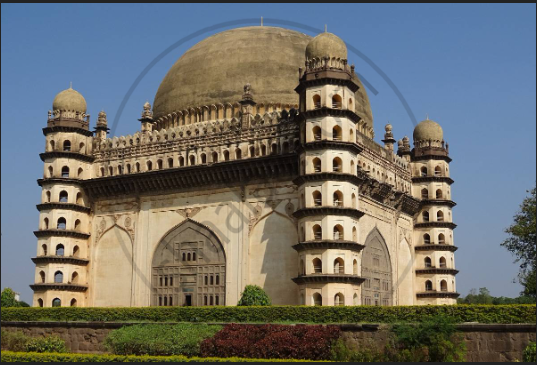
- The Taj Mahal in Agra, the Gol Gumbaz in Bijapur in Karnataka, and the Qutub Minar in Mehrauli near Delhi are three of India's most well-known examples of Islamic architecture.
Features of Indo-Islamic Architecture:
- In Islamic countries, buildings were made of brick, lime, and mortar. Their architectural styles were arcuate, which means they used arches, domes, and vaults.
- Muslims avoided using human figurines due to religious injunctions, instead opting for geometrical patterns (arabesque), floral patterns, inscriptions in various styles, and inlay on marble (Pietra dura).
- Perforated lattice screens with arabesques, star motifs, and other geometric shapes like pentagons, hexagons, octagons, and circles.
- Gardens were an essential part of Islamic architecture.
Few Examples of Indo-Islamic Architecture:
|
Qutub Minar |
1. Qutub Minar:
|
|
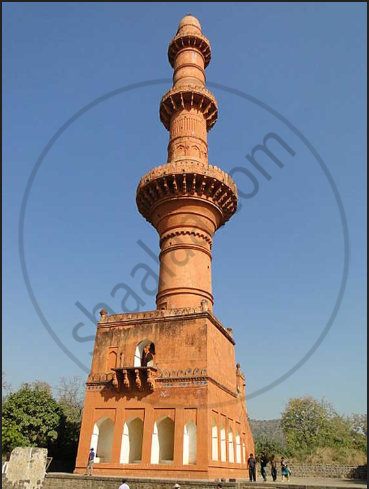
Chand Minar |
2. Chand Minar:
|
|
Taj Mahal |
3. Taj Mahal:
|
|
Gol Gumbaz |
4. Gol Gumbaz:
|
Notes
Indo-Gothic architecture:
- In India, a new architectural style emerged during the British era. First, with Mughal influence, the Gothic revival was introduced to colonial constructions, giving birth to the Indo-British style. The architectural style is referred to as Indo-Gothic.
- The buildings and monuments saw a mix of Indian (Mughal) styles, Victorian, Gothic, Palladian, Victorian Gothic, Baroque, and other styles.
- The Victorian Gothic architecture thus was basically a hotch-potch of early European styles mixed with the introduction of Middle East and Asian influences. This monument represents the themes deriving from Indian traditional architecture. This was the beginning of the Indo-gothic or Indo-Saracenic revival.
- During the British era, structures like churches, government buildings, executive mansions, and railroad stations were constructed in this style.
Three remarkable styles adopted in the British era were:
- Gothic
- Palladian
- Victorian Gothic
Prominent Features:
- The Indo-Saracenic features stand apart; they are: Minarets, Harem Windows, Open Pavilions, Pierced Open Arcading, Domed Kiosks, Many Miniature Domes, or Domed Chhatris, Towers impressive Onion (Bulbous) Domes Overhanging Eaves, Pointed Arches, Cusped Arches, or Scalloped Arches Vaulted Roofs. colonnaded balcony, Chattris & Chajjas in red sandstone.
Examples of Indo-Gothic Architecture:
|
Chhatrapati Shivaji Terminus (CST) |
1. Chhatrapati Shivaji Terminus (CST):
|
|
Gateway of India |
2. Gateway of India
|
|
Taj Mahal Palace Hotel
|
3. Taj Mahal Palace Hotel:
|
|
Municipal Corporation Building |
4. Municipal Corporation Building:
|


Key Points: Indian Traditions of Visual Arts (Drik Kala)> Architecture and Sculpture
- Rock-cut caves in India began in the 3rd century B.C.E. and combine architecture, sculpture, and painting.
- Ajanta and Verul caves are famous examples and are World Heritage Sites.
- Temple architecture started in the Gupta period and developed greatly by the 8th century C.E.
- Indian temples follow Nagara, Dravida, and mixed styles like Vesara and Bhoomija.
- Hemadpanti temples of Maharashtra are star-shaped and built without mortar.
- Islamic architecture in India developed through a mix of Persian and Indian styles, seen in Qutub Minar and Taj Mahal.
- Indo-Gothic architecture developed during British rule, with CSMT Mumbai as a World Heritage Site.

