


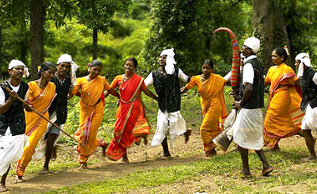

- India has rich regional traditions of folk performing arts linked with festivals and daily life.
- Maharashtra has folk arts like Koli dance, Powada, Keertan, Dashavatar, and Gondhal.
- Classical performing arts are based on the Natyashastra and the concept of the nine rasas.
- Indian classical music has two main traditions: Hindustani and Carnatic, with classical and semi-classical forms.
- Indian performing arts continue to grow through festivals, cultural exchange, and fusion experiments.
Topics
Applied History
Working of the Constitution
Historiography : Development in the West
Geographical discoveries and colonization
- Concept for Geographical Discoveries and Colonization
Africa
- Imperialism - Africa
Asia: India, China, Japan
- Concept for Asia: India, China, Japan
Historiography : Indian Tradition
Working of the Indian Constitution
The Electoral Process
Dictatorships in Europe, Second World War and world
- Concept on Dictatorships in Europe
- Second World War (1939-1945 C.E.)
First world war
The League of Nations
Russian Revolution
- Concept for Russian Revolution
United Nations Organization
- Concept for United Nations Organization
Political Parties
Applied History
Africa
- Emancipation of Africa
Asia
- Emancipation of Asia
Social and Political Movements
History of Indian Arts
Globalization
- Globalization After World War II
Scientific and Technological Progress
- Scientific and Technological Progress After World War II
Cold war
- Formation of the Cold War
Challenges Faced by Indian Democracy
Mass Media and History
Social Diversity and Democracy
- Social Diversity
- Coccept for Caste/Race and Democracy
- Concept for Language and Democracy
- Cocnept for Religion and Democracy
- Concept for Gender and Democracy
- Concept for Democracy and Diversity
Challenges to Democracy Remedial Measures to the Challenges
- Concept for Challenges to Democracy Remedial Measures to the Challenges
Internal work
Democracy
- Democracy - Meaning, Types and Characteristics
Political Parties and Types
- Political Parties
- Importance of Political Parties
- Major National and Regional Parties in India/ Types of Political Parties
Entertainment and History
Sports and History
Tourism and History
Heritage Management
History - Imperialism
History - 20th Century Age of conflict
History - Emancipation of Asia and Africa
History - World after World War 2
Political Science
Notes
Indian Music:
- The earliest tradition of Indian music may be traced to Sama Veda which contained the slokas that were put to music.
- The earliest treatise on music, drama, and dance is Bharata’s Natyashastra
- The seven swars of music – Sa, Re, Ga, Ma, Pa, Dha, Ni represent different scriptural deities: SA – Agni, RE – Brahma, GA – Saraswati, MA – Shiva, PA – Vishnu, DHA – Ganesha, NI – Surya
A. Indian Classical Music:
The origins of Indian classical music can be traced back to the recital of Vedic hymns in Hindu temples. Indian classical music during the Middle Ages was mostly centered on two traditions: the popular Hindustani classical music of North India and the Carnatic music of South India.
| Hindustani Music | Carnatic Music | |
| 1. | Its origins can be traced back to North India. Foreign traditions influenced it. | Its origins can be traced back to South India. There is no such foreign influence. |
|
2. |
There is no strict adherence to raga, tala, and Sruti unity as in Carnatic music. | Every piece contains unity of raga, tala, and Sruti. |
| 3. | There is no strong emphasis on Kriti. | There is a strong emphasis on Kriti. |
| 4. | More importance was given to vocal than instruments. | Equal importance was given to vocal as well as instruments. |
| 5. | Prevalence of a significant number of gharanas | No such prevalence of gharanas |
| 6. | Note by note raga development | Phrase by phrase raga development |
| 7. | Different styles of Hindustani music: Dhrupad, Dhamar, Thumri, Khayal and Tappa. | Different composition of Hindustani music: Gitam, Suladi, Svarajati, Jatisvaram, Varnam, Kritanam, Kriti, Pada, Javali, Tillana, Pallavi, Tanam. |
| 8. |
Hindustani musical instruments: Sitar, sarod, santoor and sarangi, Pakhawaj, tabla, and Mridangam
|
Carnatic musical instruments: Flute, veena, nadaswaram, mridangam, ghatam.
|
Folk Music
- Folk music, as opposed to established classical music, is the music of the common people.
- It gets its name from the German word volk, which means 'people.'
- Folk songs can include unique messages or meanings. They frequently talk about significant ceremonies and historical occurrences.
- They may be festivals, the advent of a new season, marriage, or the birth of a child.
- The forms of folk song in different provinces like:
State Folk songs Rajasthani Maand Bengal Bauls, Bhatiali Haryana Ragini Kashmir Gulraj Madhya Pradesh Pandavani Maharashtra Powada, Keertan, Jagar, Gondhal
Notes
Indian Dance:
1. Folk dances:
- A folk dance is a dance created by people that depicts the lives of ordinary people in a specific country or region.
- Various folk dances can be found throughout India, encompassing the length and breadth of the country.
Various folk dance forms in Maharashtra:
1. Lavani:
|
Lavani Dance Form |
2. Koli:
|

Koli Dance Form |
3. Tarpa Dance:
|
Tarpa Dance Form |
2. Indian classical dance:
- Excavations, inscriptions, chronicles, genealogies of kings and artists, literary sources, sculptures, and paintings from various periods provide extensive evidence of dance in India.
- Classical dance forms of India, also known as Shastriya Nritya, come from the words, Shastriya meaning classical and Nritya meaning the act of dancing.
- Contemporary classical dance forms evolved from musical plays or sangeet-nataka, which were performed from the 12th to the 19th century.
- Tandava (movement and rhythm) and Lasya (grace, bhava & rasa) are the two fundamental aspects of Indian classical dance.
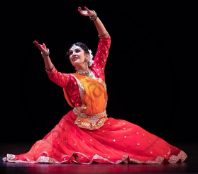
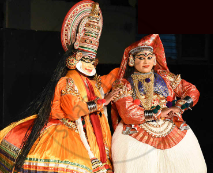
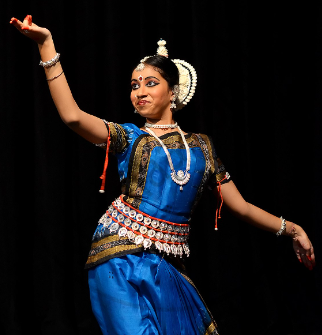
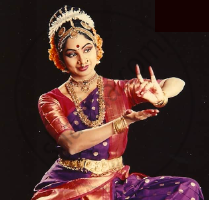
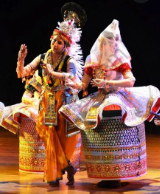
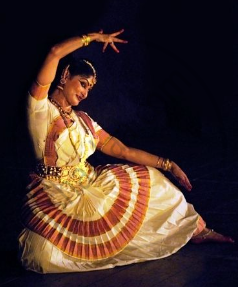
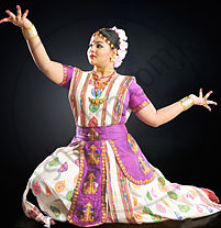
- A beautiful blend of all three forms of music, vocal, instrumental, and dance can be seen in various Indian classical dance forms like ‘Kathak of north India, ‘Odissi’ of Odisha, ‘Bharatnatyam’ of Tamilnadu, Kuchipudi of Andhra and ‘Kathakali’ and ‘Mohiniattam’ of Kerala.
Various classical dance forms in India:
1. Bharatanatyam:
|
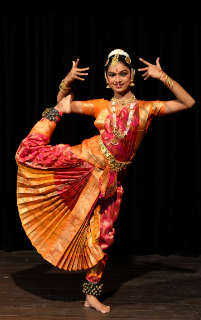 Bharatanatyam Bharatanatyam |
|
2. Kathak:
|
Kathak |
|
3. Kathakali:
|
Kathakali |
|
4. Odissi:
|
Odissi |
|
5. Kuchipudi:
|
Kuchipudi |
|
6. Manipuri
|
Manipuri |
|
7. Mohiniyattam:
|
Mohiniyattam |
|
8. Sattriya:
|
Sattriya |
Notes
Indian Traditions of Performing Arts:
- “Art is an expression of all characteristics of the human mind aesthetically”.
-
These qualities - The varied human emotions are referred to as "RAS." Ras literally translates to sweet juice in Hindi. It signifies the ultimate satisfaction of ‘aanand’. Human emotions can be categorized into nine sub-headings or ‘navras’. As follows:
1. Hasya - Laughter 2. Bhayanak - Evil Shringar 3. Rudra - chivalrous 4. Karun - pathos 5. Veer - courage 6. Adbhut - astonishing 7. Vibhatsa - terrifying glory 8. Shaanti - peace 9. Shringaar - decorating one’s self - Human emotion is reflected in art, and people use a variety of artistic mediums to spontaneously communicate their feeling.
- Thus, Art is created as a result of this fusion of intellectual and creative minds.
- Acting, singing, and dancing is examples of performing arts.
- The performing arts were a crucial part of mass education from the Vedic era through the Middle Ages with music and dance being introduced to gain popularity. For instance, Even the pitch and the accent of singing different hymns have been prescribed in the Vedic era.
- Presently, these art forms have become means of entertainment for people all over the world.
Importance of Performing Arts:
- It aids in the development of a person's overall personality.
- It fosters acceptance and love for all.
- It promotes cultural and traditional awareness among current and future generations.
- It makes a person self-assured and adaptable.
- Negative feelings vanish as the soul of music, dance and drama teach us all about loving and caring.
Notes
Indian Theatre:
- Theatre is a fantastic style of story-telling in which one or more actors use their talents for dancing, acting, singing, talking, miming, and theatre crafts like masks, make-up, and costumes to bring to life a fictional world for the audience.
- Theatrical productions are deeply rooted in the national culture and local identity of our nation.
A. Indian Classical Drama:
- Both indigenous tradition and contemporary research can be used to pinpoint the Vedas as the source of Indian theatre.
- Bharata wrote "Natyashastra" and the dramas "Asura Parajaya" and "Amrit Manthan". One of the most influential books on theatre and other performing arts is the Natyashastra.
- Bharata mentions conversations, themes, stage, music, dance, nat (male artists), nati (female artists), music instruments, and music. As a result, we might conclude that drama peaked during the Bharata era.
- The performers, the music, the stage, and the rasa are all mentioned in Patanjali's Mahabhasya from the second century B.C. during performances known as "Kamsavadha" and "Balibandha".
- During the age of the Buddha and Mahavira, drama was a means of communicating the principles of their respective religions.
Languages based examples of Indian Classical Drama:
1. Sanskrit Classical Drama:
- Sanskrit drama is defined by the works of dramatists such as Sudraka, Bhasa, Bhavbhuti, Harsha, and Kalidasa to name a few.
- The era of the great Bhasa, whose masterpiece was "Swapana Vasabdatta", a play based on the stories of Udayana, the Ramayana, and the Mahabharata. Bhasa was another celebrated dramatist who wrote thirteen plays.
- Kautilya's Arthashastra "Vatsyayan’s Kamasutra" mentions musicians, dancers, and dramatic shows.
- Kalidasa’s "Abhijnan Shakuntalam" was written in Sanskrit and was a significant play of those times.
2. Prakrit Classical Drama:
- Prakrit plays became popular by the tenth century AD.
- Vidyapati introduced Hindi and other regional languages in the form of songs. "Umapati Mishra" and "Sharada Tanaya" were also instrumental in promoting drama during the 14th Century AD.
B. Indian Folk Theatre:
- In India, folk theatre is a synthesis of elements from music, dance, pantomime, versification, epic and ballad recitation, graphic and plastic arts, religion, and festival peasantry.
- The folk theatre, which has its roots in native culture, is deeply ingrained in local identity and social values.
- Local dialect was used in folk theatre.
Example of Folk theatre in Maharashtra
1. Tamasha:
- Traditional folk theatre of Maharashtra.
- The female actress is the chief exponent of dance movements in the play.
- The show opens with a song in honour of Lord Ganesha, sometimes referred to as Gana. The presentation of Gavalan follows. The Vag is introduced in the second chapter of Tamasha.

Tamasha Performance
2. Dashavatar:
- Dashavatara is part of the folk theatre in Maharashtra with an eight-hundred-year history.
- The ten incarnations of Lord Vishnu, the Hindu god of preservation, are referred to as dashavatars. Matsya (a fish), Kurma (a tortoise), Varaha (a boar), Narasimha (a lion-man), Vaman (a dwarf), Parashuram, Ram, Krishna, Buddha, and Kalki are the 10 incarnations.
- Dashavatara shows are presented in the regions of Konkan and Goa after the harvesting season is over.
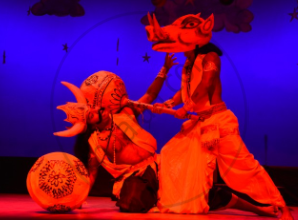
Dashavatara Theatre - Varaha Avatar
Notes
Present Scenario of the Performing Arts:
- In India, various music and dance festivals have been organized since independence in an effort to make them more accessible to the general public. Indians and foreigners alike attend these celebrations in large numbers. A well-known festival is "Savai Gandharva" in Pune.
- Recently, there has been a tendency to experiment and combine different musical genres in an effort to overcome the constraints imposed by a traditional style or school. Among these performers who invented a new style, Pandit Uday Shankar is a well-known name. He successfully combined European opera with Indian classical dance. He also included numerous folk dancing genres in his approach. As a result, it appears that the scope of Indian performing arts presentations is always growing. In the world of Indian visual arts, the same phenomena are evident.
Text
Do you know?
|
Kitab-e-Navras |
- A book titled "Kitab-e-Navras" was written in Dakhani Urdu by Ibrahim Adilshah II, the ruler of Bijapur.
- This text discusses classical music from India. It enables the listener to delight in outstanding poetry and includes verses performed in the Dhrupad style.
- Dr. Sayyad Yahya Nashit initially translated this work into Marathi. The editor of it is Dr. Arun Prabhune. The translation of the verse printed on the cover of this text reads as follows:
‘‘Oh, Mother Saraswati, you are the divine light in the world and you are complete with all qualities. If Ibrahim receives your grace (blessings), the poetry of the navras will become eternal.’’
Maharashtra State Board: Class 10
