Topics
Applied History
Working of the Constitution
Historiography : Development in the West
Geographical discoveries and colonization
- Concept for Geographical Discoveries and Colonization
Africa
- Imperialism - Africa
Asia: India, China, Japan
- Concept for Asia: India, China, Japan
Historiography : Indian Tradition
Working of the Indian Constitution
The Electoral Process
Dictatorships in Europe, Second World War and world
- Concept on Dictatorships in Europe
- Second World War (1939-1945 C.E.)
First world war
The League of Nations
Russian Revolution
- Concept for Russian Revolution
United Nations Organization
- Concept for United Nations Organization
Political Parties
Applied History
Africa
- Emancipation of Africa
Asia
- Emancipation of Asia
Social and Political Movements
History of Indian Arts
Globalization
- Globalization After World War II
Scientific and Technological Progress
- Scientific and Technological Progress After World War II
Cold war
- Formation of the Cold War
Challenges Faced by Indian Democracy
Mass Media and History
Social Diversity and Democracy
- Social Diversity
- Coccept for Caste/Race and Democracy
- Concept for Language and Democracy
- Cocnept for Religion and Democracy
- Concept for Gender and Democracy
- Concept for Democracy and Diversity
Challenges to Democracy Remedial Measures to the Challenges
- Concept for Challenges to Democracy Remedial Measures to the Challenges
Internal work
Democracy
- Democracy - Meaning, Types and Characteristics
Political Parties and Types
- Political Parties
- Importance of Political Parties
- Major National and Regional Parties in India/ Types of Political Parties
Entertainment and History
Sports and History
Tourism and History
Heritage Management
History - Imperialism
History - 20th Century Age of conflict
History - Emancipation of Asia and Africa
History - World after World War 2
Political Science
Notes
Historiography in the ancient Period:
It is a natural human trait to appreciate the past. Actually, the ancient Indians possessed a thorough knowledge of history. It is widely believed that the ancient Indians were unable to translate their notion of history into history in the modern sense. India didn't have a historian or a history that was worthy of its name, in contrast to ancient Greece, Rome, and China. They lacked historical awareness. But we cannot draw the conclusion that ancient India was deprived of history. In ancient India, history was passed down orally, and a large deal of historical literature was produced. True, the historical accounts of the ancient Indians did not follow the modern definition of history, which is a written study of the past.
Timeline of Ancient India:
The ancient history of India covers all continents inhabited by humans in the period 3000 BCE - 500 CE.
Sources of Indian Ancient Histography:
- The Harappan seals and other artefacts inscriptions attest to the fact that Indians had mastered writing by the third millennium B.C.E., and maybe earlier. The Harappan script hasn't been fully interpreted yet, though.
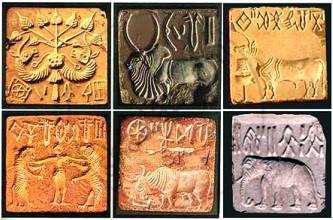
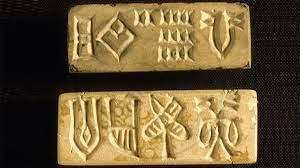
Harappan seals and other artefacts
- Inscriptions are the earliest types of historical writing that have been discovered in India. They are believed to date to the reign of Ashok Maurya in the third century B.C.E. His commands are carved into pillars of stone and in the natural rocks. Inscriptions first appear on coins, metal figures and sculptures, and copper plates starting in the first century C.E. They offer significant historical data.
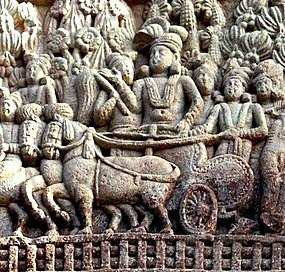
Ashoka on his chariot
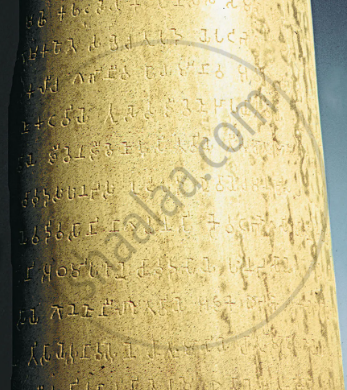
Ashokan Edicts
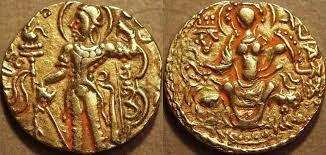
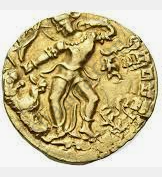
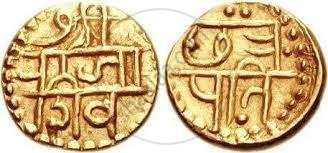
- From the 1st century C.E. inscriptions begin to occur on coins, metal images and sculptures, and also on copper plates. They provide important historical information. They depicted historical monarchs' birthdates, dynastic genealogy, the size and governance of many empires and kingdoms, significant political events, social structures, climatic conditions, famines, etc. that occurred during those periods.
|
Gold coins of Chandragupta II of the Gupta Empire, 400 CE |
Gold coin of the Gupta era, depicting a Gupta king holding a bow, 300 CE. |
Maratha Empire, Chhatrapati Shivaji, Gold hon, c. 1674-80 CE |
Written sources of ancient Indian Literature:
- Epics Ramayana and Mahabharata Puranas
- Jain and Buddhist writings
- Historical narratives written by Indian authors
- Travelogues were written by foreigners
Information from ancient written sources (Inscriptions):
- An important development in Indian history is the writing of dynastic histories and royal biographies.
- King Harsha's biography, ‘Harshacharit,’ was penned by Banabhatta in the seventh century C.E. The social, economic, political, religious, and cultural life throughout the reign of the king is accurately portrayed.
Text
Do you know?
|
Sohagaura Copper-plate |

At Sohagaura, the copper plate was discovered (District Gorakhpur, Uttar Pradesh). It is believed to date back to the Mauryan era. It has a Brahmi inscription on it. Punch-marked coins also have the "Tree-in-railing" and "Mountain" motifs that appear at the start of the inscription. Another sign, which resembles a building built on four pillars, is meant to represent a granary. The inscription records a royal directive directing the careful distribution of the grains kept in the granary. It is meant to suggest that safety measures were taken during a famine.
Key Points: Indian Historiography in the Ancient Period
- In ancient India, historical knowledge was preserved mainly through oral traditions such as stories of ancestors and mythological accounts.
- The Harappan civilisation shows early use of writing, but the Harappan script has not yet been deciphered.
- The earliest written historical records in India are the inscriptions of Emperor Ashoka from the 3rd century B.C.E.
- From the 1st century C.E., inscriptions on coins, sculptures, and copper plates provided valuable historical information.
- Writing of royal biographies, such as Harshacharit by Banabhatta, marked an important stage in Indian historiography.
