Advertisements
Online Mock Tests
Chapters
2: Chemical Bonding
3: Acids, Bases and Salts
4: Analytical Chemistry
5: Mole concept and Stoichiometry
6: Electrolysis
7: Metallurgy
8: Study of Compounds A. Hydrogen Chloride
9: Study of Compounds B. Ammonia
10: Study of Compounds C. Nitric Acid
11: Study of Compounds D. Sulphuric Acid
12: Organic Chemistry
▶ 13: Practical Work
![S.P. Singh solutions for कन्साइस केमिस्ट्री [अंग्रेजी] कक्षा १० आईसीएसई chapter 13 - Practical Work - Shaalaa.com](/images/concise-chemistry-english-class-10-icse_6:7b16b8cbeb0b4ebab074df2efa4502e0.jpg "S.P. Singh solutions for कन्साइस केमिस्ट्री [अंग्रेजी] कक्षा १० आईसीएसई chapter 13 - Practical Work")
Advertisements
Solutions for Chapter 13: Practical Work
Below listed, you can find solutions for Chapter 13 of CISCE S.P. Singh for कन्साइस केमिस्ट्री [अंग्रेजी] कक्षा १० आईसीएसई.
S.P. Singh solutions for कन्साइस केमिस्ट्री [अंग्रेजी] कक्षा १० आईसीएसई 13 Practical Work Intext Questions [Page 240]
- Give only one suitable chemical test to identify the following gases.
- Ammonia
- Sulphur dioxide
- Hydrogen chloride
- Chlorine
- Carbon dioxide
- Oxygen
- Hydrogen
- Select a basic gas mentioned in Q. (a). How is the basic nature suspected?
- Select acidic gases from the gases mentioned in Q. (a). How is the acidic nature suspected?
- The two gases A and B are bleaching agents. A is greenish-yellow and bleaches due to its oxidizing property while B is a colourless gas that bleaches due to reduction. Identify A and B?
- Which gas turn blue cobalt chloride paper light pink? Give one similarity in the test between
- Cl2 and HCl
- SO2 and CO2.
Name the gases which extinguishes burning wooden splinters.
Name the gases which turn moist red litmus blue.
Name the gases which do not affect moist litmus.
Name affects the acidified K2Cr2O7 paper and also turns lime water dirty milky.
Name two carbonates which do not produce carbon dioxide on heating.
Name a colourless gas which bleaches.
Name gases which has a sour taste.
Name a greenish-yellow gas which also bleaches.
Name gas with a rotten egg smell.
S.P. Singh solutions for कन्साइस केमिस्ट्री [अंग्रेजी] कक्षा १० आईसीएसई 13 Practical Work EXERCISE-13 [Pages 244 - 247]
MULTIPLE CHOICE TYPE: (Choose the correct answer from the options given below).
Carbon dioxide and sulphur dioxide gas can be distinguished by using ______.
moist blue litmus paper
lime water
acidified potassium dichromate paper
none of the above
The salt which in solution gives a pale green precipitate with sodium hydroxide solution and a white precipitate with barium chloride solution is ______.
Iron (III) sulphate
Iron (II) sulphate
Iron (II) chloride
Iron (III) chloride
A compound P is heated in a test tube with sodium hydroxide solution. A red litmus paper held at the mouth of the test tube turns blue.
Which of the following could compound P be?
Zinc sulphate
Copper sulphate
Ferrous sulphate
Ammonium sulphate
Aqueous lead (II) nitrate can be distinguished from aqueous zinc nitrate by adding any of the following solutions in excess, except:
aqueous potassium chloride aqueous sodium sulphate dilute sulphuric acid sodium hydroxide solution
aqueous sodium sulphate
dilute sulphuric acid
sodium hydroxide solution
A student takes Cu, Al, Fe and Zn strips, separately in four test tubes labeled as I, II, III and IV respectively. He adds 10 ml of freshly prepared ferrous sulphate solution to each test tube and observes the colour of the metal residue in each case.

He would observe a black residue in the test tubes:
(I) and (II)
(I) and (III)
(II) and (III)
(II) and (IV)
A nitrate, which forms a precipitate with ammonium hydroxide and is also soluble in excess of ______.
ferrous nitrate
ferric nitrate
lead nitrate
copper nitrate
Dilute sulphuric acid is added to sodium sulphite. The following observations are noticed:
P A gas with a suffocating smell is evolved which turns lime water milky.
Q A foul smelling gas is evolved which turns lead acetate solution black.
R A gas is evolved which decolourises pink KMnO.
Which of the following is true?
Only P
Only Q
Only R
Both P and R
A compound X consists of molecules. Which of the following properties will be shown by X?
P The boiling point of X is low.
Q The compound X is soluble in water.
R The aqueous solution of X does not conduct electricity.
Only P
Only Q
Only R
Both Pand R
The following questions are Assertion-Reason based questions. Choose the answer based on the options given below.
Assertion (A): HCI can be tested by AgNO3 solution.
Reason (R): White precipitate of AgCl is formed when AgNO3 is added to HCl.
- Both A and R are true and R is the correct explanation of A.
- Both A and R are true but R is not the correct explanation of A.
- A is true but R is false.
- A is false but R is true.
(1)
(2)
(3)
(4)
Assertion (A): SO2 and CO2 can be distinguished by lime water.
Reason (R): Both turn lime water milky.
- Both A and R are true and R is the correct explanation of A.
- Both A and R are true but R is not the correct explanation of A.
- A is true but R is false.
- A is false but R is true.
(1)
(2)
(3)
(4)
Assertion (A): On passing H2S through lead nitrate solution, a black precipitate is formed.
Reason (R): Lead nitrate reacts with H2S to form a black precipitate of PbS.
- Both A and R are true and R is the correct explanation of A.
- Both A and R are true but R is not the correct explanation of A.
- A is true but R is false.
- A is false but R is true.
(1)
(2)
(3)
(4)
Assertion (A): Chloride can be tested by adding concentrated sulphuric acid to it. A colourless gas with a pungent odour is evolved.
Reason (R): The gas formed is chlorine.
- Both A and R are true and R is the correct explanation of A.
- Both A and R are true but R is not the correct explanation of A.
- A is true but R is false.
- A is false but R is true.
(1)
(2)
(3)
(4)
Assertion (A): If barium nitrate solution is added to sodium sulphate solution, a white precipitate is formed.
Reason (R): Sodium sulphate solution is white in colour.
- Both A and R are true and R is the correct explanation of A.
- Both A and R are true but R is not the correct explanation of A.
- A is true but R is false.
- A is false but R is true.
(1)
(2)
(3)
(4)
VERY SHORT ANSWER TYPE:
Match the gases in column I to the identification of the gases mentioned in column II.
| Column I | Column II | ||
| (a) | Hydrogen sulphide | A. | Turns acidified potassium dichromate solution green |
| (b) | Nitric oxide | B. | Turns lime water milky |
| (c) | Carbon dioxide | C. | Turns reddish brown when it reacts with oxygen |
| (d) | Sulphur dioxide | D. | Turns moist lead acetate paper silvery black |
Identify the following substance:
An alkaline gas A which gives dense white fumes with hydrogen chloride.
Identify the following substance:
Gas C has an offensive smell like rotten eggs.
Identify the following substance:
Gas D is a colourless gas which can be used as a bleaching agent.
Name the gas which turns acidified potassium dichromate solution green.
Name a gas which turns moist lead acetate paper silvery black.
From the following list of substances choose those which meet the description given below.
Ammonium chloride, ammonium nitrate, chlorine, dilute hydrochloric acid, iron, lead nitrate, manganese (IV) oxide, silver nitrate, sodium nitrate, sodium nitrite, and sulphur.
Two compounds whose aqueous solutions give white precipitates with dilute hydrochloric acid.
Use the information given in (a) to (h) to identify the substances P to W selecting your answers from the given list.
| List | ||
| Calcium | Oxygen | Copper (II) Oxide |
| Carbon | Calcium hydroxide | Copper (II) Nitrate |
| Lead (II) Oxide | Hydrogen chloride | Chlorine |
| Lead (II) Nitrate | Calcium Oxide | Ammonium chloride |
- P is white solid. When heated produces white fumes (sublime).
- P and R on warming produce an alkaline gas.
- On adding water to T, heat is evolved and R is formed.
- Q burns brightly in the air to form T.
- When S is heated, it gives off brown fumes and leaves a black residue of U.
- A solution of S is formed by warming U with dilute nitric acid.
- V is a gaseous non-metallic element that reacts with hydrogen to form W.
- A solution of W will neutralize the solution of R.
Copy and complete the following table which refers to the action of heat on some carbonates:
| Carbonate | Colour of residue on cooling |
| Zinc Carbonate | |
| Lead carbonate | |
| Copper carbonate |
Sodium hydroxide solution is added first in a small quantity, then in excess to the aqueous salt solution of copper (II) sulphate, zinc nitrate, lead nitrate, calcium chloride and iron (III) sulphate. Copy of the following table and write the colour of the precipitate in (i) to (v) and the nature of the precipitate (soluble or insoluble) in (vi) to (x).
|
Aqueous salt solution |
Colour of the precipitate when NaOH is added in small quantity |
Nature of the(soluble or insoluble) when NaOH is added in excess |
|
copper (II) sulphate zinc nitrate lead nitrate calcium chloride Iron (III) sulphate |
(i) (ii) (iii) (iv) (v) |
(vi) (vii) (viii) (ix) (x) |
Mention the colour changes observed when the following indicators are added:
| Solution | Acids | Alkalies |
| (a) Alkaline phenolphthalein solution | ||
| (b) Methyl orange solution | ||
| (c) Neutral litmus solution |
Select the correct answer from A, B, C and D.
- Nitroso iron (II) sulphate
- Iron (III) chloride
- Chromium sulphate
- Lead (II) chloride.
- The compound which is responsible for the green colour formed when SO2 is bubbled through acidified potassium dichromate solution.
- Compound responsible for brown ring.
Choose from the list of substances:
Acetylene gas, aqua fortis, coke, brass, barium chloride, bronze, platinum.
An aqueous salt solution used for testing sulphate radical.
Identify:
The flame test with a salt P gave a brick red flame. What is the cation in P?
Identify:
pH of liquid R is 10. What kind of substance is R?
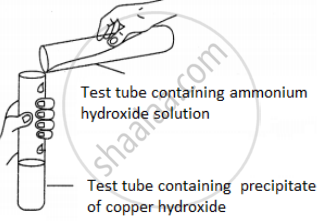
A student was asked to perform an experiment in the laboratory based on the instructions given:
Observe the picture given below and state one observation for the experiment you would notice on mixing the given solution.
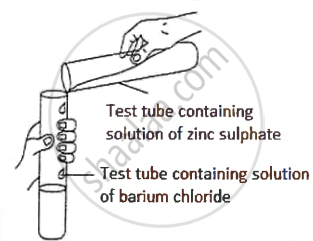
A student was asked to perform an experiment in the laboratory based on the instructions given:
Observe the picture given below and state one observation for the experiment you would notice on mixing the given solution.
SHORT ANSWER TYPE:
Name the anion present in the following compound:
Compound A, when warmed with concentrated sulphuric acid, gives a gas which fumes in moist air and which gives dense white fumes with ammonia.
Name the anion present in the following compound:
When a barium chloride solution is added to a solution of compound B, a white precipitate insoluble in dilute hydrochloric acid is formed.
Name the anion present in the following compound:
The action of heat on the insoluble compound C produces a gas which turns lime water turbid.
Name the anion [negative ion] present in the following compound:
Compound D when warmed with dilute H2SO4 gives a gas which turns acidified potassium dichromate solution green.
A given white crystalline salt was tested as follows:
It dissolved in water and the resulting solution of the salt turned blue litmus red. What conclusions can be drawn for the observation?
A given white crystalline salt was tested as follows:
The addition of barium chloride solution into this solution gave a white precipitate. What conclusions can be drawn for the observation?
A given white crystalline salt was tested as follows:
A flame test on the salt gave a persistent golden-yellow colourisation. What conclusions can be drawn for the observation?
Sodium hydroxide solution is added to solution A. A white precipitate is formed which is insoluble in excess sodium hydroxide solution. What is the metal ion present in solution A?
When ammonium hydroxide is added to solution В, a pale blue precipitate is formed. This pale blue precipitate dissolves in excess ammonium hydroxide giving an inky blue solution. Name the cation present in solution В.
The questions (i) to (v) refer to the following salt solutions listed A to F:
- Copper nitrate
- Iron (II) sulphate
- Iron (III) chloride
- Lead nitrate
- Magnesium sulphate
- Zinc chloride
- Which two solutions will give a white precipitate when treated with dilute hydrochloric acid followed by barium chloride solution?
- Which two solutions will give a white precipitate when treated with dilute nitric acid followed by silver nitrate solution ?
- Which solution will give a white precipitate, when either dilute hydrochloric acid or dilute sulphuric acid is added to it?
- Which solution becomes a deep/inky blue colour when excess of ammonium hydroxide is added to it ?
- Which solution gives a white precipitate with excess ammonium hydroxide solution?
Salts A, B, C, D and E undergo reactions (i) to (v) respectively. Identify the anion present in these salts on the basis of these reactions.
- When silver nitrate solution is added to a solution of A, a white precipitate, insoluble in dilute nitric acid, is formed.
- The addition of dilute hydrochloric acid to B produces a gas which turns lead acetate black on paper.
- When a freshly prepared solution of ferrous sulphate is added to a solution of C and concentrated sulphuric acid is gently poured from the side of the test tube, a brown ring is formed.
- When dilute sulphuric acid is added to D, a gas is produced which turns acidified potassium dichromate solution from orange to green.
- The addition of dilute hydrochloric acid to E produces effervescence. The gas produced turns lime water milky but does not affect acidified potassium dichromate solution.
State your observation when lead nitrate solution and sodium chloride solution are mixed.
State your observation when zinc chloride solution, zinc nitrate solution, and zinc sulphate solutions are added individually to barium chloride solution.
State your observations when zinc chloride solution, zinc nitrate solution, and zinc sulphate solutions are added individually to lead nitrate solution.
Write the observation for the following:
Decomposition of bicarbonates by dil. H2SO4.
\[\ce{2NaHCO3 + H2SO4 -> Na2SO4 + 2H2O + 2CO2}\]
Write the observation for the following:
Decomposition of bicarbonates by dil. H2SO4.
\[\ce{2KHCO3 + H2SO4 -> K2SO4 + 2H2O + 2CO2}\]
State your observations when zinc carbonate is heated strongly.
State your observation when a piece of moist blue litmus paper is introduced in a jar of chlorine.
State your observation for the following case:
Paper soaked in potassium permanganate solution is introduced into a gas jar of sulphur dioxide.
State your observation of the following case:
When moist starch iodide paper is introduced into chlorine gas.
Complete the following table and write your observations.
| Hydrogen sulphide | Ammonia | Sulphur dioxide | Hydrogen chloride | |
| Shake the gas with red litmus solution | ||||
| Shake the gas with blue litmus solution | ||||
| Apply a burning splint to the gas |
Identify the anion present in the following compound:
Compound X on heating with copper turnings and conc. sulphuric acid liberates a reddish brown gas.
Identify the anion present in the following compound:
When a solution of compound Y is treated with silver nitrate solution a white precipitate is obtained which is soluble in excess of ammonium hydroxide solution.
Identify the anion present in the following compound.
Compound Z which on reacting with dilute sulphuric acid liberates a gas that has no effect on acidified potassium dichromate but turns lime water milky.
Identify the anion present in the following compound:
Compound L on reacting with barium chloride solution gives a white precipitate insoluble in dilute hydrochloric acid or dilute nitric acid.
State giving reasons if zinc and aluminium can be distinguished by heating the metal powder with a concentrated sodium hydroxide solution.
State giving reasons if calcium nitrate and lead nitrate can be distinguished by adding ammonium hydroxide solution to the salt solution.
Identify the substance ‘R’ based on the information given below:
The pale green solid ‘R’ turns reddish brown on heating. Its aqueous solution gives a white precipitate with barium chloride solution. The precipitate is insoluble in mineral acids.
Write the equation for the following reaction:
Magnesium sulphate solution is mixed with barium chloride solution.
LONG ANSWER TYPE:
When an ammonium salt is warmed with sodium hydroxide solution, a gas is evolved. State three ways in which you could identify this gas.
Give a chemical test to distinguish between the following pair of compounds:
Sodium chloride solution and sodium nitrate solution.
Give a chemical test to distinguish between the following pair of compounds:
Hydrogen chloride gas and hydrogen sulphide gas
Give one test to distinguish between the following pair of chemicals.
Zinc nitrate solution and calcium nitrate solution
Give a chemical test to distinguish between the following pair of compounds:
Carbon dioxide gas and sulphur dioxide gas
Distinguish by a chemical test sodium carbonate and sodium sulphite.
State one chemical test between the following pair:
Ferrous nitrate and lead nitrate
State one chemical test between the following pair:
Manganese dioxide and copper (II) oxide
Distinguish between the given pair of compounds using the test given within brackets:
Sodium nitrate and sodium sulphite (using dilute sulphuric acid).
Distinguish by a chemical test sodium chloride and sodium sulphide.
Distinguish by a chemical test sodium hydroxide solution and ammonium hydroxide solution.
Distinguish by a chemical test, ammonium sulphate and sodium sulphate.
Distinguish by a chemical test, sulphuric acid from nitric acid and hydrochloric acid.
Distinguish by a chemical test, magnesium chloride and magnesium nitrate solutions.
Give one chemical test to distinguish between the following pair of compounds:
Zinc sulphate solution and Zinc chloride solution
Give one chemical test to distinguish between the following pair of compounds:
Iron (II) chloride solution and iron (III) chloride solution
Give one chemical test to distinguish between the following pair of compounds.
Calcium nitrate solution and calcium chloride solution.
Solutions for 13: Practical Work
S.P. Singh solutions for कन्साइस केमिस्ट्री [अंग्रेजी] कक्षा १० आईसीएसई chapter 13 - Practical Work
Shaalaa.com has the CISCE Mathematics कन्साइस केमिस्ट्री [अंग्रेजी] कक्षा १० आईसीएसई CISCE solutions in a manner that help students grasp basic concepts better and faster. The detailed, step-by-step solutions will help you understand the concepts better and clarify any confusion. S.P. Singh solutions for Mathematics कन्साइस केमिस्ट्री [अंग्रेजी] कक्षा १० आईसीएसई CISCE 13 (Practical Work) include all questions with answers and detailed explanations. This will clear students' doubts about questions and improve their application skills while preparing for board exams.
Further, we at Shaalaa.com provide such solutions so students can prepare for written exams. S.P. Singh textbook solutions can be a core help for self-study and provide excellent self-help guidance for students.
Concepts covered in कन्साइस केमिस्ट्री [अंग्रेजी] कक्षा १० आईसीएसई chapter 13 Practical Work are Basics of Acids, Bases, and Salts, Acids, Classification of Acids, Preparation of Acids, Properties of Acids > Physical Properties, Uses of Acids, Properties of Acids > Chemical Properties, Properties of Bases > Chemical Properties, Bases, Classification of Bases (Alkalis), Preparation of Bases, Properties of Bases > Physical Properties, Uses of Bases, Test for Acidity and Alkalinity, Importance of pH in Everyday Life, Chemical Analysis, Action of Sodium Hydroxide Solution on Certain Metallic Salt Solutions, Action of Ammonium Hydroxide on Certain Salt Solutions, Action of Alkalis on Certain Metals, Action of Alkalis on Metal Oxides, Colours of the Salts and Their Solutions.
Using S.P. Singh कन्साइस केमिस्ट्री [अंग्रेजी] कक्षा १० आईसीएसई solutions Practical Work exercise by students is an easy way to prepare for the exams, as they involve solutions arranged chapter-wise and also page-wise. The questions involved in S.P. Singh Solutions are essential questions that can be asked in the final exam. Maximum CISCE कन्साइस केमिस्ट्री [अंग्रेजी] कक्षा १० आईसीएसई students prefer S.P. Singh Textbook Solutions to score more in exams.
Get the free view of Chapter 13, Practical Work कन्साइस केमिस्ट्री [अंग्रेजी] कक्षा १० आईसीएसई additional questions for Mathematics कन्साइस केमिस्ट्री [अंग्रेजी] कक्षा १० आईसीएसई CISCE, and you can use Shaalaa.com to keep it handy for your exam preparation.
