Advertisements
Advertisements
प्रश्न
Give a chemical test to distinguish between the following pair of compounds:
Hydrogen chloride gas and hydrogen sulphide gas
Advertisements
उत्तर
When exposed to hydrogen sulphide gas, lead acetate paper that is moist turns black; when exposed to hydrogen chloride gas, it remains colourless.
संबंधित प्रश्न
State your observations when Dilute Hydrochloric acid is added to Sodium thiosulphate.
For the preparation of hydrochloric acid in the laboratory:
What arrangement is done to dissolve hydrogen chloride gas in water?
Write an equation for the reaction of aqueous hydrochloric acid on lead nitrate solution.
Give three distinct test [apart from using an indicator] you would carry out with solution of HCl to illustrate the typical properties of an acid.
MnO2, PbO2 and red lead react with conc. HCl acid to liberate Cl2.
What is the common property being shown by these metal oxides?
State the composition of aqua regia. State which component is the oxidizing agent in aqua regia.
Match the following:
| Column A | Column B |
| 1. A substance that turns moist starch iodide paper blue. | A. Ammonium sulphate |
| 2. A compound which release a reddish brown gas on reaction with concentrated sulphuric acid and copper turnings. | B. Lead carbonate |
| 3. A solution of this compound gives dirty green precipitate with sodium hydroxide. | C. Chlorine |
| 4. A compound which on heating with sodium hydroxide produces a gas which forms dense white fumes with hydrogen chloride. | D. Copper nitrate |
| 5. A white solid which gives a yellow residue on heating | E. Ferrous sulphate |
Write the balanced equation for the reaction of dilute hydrochloric acid with the following:
Magnesium sulphite
A solution of hydrogen chloride in water is prepared. The following substances are added to separate portions of the solution :
| S.NO. | Substances added | Gas evolved | Odour |
| 1. | Calcium carbonate | ______ | ______ |
| 2. | Magnesium ribbon | ______ | ______ |
| 3. | Manganese (IV) oxide with heating | ______ | ______ |
| 4. | Sodium sulphide | ______ | ______ |
Complete the table by writing the gas evolved in each case and its odour.
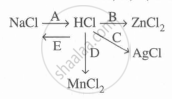
Study the flow chart and give balanced equations with conditions for the conversions A, B, C, D, and E.