Advertisements
Chapters
1: Earth as a Planet
2: Geographic Grid: Latitudes and Longitudes
3: Rotation and Revolution
UNIT 2 - Structure of the Earth
4: Earth’s Structure
5: Landforms of the Earth
6: Rocks
7: Volcanoes
8: Earthquakes
9: Weathering
10: Denudation
UNIT 3 - Hydrosphere
▶ 11: Hydrosphere
UNIT 4 - Atmosphere
12: Composition and Structure of the Atmosphere
13: Insolation
14: Atmospheric Pressure and Winds
15: Humidity
UNIT 5 - Pollution
16: Pollution
17: Sources of Pollution
18: Effects of Pollution
19: Preventive Measures
UNIT 6 - Natural Regions of the World
20: Natural Regions of the World
![Morning Star solutions for टोटल जियोग्राफी [अंग्रेजी] कक्षा ९ आईसीएसई chapter 11 - Hydrosphere - Shaalaa.com](/images/total-geography-english-class-9-icse_6:383837e303f247e39353ecf0a3404fb4.jpg "Morning Star solutions for टोटल जियोग्राफी [अंग्रेजी] कक्षा ९ आईसीएसई chapter 11 - Hydrosphere")
Advertisements
Solutions for Chapter 11: Hydrosphere
Below listed, you can find solutions for Chapter 11 of CISCE Morning Star for टोटल जियोग्राफी [अंग्रेजी] कक्षा ९ आईसीएसई.
Morning Star solutions for टोटल जियोग्राफी [अंग्रेजी] कक्षा ९ आईसीएसई 11 Hydrosphere EXERCISES [Pages 104 - 108]
Choose the correct option:
Hydrosphere refers to the combined mass of water
in the oceans
rivers, streams and lakes
in the atmosphere
All of the above
Water is not usually thought of as a solid, and only a small fraction of the Earth's water is in a solid state, in the form of ice. This ice includes all forms of frozen water, from the ice sheets at the North and South poles to icebergs, ice on the top of mountains, frozen lakes in the winter, or even the ice in a freezer. Though all the ice on earth is part of the hydrosphere, the frozen aspect is known as the cryosphere. This frozen water is three-fourths of the earth's freshwater, which makes it quite important. Identify other sources of fresh water.
rivers, lakes and streams
underground water
reservoirs and dams
All of the above
Underground water is found in ______.
soil
subsoil
underground streams
All of the above
Assertion (A): Waves are oscillatory movements on the surface of the sea.
Reason (R): Waves result from the action of wind on the surface of the sea.
Both A and Rare true and R is the correct explanation of A.
Both A and R are true but R does not explain A.
A is true but R is false.
A is false but R is true.
Name the rise and fall of sea water due to the gravitational forces of the sun and the moon:
Tides
Waves
Spheres
Oscillations
The difference in height between high tide and low tide is called ______.
Ebb
Tidal wave
Tidal range
Tidal crest
Apogee : Earth-moon distance ______ : : Perigee : Earth-moon distance ______
maximum, minimum
minimum, maximum
equal, equal
All of the above
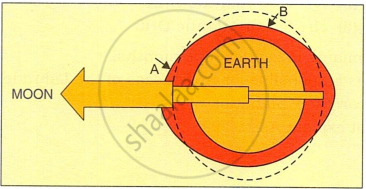
Study the diagram and identify A and B.
A: High tide B: Low tide
A: Low tide B: Low tide
A: Low tide B: High tide
A: High tide B: High tide
Assertion (A): Tidal range is not constant.
Reason (R): Tidal range varies due to the earth's rotation on its axis.
Both A and R are true and R is the correct explanation of A.
Both A and R are true but R does not explain A.
A is true but R is false.
A is false but R is true.
Which of the following statements are true?
- The alternate advance and retreat of seawater along a coast is called tide.
- When water advances to its fullest extent on to the shore it is called high tide.
- When water recedes to its fullest extent from the shore it is called low tide.
- Some freshwater rivers and lakes can have tides too.
(1) (2) (3) (4)
Only (1)
Only (2) and (3)
(1) (2) and (3)
______ flow from the lower latitudes towards the higher latitudes.
Warm currents
Cold currents
Surface currents
Deep water currents
Which amongst the following is NOT one of the causes of Ocean Currents?
Level of Salinity
Temperature
The Earth's Revolution
Planetary Winds
The water from the Atlantic ocean flows over the Mediterranean sea because ______.
the latter is more saline.
the latter is warmer.
of the direction of westerlies.
of the earth's rotation.
Name the winds that blow between the Equator and the Tropics.
Westerlies
Trade Winds
Monsoon Winds
Summer Winds
What is the direction of air circulation over the oceans in the middle latitudes?
Cyclonic
Hemispherical
Spherical
Anticyclonic
Assertion (A): Gulf stream flows in a clockwise direction.
Reason (R): In the Northern Hemisphere curren ts flow in a clockwise direction.
Both A and R are true and R is the correct explanation of A.
Both A and Rare true but R does not explain A.
A is true but R is false .
A is false but R is true.
Name the warm Atlantic Ocean Current which keeps the ports of Great Britain ice free even in winters.
The West Atlantic Drift
The East Atlantic Drift
The North Atlantic Drift
The South Atlantic Drift
Assertion (A): The Labrador Current remains frozen for nine months.
Reason (R): The cold Arctic Current is responsible for frozen seas of the Labrador Current.
Both A and R are true and R is the correct explanation of A.
Both A and Rare true but R does not explain A.
A is true but R is false.
A is false but R is true.
Identify the Warm Currents flowing in the Atlantic ocean.
Gulf Stream - North Atlantic Drift
Labrador Current - Irminger Current
Canaries Current - Cayenne Current
Alaska Current - California Current
The Gulf Stream Current is deflected towards the east as a result of the earth's rotation and the westerlies to become the ______.
Labrador Current
North Atlantic Drift
Sargasso Sea
Arctic Current
Assertion (A): The water which gets collected under the surface of the land, known as underground water, remains in soil, sub-soil or bedrock.
Reason (R): The water from precipitation, that is from rain or snow flows on the surface.
Both A and R are true and R is the correct explanation of A.
Both A and R are true but R does not explain A.
A is true but R is false.
A is false but R is true.
Assertion (A): On the seventh or eighth day of every fortnight a neap tide, which is lower in height than a low tide, occurs.
Reason (R): The tide producing forces of the sun and the moon work in opposite direction causing a low tide.
Both A and R are true and R is the correct explanation of A.
Both A and Rare true but R does not explain A.
A is true but R is false.
A is false but R is true.
Which current is also known as the ‘Black Stream’?
Atlantic current
Kuroshio current
Oyashio current
Newfoundland current
Name the current that keeps the hub of world trade, the Port of Montreal, open all year round.
Gulf Stream
Labrador current
Canaries current
Florida current
Which currents have created one of the world's richest fishing grounds?
Labrador current and Gulf stream
Labrador current and Irminger current
Oyashio current and Kuroshio current
Both (a) and (c)
Assertion (A): Warm currents flow from the low latitudes in Tropical Zones towards the high latitudes.
Reason (R): They bring warm water into cold water areas.
Both A and R are true and R is the correct explanation of A.
Both A and R are true but R does not explain A.
A is true but R is false.
A is false but R is true.
Assertion (A): The air circulation over the oceans in the middle latitudes is mainly anticyclonic.
Reason (R): The oceanic circulation pattern corresponds with the circulation of air.
Both A and R are true and R is the correct explanation of A.
Both A and Rare true but R does not explain A.
A is true but R is false.
A is false but R is true.
Currents influence which of the following?
temperature
rainfall
fish population
all of the above
Short Answer Questions
Name any two ways in which movement of ocean water takes place.
What are tides?
Name one factor that causes tides.
What is the time interval between tides? Name the factors responsible for this time interval.
What are Spring?
What are Neap tides?
Mona had gone to visit her friend's boat on the Visakhapatnam jetty. She was surprised to see that the boats seemed to have sunk because the water level in the jetty was low and the gangways to the boats were almost vertical. As a student of geography name and explain the phenomena that caused this.
Name two types of ocean currents based on their temperature. Give an example of each.
For what is the Gulf Stream famous?
What happens when warm and cold currents meet?
Tara had gone to Canada to visit her cousins staying in Newfoundland. Her cousins took her to the seaside where they encountered heavy fog. As a student of geography Tara explained the cause of the fog. What did Tara say? What is the main occupation of the people in that place?
Structured Questions
How are tides formed?
Differentiate between High Tides and Low Tides.
Give reasons for the following:
There are two high and two low tides in a day.
Give reasons for the following:
Each day a tide is delayed by 26 minutes.
Give reasons for the following:
The tidal range differs from one water body to the other.
Draw a well labelled diagram showing the formation of spring and neap tides.
Name two types of ocean currents based on their temperature. Give an example of each.
State any two factors responsible for causing the currents.
Give a reason for the following:
Warm currents produce a milder climate.
Give reasons for the following:
The eastern coasts of the USA are comparatively cold.
Give reasons for the following:
The coasts of Norway are not frozen in winter whereas its adjoining coasts are frozen for most parts of the year.
Describe one effect of the following ocean current.
Labrador Current of the Atlantic Ocean.
Describe one effect of the following ocean current.
The Kuroshio current
Describe one effect of the following ocean current.
Oyashio Current of the Pacific Ocean.
State the origin and flow of the Gulf Stream.
What is the effect of Gulf Stream on the coasts of North America?
What is the effect of Gulf Stream on the coasts of Western Europe?
Give reasons for the following:
The waters of the Oyashio Current form the richest fishing grounds in the world.
Give reasons for the following:
There is heavy rainfall in Queensland but the Atacama desert is arid.
Give reasons for the following:
Rich fishing grounds are located on the Pacific coast of North America.
Describe three major effects of currents.
Thinking Skills
You are watching the sea waves from the balcony of a seaside resort in Mumbai on a New Moon Day. Suddenly you noticed rise of sea water and its movement towards the coast. What was this wave and after how much time will it be repeated?
Imagine that the Ocean Currents stop flowing. What would be its consequences for the human beings?
Practical/Map Work
On an outline map of the world name and show the direction of one warm and one cold current each of the Pacific Ocean and the Atlantic Ocean.
Give a diagrammatic representation of the process of the rise and fall of tides.
Solutions for 11: Hydrosphere
Morning Star solutions for टोटल जियोग्राफी [अंग्रेजी] कक्षा ९ आईसीएसई chapter 11 - Hydrosphere
Shaalaa.com has the CISCE Mathematics टोटल जियोग्राफी [अंग्रेजी] कक्षा ९ आईसीएसई CISCE solutions in a manner that help students grasp basic concepts better and faster. The detailed, step-by-step solutions will help you understand the concepts better and clarify any confusion. Morning Star solutions for Mathematics टोटल जियोग्राफी [अंग्रेजी] कक्षा ९ आईसीएसई CISCE 11 (Hydrosphere) include all questions with answers and detailed explanations. This will clear students' doubts about questions and improve their application skills while preparing for board exams.
Further, we at Shaalaa.com provide such solutions so students can prepare for written exams. Morning Star textbook solutions can be a core help for self-study and provide excellent self-help guidance for students.
Concepts covered in टोटल जियोग्राफी [अंग्रेजी] कक्षा ९ आईसीएसई chapter 11 Hydrosphere are .
Using Morning Star टोटल जियोग्राफी [अंग्रेजी] कक्षा ९ आईसीएसई solutions Hydrosphere exercise by students is an easy way to prepare for the exams, as they involve solutions arranged chapter-wise and also page-wise. The questions involved in Morning Star Solutions are essential questions that can be asked in the final exam. Maximum CISCE टोटल जियोग्राफी [अंग्रेजी] कक्षा ९ आईसीएसई students prefer Morning Star Textbook Solutions to score more in exams.
Get the free view of Chapter 11, Hydrosphere टोटल जियोग्राफी [अंग्रेजी] कक्षा ९ आईसीएसई additional questions for Mathematics टोटल जियोग्राफी [अंग्रेजी] कक्षा ९ आईसीएसई CISCE, and you can use Shaalaa.com to keep it handy for your exam preparation.
