Advertisements
Chapters
1: Earth as a Planet
2: Geographic Grid: Latitudes and Longitudes
3: Rotation and Revolution
UNIT 2 - Structure of the Earth
▶ 4: Earth’s Structure
5: Landforms of the Earth
6: Rocks
7: Volcanoes
8: Earthquakes
9: Weathering
10: Denudation
UNIT 3 - Hydrosphere
11: Hydrosphere
UNIT 4 - Atmosphere
12: Composition and Structure of the Atmosphere
13: Insolation
14: Atmospheric Pressure and Winds
15: Humidity
UNIT 5 - Pollution
16: Pollution
17: Sources of Pollution
18: Effects of Pollution
19: Preventive Measures
UNIT 6 - Natural Regions of the World
20: Natural Regions of the World
![Morning Star solutions for टोटल जियोग्राफी [अंग्रेजी] कक्षा ९ आईसीएसई chapter 4 - Earth’s Structure - Shaalaa.com](/images/total-geography-english-class-9-icse_6:383837e303f247e39353ecf0a3404fb4.jpg "Morning Star solutions for टोटल जियोग्राफी [अंग्रेजी] कक्षा ९ आईसीएसई chapter 4 - Earth’s Structure")
Advertisements
Solutions for Chapter 4: Earth’s Structure
Below listed, you can find solutions for Chapter 4 of CISCE Morning Star for टोटल जियोग्राफी [अंग्रेजी] कक्षा ९ आईसीएसई.
Morning Star solutions for टोटल जियोग्राफी [अंग्रेजी] कक्षा ९ आईसीएसई 4 Earth’s Structure EXERCISES [Pages 42 - 44]
Choose the correct option:
The molten material thrown up by volcanoes rises to the surface of the earth from the ______.
Magnum chamber
Magma chamber
Magnum
Magma
Meteors are rocks from outer space. They hold special significance for scientists because ______.
they contain radioactive materials.
the earth is made of same materials.
they give an idea of other planets.
they pass through the atmosphere of earth.
The earth is made up of several concentric layers. The correct order of the layers from the centre to the surface is ______.
Crust - Mantle - Core
Core - Mantle - Crust
Mantle - Crust - Core
Mantle - Core - Crust
Name the two broad divisions the earth's crust is divided, depending on chemical composition.
Lithosphere, hydrosphere
SIAL, SIMA
Core, Mantle
Crust, Asthenosphere
Study the figure on the right and complete the analogy:

Continents : SIAL :: ______ : SIMA
Mountains tops
Ocean floor
Plains
Volcanoes
This is the densest part of the earth believed to be composed of iron and nickel which is responsible for earth's magnetism. Identify it.
Mantle
Core
Crust
None of the above
Assertion (A): Sial appears to float above Sima.
Reason (R): Sial has lower density than Sima.
Both A and R are true and R is the correct explanation of A.
Both A and R are true but R does not explain A.
A is true but R is false.
A is false but R is true.
Which of the following is the correct order as we move towards the interior of the earth.
SIAL - SIMA - NIFE
NIFE - SIMA - SIAL
NIFE - SIAL - SIMA
None of the above
Which of the following is incorrect about the inner core?
It is in a molten state.
It is a region of high density.
It is a region of high pressure.
It is composed of iron and nickel.
At the depth of around 100-410 km, mantle is partially molten and is known as ______.
Asthenosphere
Mantlenosphere
Moltenosphere
None of the above
What is the temperature variation in the mantle in °C?
1500 to 3700
1500 to 2500
1000 to 3700
1000 to 4000
Name the mantle-core interface where primary seismic waves slow down and secondary seismic waves disappear completely.
Gutenberg Discontinuity
Mantlic Discontinuity
Core Discontinuity
Mohorovicic Discontinuity
Name the boundary between the crust and the mantle which has characteristics of both layers.
Gutenberg Discontinuity
Crust Discontinuity
Mantlic Discontinuity
Mohorovicic Discontinuity
Assertion (A): The thickness of the lithosphere is very fragile compared to the nature and composition of the earth.
Reason (R): There are continuous changes in the earth's crust due to forces of nature.
Both A and R are true and R is the correct explanation of A.
Both A and R are true but R does not explain A.
A is true but R is false.
A is false but R is true.
What life sustaining unit contains only one percent of the earth's mass?
biosphere
lithosphere
crust
mantle
Mohorovicic discontinuity is found at about ______ beneath the oceans and ______ beneath the continents.
8 km, 32 km
36 km, 10 km
60 km, 6 km
40 km, 4 km
Extending upwards, the earth is enveloped by a blanket of gases. Name it.
Lithosphere
Hydrosphere
Atmosphere
Chamber
The diameter of the core is about ______ km.
5000
6000
7000
8000
Name the layer of the earth that is fragile as compared to the rest of the layers of the earth. Different theories suggest that this layer undergoes changes to give earth a new shape.
Mantle
Core
Crust
Asthenosphere
Short Answer Questions
In which part of the earth is NIFE found?
What is composed of NIFE?
What are the consequences of the pressure and temperature in the interior of the earth?
How do the meteorites helps scientists to know about the interior of the earth?
What is the composition of the Earth’s crust?
What is the lithosphere?
Name the three layers of the earth’s interior.
Name the boundaries of three layers of the earth's interior.
Describe the mantle.
State two characteristics of the mantle.
Where is asthenosphere found?
In which form does the asthenosphere exist?
What happens to the P and S waves at the Gutenberg Discontinuity?
Why is the earth’s interior in most part found in a solid state despite great heat and pressure?
Distinguish between Core and Crust.
Differentiate between SIAL and SIMA.
Distinguish between the Gutenberg Discontinuity and Mohorovicic Discontinuity.
Structured Questions
Describe the layers of the interior of the earth and their chemical composition.
There are two transitional zones between the two consecutive layers of the interior of the earth. Name them and state their chief characteristics.
Give a geographical reason for the following:
Temperature starts rising gradually towards the interior of the earth.
Give a geographical reason for the following:
The asthenosphere is in a semi-molten state.
Give a geographical reason for the following:
The inner core of the earth is in a solid state.
Look at the figure on the side and answer the question:
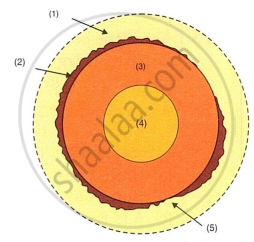
Label the parts: (1), (2), (3), (4) and (5).
Look at the figure on the side and answer the question:
Name the state (solid, liquid or gas) in which each part exists.
Look at the figure on the side and answer the question:
Which part of the earth is suitable for human habitation? Why?
State two chief characteristics of the earth’s crust.
Which layer is responsible for earth’s magnetic field? Why?
Give a geographical reason for the following:
NIFE is so called.
Give a geographical reason for the following:
The core of the earth is the most inaccessible part of the earth.
Give a geographical reason for the following:
The earth's crust undergoes many changes.
Draw neat diagram, label them and explain.
The interior of the earth
Thinking Skills
The earth's crust is only one percent of earth's mass yet it is a large reservoir of resources for mankind. Justify this statement with examples.
What would happen if the earth's core no longer remain hot and the magma cools and hardens inside the earth? Give reasons to support your answer.
Project/Practical Activity
Suppose you were given the responsibility to explore the interior of the earth. Draw a project report describing the steps you would take, your objectives and the estimation of the costs of the project, etc.
Solutions for 4: Earth’s Structure
Morning Star solutions for टोटल जियोग्राफी [अंग्रेजी] कक्षा ९ आईसीएसई chapter 4 - Earth’s Structure
Shaalaa.com has the CISCE Mathematics टोटल जियोग्राफी [अंग्रेजी] कक्षा ९ आईसीएसई CISCE solutions in a manner that help students grasp basic concepts better and faster. The detailed, step-by-step solutions will help you understand the concepts better and clarify any confusion. Morning Star solutions for Mathematics टोटल जियोग्राफी [अंग्रेजी] कक्षा ९ आईसीएसई CISCE 4 (Earth’s Structure) include all questions with answers and detailed explanations. This will clear students' doubts about questions and improve their application skills while preparing for board exams.
Further, we at Shaalaa.com provide such solutions so students can prepare for written exams. Morning Star textbook solutions can be a core help for self-study and provide excellent self-help guidance for students.
Concepts covered in टोटल जियोग्राफी [अंग्रेजी] कक्षा ९ आईसीएसई chapter 4 Earth’s Structure are .
Using Morning Star टोटल जियोग्राफी [अंग्रेजी] कक्षा ९ आईसीएसई solutions Earth’s Structure exercise by students is an easy way to prepare for the exams, as they involve solutions arranged chapter-wise and also page-wise. The questions involved in Morning Star Solutions are essential questions that can be asked in the final exam. Maximum CISCE टोटल जियोग्राफी [अंग्रेजी] कक्षा ९ आईसीएसई students prefer Morning Star Textbook Solutions to score more in exams.
Get the free view of Chapter 4, Earth’s Structure टोटल जियोग्राफी [अंग्रेजी] कक्षा ९ आईसीएसई additional questions for Mathematics टोटल जियोग्राफी [अंग्रेजी] कक्षा ९ आईसीएसई CISCE, and you can use Shaalaa.com to keep it handy for your exam preparation.
