Advertisements
Online Mock Tests
Chapters
2: Chemical Bonding
3: Acids, Bases and Salts
4: Analytical Chemistry
5: Mole Concept and Stoichiometry
6: Electrolysis
7: Metallurgy
8: Study of Compounds: Hydrogen Chloride
9: Study of Compounds: Ammonia
10: Study of Compounds: Nitric Acid
▶ 11: Study of Compounds: Sulphuric Acid
12: Organic Chemistry
13: Practical Work
![Lakhmir Singh solutions for केमिस्ट्री [अंग्रेजी] कक्षा १० आईसीएसई chapter 11 - Study of Compounds: Sulphuric Acid - Shaalaa.com](/images/chemistry-english-class-10-icse_6:b9d33ffc3c864725b49a398fa5334703.jpg "Lakhmir Singh solutions for केमिस्ट्री [अंग्रेजी] कक्षा १० आईसीएसई chapter 11 - Study of Compounds: Sulphuric Acid")
Advertisements
Solutions for Chapter 11: Study of Compounds: Sulphuric Acid
Below listed, you can find solutions for Chapter 11 of CISCE Lakhmir Singh for केमिस्ट्री [अंग्रेजी] कक्षा १० आईसीएसई.
Lakhmir Singh solutions for केमिस्ट्री [अंग्रेजी] कक्षा १० आईसीएसई 11 Study of Compounds: Sulphuric Acid Intext Question [Pages 213 - 219]
TEST YOUR UNDERSTANDING - 1
State whether the following statement is True or False.
The mixture of sulphur dioxide and air comes in contact with the catalysts in the contact tower.
State whether the following statement is True or False.
Vanadium pentoxide is more efficient than platinum.
State whether the following statement is True or False.
A temperature of 300 to 450°C gives the best yield in the contact process.
Fill in the following blanks with suitable words.
______ process is used to prepare sulphuric acid on a large scale.
SO3 + H2SO4 → ______
Sulphuric acid is called ______ of chemicals.
Choose the correct option for each of the following questions.
Excess of oxygen in the contact process leads to increased production of ______.
sulphur dioxide
sulphur trioxide
sulphur
Both sulphur dioxide and sulphur trioxide
Sulphuric acid can be obtained by adding water to ______.
sulphur
sulphur dioxide
sulphuryl chloride
All of these
Conditions favourable for the contact process are ______.
high temperature and high pressure
high temperature and low pressure
low temperature and high pressure
low temperature and low pressure
Give the preparation of sulphuric acid in the earlier times.
Draw the structure of the following:
H2SO4
Write the molecular formula of sulphuric acid.
How can sulphuric acid be prepared from sulphur?
What are the conditions required to carry out the contact process?
TEST YOUR UNDERSTANDING - 2
State whether the following statement is True or False.
Dilute acid cannot act has an oxidising agent.
State whether the following statement is True or False.
Carbohydrates such as glucose, sugar, and cellulose on reaction with conc. H2SO4 give a black spongy mass of carbon.
State whether the following statement is True or False.
Concentrated H2SO4 is used in making lead batteries.
Fill in the following blanks with suitable words.
Ionisation of sulphuric acid occurs in ______ steps.
Carbon obtained on adding conc. H2SO4 to cane sugar is called ______.
CH3COONa + H2SO4 → ______ + ______
Choose the correct option for each of the following questions.
Which of the following gas is evolved when concentrated H2SO4 reacts with metal carbonate?
Sulphur dioxide
Carbon dioxide
Hydrogen sulphide
Hydrogen chloride
Dilute H2SO4 is a/an ______.
strong electrolyte
weak electrolyte
oxidising agent
Both strong and weak electrolytes
Iron sulphide on reaction with dil. H2SO4 gives ______.
Sulphur dioxide
Carbon dioxide
Hydrogen sulphide
Hydrogen chloride
Comment on the conductivity of concentrated sulphuric acid.
What is the basicity of sulphuric acid. Give the equations involved?
What happens when concentrated sulphuric acid is added to carbonates?
Sulphuric acid is used in the preparation of insoluble sulphate salts. Explain.
Suggest a method to prepare pure carbon using sulphuric acid and an organic compound.
How is sulphuric acid useful in the extraction of metals?
DO IT RIGHT
As we know that sulphuric acid is usually regarded as the King of Chemicals. It has a variety of applications in different industries. In order to get a basic understanding of how much commercially significant sulphuric acid is, you are required to do online research and make a PowerPoint presentation discussing the following points:
- Top chemical companies in India and around the world that produce sulphuric acid.
- Major industrial sectors where sulphuric acid is consumed.
- The main products in our daily life, in the manufacture of which sulphuric acid acts as a key ingredient.
Lakhmir Singh solutions for केमिस्ट्री [अंग्रेजी] कक्षा १० आईसीएसई 11 Study of Compounds: Sulphuric Acid EXERCISE [Pages 221 - 225]
Objective Questions
True or False.
The catalyst is heated only once in the beginning of the contact process at the temperature of 450°C.
True or False.
Sulphuric acid is a colourless gas and has a pungent smell in the contact process.
True or False.
To remove the impurities, the mixture is passed through the converter.
True or False.
Concentrated H2SO4 removes even chemically combined water from compounds.
True or False.
Pure acid conducts electricity.
Fill in the Blanks
S + ______ → H2SO4 + NO2 + 2H2O
A pressure of ______ to ______ atm is maintained in the Contact process.
Pb(NO3)2 + H2SO4 → PbSO4 + ______
Thermal decomposition of conc. H2SO4 gives ______ oxygen.
Multiple Choice Questions
Production of sulphur trioxide is ______.
endothermic
exothermic
spontaneous
Both endothermic and spontaneous
Sulphur in the first step of Contact process can be produced by ______.
reactive metals
metallic oxides
metallic sulphides
green vitriol
The mixture that is diluted to obtain the sulphuric acid is ______.
oleum
Conc. H2SO4
sulphur trioxide
vanadium pentoxide
Initially sulphuric acid was obtained from ______.
Blue vitriol
Oil of vitriol
Green vitriol
Both Oil of vitriol and Green vitriol
Oleum is the common name of ______.
peroxodisulphuric acid
sulphurous acid
thiosulphuric acid
pyrosulphuric acid
Which of the following is not a property of conc. sulphuric acid?
oxidising
dehydrating
corrosive
bleaching
Which of the following can be used to identify sulphuric acid?
Barium chloride
Lead sulphate
Iron sulphide
Sodium bicarbonate
Concentrated sulphuric acid on reaction with copper evolves ______.
Hydrogen sulphide
Nitric acid
Carbon dioxide
Sulphur dioxide
Match the following.
| Column I | Column II |
| (p) Contact tower | (i) conc. H2SO4 |
| (q) Drying tower | (ii) oxygen |
| (r) Dilution tank | (iii) catalysts |
| (s) Blower | (iv) oleum |
(p) - (i), (q) - (iii), (r) - (ii), (s) - (iv)
(p) - (iv), (q) - (ii), (r) - (iii), (s) - (i)
(p) - (iii), (q) - (i), (r) - (iv), (s) - (ii)
(p) - (i), (q) - (ii), (r) - (iv), (s) - (iii)
Descriptive Questions Short Answer Questions
In what forms is sulphuric acid found naturally?
Name the catalyst used to manufacture H2SO4 by contact process.
Explain the oxidising behaviour of conc. sulphuric acid.
What is the action of conc. sulphuric acid on potassium chloride?
What is the action of conc. sulphuric acid on potassium nitrate?
Give two tests to identify sulphuric acid.
Discuss the dehydrating property of conc. sulphuric acid on sulphate salts.
Discuss the dehydrating property of conc. sulphuric acid on sugar.
Discuss the dehydrating property of conc. sulphuric acid on organic compounds.
Name the process used for the large scale manufacture of sulphuric acid.
Which property of sulphuric acid accounts for its use as a dehydrating agent ?
Concentrated sulphuric acid is both an oxidizing agent and a non-volatile acid. Write one equation. Each illustrates the above-mentioned properties of sulphuric acid.
Write the equation for the reaction:
Aluminium nitride and Water.
Write the equation for the following reaction:
Sulphur dioxide and water.
State one chemical test between the following pair:
Sodium carbonate and sodium sulphite
State one chemical test between the following pair:
Ferrous nitrate and lead nitrate
State one chemical test between the following pair:
Manganese dioxide and copper (II) oxide
Give one equation to show the following property of sulphuric acid:
Dehydrating property
Give one equation to show the following property of sulphuric acid:
Acidic nature
Give one equation to show the following property of sulphuric acid:
As a non-volatile acid
Give a balanced chemical equation for the action of sulphuric acid on the following:
Potassium hydrogen carbonate
Give a balanced chemical equation for the action of sulphuric acid on the following:
Sulphur
In the contact process for the manufacture of sulphuric acid give the equations for the conversion of sulphur trioxide to sulphuric acid.
A, B, C and D summarise the properties of sulphuric acid depending on whether it is dilute or concentrated.
A = Typical acid property
B = Non-Volatile acid
C = Oxidising agent
D = Dehydrating agent
Choose the property (A, B, C or D) depending on which is relevant to each of the following :
(i) Preparation of hydrogen chloride gas
(ii) Preparation of copper sulphate from copper oxide
(iii) Action of cone, sulphuric acid on sulphur
Write balanced chemical equations to show how SO3 is converted to Sulphuric acid in the contact process.
Write balanced chemical equation to show :
The oxidizing action of conc.sulphuric acid on carbon
Write balanced chemical equation to show :
The behavior of H2SO4 as an acid when it reacts with magnesium.
Write balanced chemical equation to show :
The dehydrating property of conc. sulphuric acid
Which property of sulphuric acid is shown by the reaction of the concentrated sulphuric acid with ethanol?
Which property of sulphuric acid is shown by the reaction of the concentrated sulphuric acid with carbon?
Write a balanced equation for the preparation of the following salts:
Copper sulphate from copper carbonate.
Write a balanced equation for the preparation of the following salt:
Zinc carbonate from zinc sulphate.
Name the acid used for the preparation of hydrogen chloride gas in the laboratory. Why is this particular acid preferred to other acids?
Write the balanced chemical equation for the laboratory preparation of hydrogen chloride gas.
Write a balanced chemical equation for each of the following reactions :
Action of dilute sulphuric acid on sodium hydroxide.
Write a balanced chemical equation for each of the following reactions :
Action of dilute sulphuric acid on zinc sulphide.
Distinguish between the following pairs of compounds using the reagent given in the bracket.
Mangenese dioxide and copper (II) oxide. (using concentrated HCl)
Distinguish between the following pairs of compounds using the reagent given in the bracket.
Ferrous sulphate solution and ferric sulphate solution. (Using sodium hydroxide solution)
Distinguish between the following pairs of compounds using the reagent given in the bracket.
Dilute hydrochloric acid and dilute sulphuric acid. (Using lead nitrate solution)
Complete the following equations :
S + conc.HNO3 →
Complete the following equations:
\[\ce{C + conc{.} H2SO4 ->}\]
Complete the following equation:
\[\ce{Cu + dil{.} HNO3 ->}\]
Long Answer Questions
What happens when conc. sulphuric acid is added to active metals? Explain using a suitable reaction.
What happens when conc. sulphuric acid is added to oxides? Explain using a suitable reaction.
What happens when conc. sulphuric acid is added to hydroxides? Explain using a suitable reaction.
What happens when conc. sulphuric acid is added to sulphides? Explain using a suitable reaction.
What happens when conc. sulphuric acid is added to Sulphite? Explain using a suitable reaction.
Discuss how sulphuric acid can be obtained by the contact process.
Give reason:
V2O5 is used instead of platinum as a catalyst in the contact process.
Give reason:
High pressure is favourable for the preparation of sulphuric acid in contact process.
Give reason:
Why water is not added to acid.
Give reason:
Why sulphuric acid can cause burns on skin.
Give any four uses of sulphuric acid.
Some properties of sulphuric acid are listed below. Choose the property A, B, C or D which is responsible for the reaction (a) to (e). Some properties may be repeated.
A. Acid
B. Dehydrating agent
C. Non-volatile acid
D. Oxidizing agent
(a) \[\ce{C12H22O11 + nH2SO4 -> 12C + 11H2O + nH2SO4}\]
(b) \[\ce{S + 2H2SO4 -> 3SO2 + 2H2O}\]
(c) \[\ce{NaCl + 2H2SO4 -> NaHSO4 + HCl}\]
(d) \[\ce{CuO + 2H2SO4 -> CuSO4 + H2O}\]
(e) \[\ce{Na2CO3 + H2SO4 -> Na2SO4 + H2O + CO2}\]
Write the balanced chemical equation for the following conversion:
Lead sulphate from lead nitrate solution and dilute sulphuric acid.
Write the balanced chemical equation for the following conversion:
Copper sulphate from copper and concentrated sulphuric acid.
Write a balanced equation for the following reaction:
Lead chloride from lead nitrate solution and sodium chloride solution.
Write the balanced chemical equation for the following conversion:
Ammonium sulphate from ammonia and dilute sulphuric acid.
Write a balanced equation for the following reaction:
Sodium chloride from sodium carbonate solution and dilute hydrochloric acid.
HCl, HNO3 and H2SO4 are formulae of three compounds. Which of these compounds has the highest boiling point and which has the lowest?
Dilute hydrochloric acid and dilute sulphuric acid are both colourless solutions. How will the addition of barium chloride solution to each help to distinguish between the two?
Copy and complete the following table relating to important industrial processes. Output refers to the product of the process, not the intermediate steps.
| Name of process | Inputs | Catalyst | Equation for catalytic reaction | Output |
| Haber process | Hydrogen + ______ | |||
| Ammonia + Air | Nitric acid | |||
| Contact process | Sulphur dioxide + oxygen |
What is the property of concentrated sulphuric acid (H2SO4) which allows it to be used in the preparation of hydrogen chloride (HCl) and nitric acid (HNO3)?
What property of hydrogen chloride is demonstrated when it is collected by downward delivery (upward displacement) ?
Why is hydrogen chloride not collected over water?
What is the property of nitric acid which allows it to react with copper?
What property of conc. H2SO4 is used in the action when sugar turns black in its presence?
Write the equation for the reaction of dilute nitric acid with copper.
Write the equation for the following reaction:
Dilute sulphuric acid and barium chloride.
Write a balanced chemical equation.
Sodium thiosulphate is reacted with dilute hydrochloric acid.
Write the equation for the reaction between hydrochloric acid of the following:
Lead nitrate solution
Write the equation for the following reaction:
Dilute sulphuric acid and sodium sulphide.
Write the equation of the following reaction:
Sulphur is heated with concentrated sulphuric acid.
Write the equation for the following reaction :
Zinc oxide is treated with sodium hydroxide solution.
Give the equation for the reaction:
Ammonium chloride is heated with sodium hydroxide.
Write the equation of the following reaction :
Concentrated sulphuric acid is poured over sugar
Write the equation for the following reaction:
Magnesium sulphate solution is mixed with barium chloride solution.
Give the equation for the preparation of the following salt from the starting material given.
Copper sulphate from copper (II) oxide
Give the equation for the preparation of the following salt from the starting material given.
Iron (III) Chloride from Iron
Give the equation for the preparation of the following salt from the starting material given.
Potassium sulphate from potassium hydroxide solution
Give the equation for the preparation of the following salt from the starting material given.
Lead chloride from lead carbonate (two equations)
Give equations for the following conversions A to E.
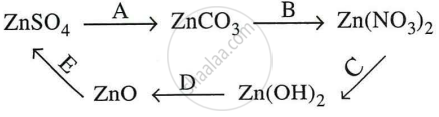
Give the balanced equation for dilute nitric acid and copper carbonate.
Give a balanced equation for the reaction:
Conc. hydrochloric acid and potassium permanganate solution.
Give a balanced equation for the reaction:
Silver nitrate solution and sodium chloride solution.
Give a balanced equation for the reaction:
Zinc sulphide and dilute sulphuric acid.
With the help of equations, give an outline for the manufacture of sulphuric acid by the contact process.
What property of sulphuric acid is shown by the reaction of concentrated sulphuric acid when heated with potassium nitrate?
Which property of sulphuric acid is shown by the reaction of the concentrated sulphuric acid with carbon?
Some properties of sulphuric acid are listed below. Choose the role played by sulphuric acid as A, B, C or D which is responsible for the reactions (i) to (v). Some role/s may be repeated.
- Dilute acid
- Dehydrating agent
- Non-volatile acid
- Oxidising agent
- \[\ce{CuSO4 * 5H2O ->[conc. H2SO4] CuSO4 + 5H2O}\]
- \[\ce{S + 2H2SO4 [conc.] -> 3SO2 + 2H2O}\]
- \[\ce{NaNO3 + \underset{[conc.]}{H2SO4} ->[<200^\circ C] NaHSO4 + HNO3}\]
- \[\ce{MgO + H2SO4 -> MgSO4 + H2O}\]
- \[\ce{Zn + 2H2SO4 [conc.] -> ZnSO4 + SO2 + 2H2O}\]
Choosing only substances from the list given in the box below, write equations for the reactions which you would use in the laboratory to obtain: Sodium sulphate
| Dilute sulphuric acid | Copper | Copper carbonate |
| Iron | Sodium carbonate | |
| Sodium | ||
| Zinc |
Choosing the substances from the list given below, write balanced chemical equations for the reactions which would be used in the laboratory to obtain the following salts:
| Dilute sulphuric acid | Copper | Copper (II) carbonate |
| Iron | Sodium carbonate | |
| Sodium | Sodium chloride | |
| Zinc nitrate |
Zinc carbonate
Choosing only substances from the list given in the box below, write equations for the reactions which you would use in the laboratory to obtain: Copper sulphate.
| Dilute sulphuric acid | Copper | Copper carbonate |
| Iron | Sodium carbonate | |
| Sodium | ||
| Zinc |
Choosing only substances from the list given in the box below, write equations for the reactions which you would use in the laboratory to obtain: lron(II) sulphate
| Dilute sulphuric acid | Copper | Copper carbonate |
| Iron | Sodium carbonate | |
| Sodium | ||
| Zinc |
Identify the following substance which is underlined:
An alkaline gas which produces dense white fumes when reacted with hydrogen chloride gas.
Identify the following substance which is underlined:
An acid which is present in vinegar.
Identify:
A gas which does not conduct electricity in the liquid state but conducts electricity when dissolved in water.
Identify the substance underlined:
A dilute mineral acid which forms a white precipitate when treated with barium chloride solution.
Identify the following substance which is underlined:
The element which has the highest ionisation potential.
Copy and complete the following table which refers to the industrial method for the preparation of ammonia and sulphuric acid:
| Name of the compoun | Name of the process | Catalytic equation (with the catalyst) |
| Ammonia | (i)__________ | (ii) __________ |
| Sulhuric acid | (iii) ___________ | (iv) __________ |
Hydrogen chloride gas is prepared in the laboratory by the action of concentrated sulphuric acid on sodium chloride.
Give a balanced chemical equation for the above reaction.
Hydrogen chloride gas is prepared in the laboratory using concentrated sulphuric acid and sodium chloride. Answer the question that follow based on this reaction.
Why is concentrated sulphuric acid used instead of concentrated nitric acid?
Hydrogen chloride gas is prepared in the laboratory using concentrated sulphuric acid and sodium chloride. Answer the question that follow based on this reaction.
How is the gas collected?
Hydrogen chloride gas is prepared in the laboratory using concentrated sulphuric acid and sodium chloride. Answer the question that follow based on this reaction.
Name the drying agent not used for drying the gas.
Solutions for 11: Study of Compounds: Sulphuric Acid
Lakhmir Singh solutions for केमिस्ट्री [अंग्रेजी] कक्षा १० आईसीएसई chapter 11 - Study of Compounds: Sulphuric Acid
Shaalaa.com has the CISCE Mathematics केमिस्ट्री [अंग्रेजी] कक्षा १० आईसीएसई CISCE solutions in a manner that help students grasp basic concepts better and faster. The detailed, step-by-step solutions will help you understand the concepts better and clarify any confusion. Lakhmir Singh solutions for Mathematics केमिस्ट्री [अंग्रेजी] कक्षा १० आईसीएसई CISCE 11 (Study of Compounds: Sulphuric Acid) include all questions with answers and detailed explanations. This will clear students' doubts about questions and improve their application skills while preparing for board exams.
Further, we at Shaalaa.com provide such solutions so students can prepare for written exams. Lakhmir Singh textbook solutions can be a core help for self-study and provide excellent self-help guidance for students.
Concepts covered in केमिस्ट्री [अंग्रेजी] कक्षा १० आईसीएसई chapter 11 Study of Compounds: Sulphuric Acid are .
Using Lakhmir Singh केमिस्ट्री [अंग्रेजी] कक्षा १० आईसीएसई solutions Study of Compounds: Sulphuric Acid exercise by students is an easy way to prepare for the exams, as they involve solutions arranged chapter-wise and also page-wise. The questions involved in Lakhmir Singh Solutions are essential questions that can be asked in the final exam. Maximum CISCE केमिस्ट्री [अंग्रेजी] कक्षा १० आईसीएसई students prefer Lakhmir Singh Textbook Solutions to score more in exams.
Get the free view of Chapter 11, Study of Compounds: Sulphuric Acid केमिस्ट्री [अंग्रेजी] कक्षा १० आईसीएसई additional questions for Mathematics केमिस्ट्री [अंग्रेजी] कक्षा १० आईसीएसई CISCE, and you can use Shaalaa.com to keep it handy for your exam preparation.
