Advertisements
Chapters
1.1: Where the mind is without fear
1.2: The Thief’s Story
1.3: On Wings of Courage
1.4: All the World’s a Stage
1.5: Joan of Arc
1.6: The Alchemy of Nature
Unit Two
2.1: Animals
▶ 2.2: Three Questions
2.3: Connecting the Dots
2.4: The Pulley
2.5: Let’s March
2.6: Science and Spirituality
Unit Three
3.1: Night of the Scorpion
3.2: The Night I Met Einstein
3.3: Stephen Hawking
3.4: The Will to Win
3.5: Unbeatable Super Mom-Mary Kom
3.6: The Concert
Unit Four
4.1: A Thing of Beauty is a Joy For Ever
4.2: The Luncheon
4.3: World Heritage
4.4: The Height of the Ridiculous
4.5: The Old Man and The Sea: Book Review
4.6: The Gift of the Magi
![Balbharati solutions for इंग्लिश कुमारभारती [अंग्रेजी] कक्षा १० महाराष्ट्र राज्य बोर्ड chapter 2.2 - Three Questions - Shaalaa.com](/images/english-kumarbharati-english-standard-10-maharashtra-state-board_6:43b420453f1a47c196e03d236e44f081.JPG "Balbharati solutions for इंग्लिश कुमारभारती [अंग्रेजी] कक्षा १० महाराष्ट्र राज्य बोर्ड chapter 2.2 - Three Questions")
Advertisements
Solutions for Chapter 2.2: Three Questions
Below listed, you can find solutions for Chapter 2.2 of Maharashtra State Board Balbharati for इंग्लिश कुमारभारती [अंग्रेजी] कक्षा १० महाराष्ट्र राज्य बोर्ड.
Balbharati solutions for इंग्लिश कुमारभारती [अंग्रेजी] कक्षा १० महाराष्ट्र राज्य बोर्ड 2.2 Three Questions Warming Up! [Pages 50 - 51]
Expressions in English classified under different heads.
Pair up with your partner, guess and match the columns. (Use a dictionary.)
| A | B | ||
| (1) | Principle | (a) | a generally accepted, evident, truth |
| (2) | Quotation | (b) | short striking messages for the public |
| (3) | Moral | (c) | a short witty remark stating truth |
| (4) | Idioms | (d) | a popular, well-known truth |
| (5) | Slogans | (e) | established expressions which do not convey exactly the same as individual words |
| (6) | One-liners | (f) | words cited from a speech/text of a famous person |
| (7) | Maxims | (g) | a lesson derived from a story or experience |
| (8) | Proverb | (h) | a rule to govern one’s behaviour |
Read the polite request/suggestion and complete the gaps in the responses. Make sure they are polite and not repeated.
| Could you lend me your dictionary? | Accept (1) .................. Refuse (2) .................. |
Read the polite request/suggestion and complete the gaps in the responses. Make sure they are polite and not repeated.
| Can you please pass the salad? | Accept (1) ................ Accept (2) ................ |
Read the polite request/suggestion and complete the gaps in the responses. Make sure they are polite and not repeated.
| May I know the exact time? | Accept (1) .............. Refuse (2) .............. |
Read the polite request/suggestion and complete the gaps in the responses. Make sure they are polite and not repeated.
| Shall we plan a class-picnic? | Agree (1) ................ Refuse (2) ................ |
Read the polite request/suggestion and complete the gaps in the responses. Make sure they are polite and not repeated.
| Do you need help? | Accept (1) ................. Refuse (2) ................. |
Read the polite request/suggestion and complete the gaps in the responses. Make sure they are polite and not repeated.
| Is it alright if I use your laptop? | Accept (1) ............... Refuse (2) ............... |
Let’s see if you remember a nursery rhyme you must have sung, as a kid:
Fill in the missing words:
‘The time to be happy is ______
The ______ to be happy is here.
And the way to be ______, is to ______ someone
happy And have a little ______ right here!’
(happy, make, heaven, now, place)
(You can listen to this song on the internet.)
Balbharati solutions for इंग्लिश कुमारभारती [अंग्रेजी] कक्षा १० महाराष्ट्र राज्य बोर्ड 2.2 Three Questions English Workshop [Pages 55 - 60]
Read the story and answer whether the following statement is true or false.
The people convinced the King to make a proclamation.
Read the story and answer whether the following statement is true or false.
The hermit spoke usually to everyone.
Read the story and answer whether the following statement is true or false.
The King received all answers from the hermit.
Read the story and answer whether the following statement is true or false.
The person the King saved and helped was his enemy.
Read the story and answer whether the following statement is true or false.
To do good to people is the purpose of our life.
Match the titles with the contents of the proper paragraph.
| 1 | Once a certain king... important to do. |
a | King gains a friend. |
| 2 | Many learned people... time for everything. |
b | The wounded stranger. |
| 3 | Equally varied... gave the reward to none. |
c | King helps the hermit. |
| 4 | When the King arrived,... my first attention. |
d | The stranger begs for pardon. |
| 5 | The hermit listened... continued to dig. |
e | The hermit points out answers. |
| 6 | The King turned round... gave it to him. |
f | Stranger’s vicious intention. |
| 7 | Meanwhile the sun... said the King. |
g | Questions remain unanswered. |
| 8 | “You do not know... all my life. |
h | The king receives various answers. |
| 9 | The King was very glad... the day before. |
i | King’s announcement. |
| 10 | “Do you not see?”... sent into this life!” |
j | The King meets the hermit. |
The character traits of the king and hermit are mixed up. Sort them out in the right box.
| feeble | helpful | enlightened |
| impatient | eager to succeed | wise |
| patient | convincing |
| KING | HERMIT |
Complete the Tree diagram associated with the happening in the story.
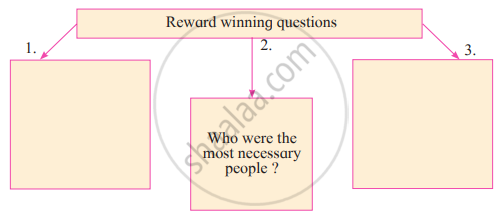
Complete the Tree diagram associated with the happening in the story.
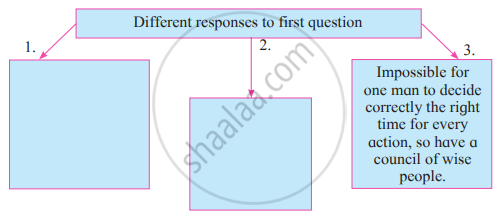
Complete the Tree diagram associated with the happening in the story.
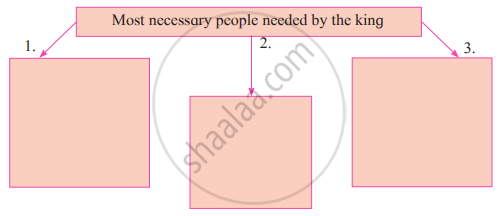
Complete the Tree diagram associated with the happenings in the story.
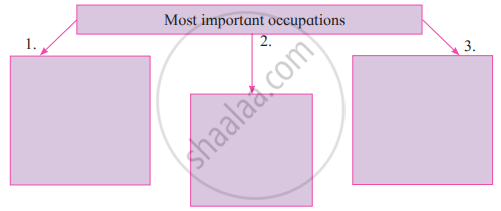
Write down in your notebook two points for the following.
How do you know the learned advisers who came to the court confused the king?
Write down in your notebook two points for the following.
How do you know the king was humble?
Write down in your notebook two points for the following.
How do you know the king’s enemy was repentant?
Write down in your notebook two points for the following.
How do you know the hermit was truly wise?
Choose the correct answer and fill in the blanks.
“Varied” (Paragraph-3) means ______.
different
unnecessary
unequal
unimportant
Many learned people came to the court and gave ______.
The same answers
correct answers
different answers
wrong answers
The synonym of ‘convinced’ is ______.
persuaded
happy
unhappy
angry
The King wanted to know the ______ time to begin everything.
right
exact
proper
good
‘‘I pray you to answer my question.’’ Here, ‘pray’ means ______.
plead to God
request
order
suggest
Choose an adverb that collocates with “breathed ______.
hurriedly
heavily
hardly
calmly
Answer the following questions.
The learned people were sometimes divided in their opinions, different persons giving quite different answers; at other times, none of them gave an answer. They all suggested ways to look for an answer. Point out one example of each.
Though the hermit did not say anything to the king for some time, he did not ignore the king or treat him rudely in any way. Do you agree? What evidence of his politeness can you point out? What shows that he listened and responded to the king’s words?
The hermit ‘spoke only to common people’; so the king ‘put on simple clothes’. Do you think the king hoped to be mistaken for a common man, or was he just showing that he was a humble person? What shows that the hermit knew him to be the king?
Did the king behave as an ordinary person, rather than as a ruler, at the hermit’s hut? What shows it? Did he also act as a good, kind person? When did he do so?
Do you think the hermit knew, beforehand, not only about the king’s arrival but about the ambush by his enemy? Think a little about this and say what you really feel.
Consider this list of the different things that happened and rearrange them in the order of time, that is, what happened first, what happened next, and so on. Read the related paragraph again if you are uncertain.
- The bearded man resolved to kill the king.
- The king went alone to see the hermit.
- The king executed the bearded man’s brother.
- The king spent the night at the hermit’s hut.
- The bearded man laid an ambush to kill the king.
- The king’s bodyguards recognised and wounded the bearded man.
- The bearded man came out of the ambush.
Read the story in your own language, summarize the following aspect of the story in 4 to 5 lines in your own language. Write it in your notebook.
King’s problem
Read the story in your own language, summarize the following aspect of the story in 4 to 5 lines in your own language. Write it in your notebook.
Attempts made to find a solution
Read the story in your own language, summarize the following aspect of the story in 4 to 5 lines in your own language. Write it in your notebook.
Climax
Read the story in your own language, summarize the following aspect of the story in 4 to 5 lines in your own language. Write it in your notebook.
Solution
Read the story in your own language, summarize the following aspect of the story in 4 to 5 lines in your own language. Write it in your notebook.
Message
The following compound word from the story are spelt in a jumbled order. Rearrange the letters to make the word meaningful.
a r e e t u k d n
The following compound words from the story are spelled in a jumbled order. Rearrange the letters to make them meaningful.
y o n n a e
The following compound words from the story are spelled in a jumbled order. Rearrange the letters to make them meaningful.
s t a p s i e m
The following compound words from the story are spelled in a jumbled order. Rearrange the letters to make them meaningful.
d u b g y r o a d
The following compound words from the story are spelled in a jumbled order. Rearrange the letters to make them meaningful.
f r a w e r a
The following compound words from the story are spelled in a jumbled order. Rearrange the letters to make them meaningful.
h e e d a r f o n b
The following compound words from the story are spelled in a jumbled order. Rearrange the letters to make them meaningful.
h e i l n e w a m
The following compound words from the story are spelled in a jumbled order. Rearrange the letters to make them meaningful.
n e v h i g r e t y
From the story, find the collocation of the following.
............ important.
From the story, find the collocation of the following.
............. intently
From the story, find the collocation of the following.
frail and .........
From the story, find the collocation of the following.
widely ..........
From the story, find the collocation of the following.
.......... time
From the story, find the collocation of the following.
......... blood
From the story, find the collocation of the following.
simple ..........
From the story, find the collocation of the following.
......... closed
From the story, find the collocation of the following.
.......... asleep
From the story, find the collocation of the following.
.......... peace.
Say whether the Verbs underlined in the sentence are finite (limited by the number or person of the subject) or non-finite (not governed by the subject, number or person).
He decides to go to a hermit.
Say whether the Verbs underlined in the sentence are finite (limited by the number or person of the subject) or non-finite (not governed by the subject, number or person).
I have come to you, wise hermit.
Say whether the Verbs underlined in the sentence are finite (limited by the number or person of the subject) or non-finite (not governed by the subject, number or person).
He gave the reward to none.
Say whether the Verbs underlined in the sentence are finite (limited by the number or person of the subject) or non-finite (not governed by the subject, number or person).
The hermit was digging the ground.
Say whether the Verbs underlined in the sentence are finite (limited by the number or person of the subject) or non-finite (not governed by the subject, number or person).
I pray for you to answer my questions.
Say whether the Verbs underlined in the sentence are finite (limited by the number or person of the subject) or non-finite (not governed by the subject, number or person).
“Forgive me.”
Say whether the Verbs underlined in the sentence are finite (limited by the number or person of the subject) or non-finite (not governed by the subject, number or person).
The sun began to sink.
Narrate an experience of your own that has helped you to realise that ‘Patience is bitter, but its fruit is sweet.’ Write it in your notebook, in about 20 lines.
After reading this story, develop a dialogue with 2 of your classmates about the characters in the story. Besides the tactful introduction to the conversation and write 8 to 10 sets of dialogues.
From the library or Internet, read the story ‘How much land does a man need?’ by Leo Tolstoy and write a review of the same, covering the following points.
- Background of the story
- Characters
- Plot/Theme
- Climax
- Message/Moral
Solutions for 2.2: Three Questions
Balbharati solutions for इंग्लिश कुमारभारती [अंग्रेजी] कक्षा १० महाराष्ट्र राज्य बोर्ड chapter 2.2 - Three Questions
Shaalaa.com has the Maharashtra State Board Mathematics इंग्लिश कुमारभारती [अंग्रेजी] कक्षा १० महाराष्ट्र राज्य बोर्ड Maharashtra State Board solutions in a manner that help students grasp basic concepts better and faster. The detailed, step-by-step solutions will help you understand the concepts better and clarify any confusion. Balbharati solutions for Mathematics इंग्लिश कुमारभारती [अंग्रेजी] कक्षा १० महाराष्ट्र राज्य बोर्ड Maharashtra State Board 2.2 (Three Questions) include all questions with answers and detailed explanations. This will clear students' doubts about questions and improve their application skills while preparing for board exams.
Further, we at Shaalaa.com provide such solutions so students can prepare for written exams. Balbharati textbook solutions can be a core help for self-study and provide excellent self-help guidance for students.
Concepts covered in इंग्लिश कुमारभारती [अंग्रेजी] कक्षा १० महाराष्ट्र राज्य बोर्ड chapter 2.2 Three Questions are Grammar, The Alphabet, Parts of Speech, Noun, Pronoun, Root Word, Prefix-suffix, Compound Words, Word Building, Punctuation, Speech, Pronunciation, Figures of Speech, Idioms and Phrases, Syllables, Tense, English Translation, Rhyme Scheme, Modal Auxiliary, Use ‘Not Only but Also’, Use ‘As Soon As’, ‘either ... or’ and ‘No Sooner ... Than’, Rhyming Words, Wh-questions, Add a Question Tag, Change the Voice, Make a Sentence, Use of Though, Although, Even Though and but, Spotting Errors, Verb, Adjective, Adverb, Preposition, Conjunction, Interjection, Determiners, Articles - A, An, The, Degrees of Comparison, Make a Sentence, Types of Sentences, Types of Sentences, Subject and Predicate, Direct-Indirect Speech, Clauses, Vocabulary, Synonyms, Antonyms, Homonyms, Homophones, Homographs, Register, Writing Skills, Speech Writing, Story Writing, Summary Writing, Dialogue Writing, Interview Questions, Report Writing, Note Making, Letter Writing, Notice Writing, View and Counterview, Tourist Leaflet, Article Writing, Information Transfer, Expansion of Ideas, Narration, Paragraph Writing, Reading Skills, Unseen Passage Comprehension, Unseen Poem Comprehension.
Using Balbharati इंग्लिश कुमारभारती [अंग्रेजी] कक्षा १० महाराष्ट्र राज्य बोर्ड solutions Three Questions exercise by students is an easy way to prepare for the exams, as they involve solutions arranged chapter-wise and also page-wise. The questions involved in Balbharati Solutions are essential questions that can be asked in the final exam. Maximum Maharashtra State Board इंग्लिश कुमारभारती [अंग्रेजी] कक्षा १० महाराष्ट्र राज्य बोर्ड students prefer Balbharati Textbook Solutions to score more in exams.
Get the free view of Chapter 2.2, Three Questions इंग्लिश कुमारभारती [अंग्रेजी] कक्षा १० महाराष्ट्र राज्य बोर्ड additional questions for Mathematics इंग्लिश कुमारभारती [अंग्रेजी] कक्षा १० महाराष्ट्र राज्य बोर्ड Maharashtra State Board, and you can use Shaalaa.com to keep it handy for your exam preparation.
