Advertisements
Advertisements
The magnetic intensity H at the centre of a long solenoid carrying a current of 2.0 A, is found to be 1500 A m−1. Find the number of turns per centimetre of the solenoid.
Concept: undefined >> undefined
The magnetic field inside a long solenoid of 50 turns cm−1 is increased from 2.5 × 10⁻³ T to 2.5 T when an iron core of cross-sectional area 4 cm2 is inserted into it. Find (a) the current in the solenoid (b) the magnetisation I of the core and (c) the pole strength developed in the core.
Concept: undefined >> undefined
Advertisements
The magnetic field B and the magnetic intensity H in a material are found to be 1.6 T and 1000 A m−1, respectively. Calculate the relative permeability µr and the susceptibility χ of the material.
Concept: undefined >> undefined
Assume that each iron atom has a permanent magnetic moment equal to 2 Bohr magnetons (1 Bohr magneton equals 9.27 × 10⁻²⁴ A m2). The density of atoms in iron is 8.52 × 1028 atoms m−3. (a) Find the maximum magnetisation I in a long cylinder of iron (b) Find the maximum magnetic field B on the axis inside the cylinder.
Concept: undefined >> undefined
Two circular loops are placed with their centres separated by a fixed distance. How would you orient the loops to have (a) the largest mutual inductance (b) the smallest mutual inductance?
Concept: undefined >> undefined
A rectangular coil of 100 turns has length 5 cm and width 4 cm. It is placed with its plane parallel to a uniform magnetic field and a current of 2 A is sent through the coil. Find the magnitude of the magnetic field B if the torque acting on the coil is 0.2 N m−1
Concept: undefined >> undefined
Is p − E/c valid for electrons?
Concept: undefined >> undefined
The frequency and intensity of a light source are doubled. Consider the following statements.
(A) The saturation photocurrent remains almost the same.
(B) The maximum kinetic energy of the photoelectrons is doubled.
Concept: undefined >> undefined
A non-monochromatic light is used in an experiment on photoelectric effect. The stopping potential
Concept: undefined >> undefined
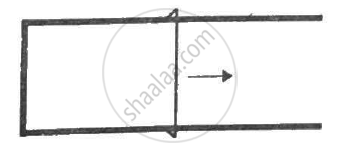
Figure shows a metallic wire of resistance 0.20 Ω sliding on a horizontal, U-shaped metallic rail. The separation between the parallel arms is 20 cm. An electric current of 2.0 µA passes through the wire when it is slid at a rate of 20 cm s−1. If the horizontal component of the earth's magnetic field is 3.0 × 10⁻⁵ T, calculate the dip at the place.
Concept: undefined >> undefined
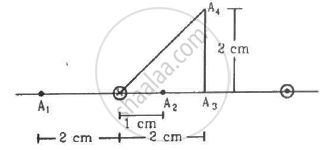
Figure shows two parallel wires separated by a distance of 4.0 cm and carrying equal currents of 10 A along opposite directions. Find the magnitude of the magnetic field B at the points A1, A2, A3.
Concept: undefined >> undefined
Two parallel wires carry equal currents of 10 A along the same direction and are separated by a distance of 2.0 cm. Find the magnetic field at a point which is 2.0 cm away from each of these wires.
Concept: undefined >> undefined
Two long, straight wires, each carrying a current of 5 A, are placed along the x- and y-axis respectively. The currents point along the positive directions of the axes. Find the magnetic fields at the points (a) (1 m, 1 m), (b) (−1 m, 1 m), (c) (−1 m, −1 m) and (d) (1 m, −1 m).
Concept: undefined >> undefined
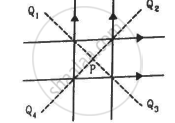
Four long, straight wires, each carrying a current of 5.0 A, are placed in a plane as shown in figure. The points of intersection form a square of side 5.0 cm.
(a) Find the magnetic field at the centre P of the square.
(b) Q1, Q2, Q3, and Q4, are points situated on the diagonals of the square and at a distance from P that is equal to the diagonal of the square. Find the magnetic fields at these points.
Concept: undefined >> undefined
Consider a 10-cm long piece of a wire which carries a current of 10 A. Find the magnitude of the magnetic field due to the piece at a point which makes an equilateral triangle with the ends of the piece.
Concept: undefined >> undefined
A long, straight wire carries a current i. Let B1 be the magnetic field at a point P at a distance d from the wire. Consider a section of length l of this wire such that the point P lies on a perpendicular bisector of the section B2 be the magnetic field at this point due to this second only. Find the value of d/l so that B2 differs from B1 by 1%.
Concept: undefined >> undefined
The electric field at a point associated with a light wave is `E = (100 "Vm"^-1) sin [(3.0 xx 10^15 "s"^-1)t] sin [(6.0 xx 10^15 "s"^-1)t]`.If this light falls on a metal surface with a work function of 2.0 eV, what will be the maximum kinetic energy of the photoelectrons?
(Use h = 6.63 × 10⁻³⁴J-s = 4.14 × 10⁻¹⁵ eV-s, c = 3 × 10⁸ m/s and me = 9.1 × 10⁻³¹kg)
Concept: undefined >> undefined
A monochromatic light source of intensity 5 mW emits 8 × 10¹⁵ photons per second. This light ejects photoelectrons from a metal surface. The stopping potential for this setup is 2.0 V. Calculate the work function of the metal.
(Use h = 6.63 × 10⁻³⁴J-s = 4.14 × 10⁻¹⁵ eV-s, c = 3 × 10⁸ m/s and me = 9.1 × 10⁻³¹kg)
Concept: undefined >> undefined
The first excited energy of a He+ ion is the same as the ground state energy of hydrogen. Is it always true that one of the energies of any hydrogen-like ion will be the same as the ground state energy of a hydrogen atom?
Concept: undefined >> undefined
Find the thermo-emf developed in a copper-silver thermocouple when the junctions are kept at 0°C and 40°C. Use the data given in the following table.
| Metal with lead (Pb) |
a `mu V"/"^oC` |
b `muV"/("^oC)` |
| Aluminium | -0.47 | 0.003 |
| Bismuth | -43.7 | -0.47 |
| Copper | 2.76 | 0.012 |
| Gold | 2.90 | 0.0093 |
| Iron | 16.6 | -0.030 |
| Nickel | 19.1 | -0.030 |
| Platinum | -1.79 | -0.035 |
| Silver | 2.50 | 0.012 |
| Steel | 10.8 | -0.016 |
Concept: undefined >> undefined
