Please select a subject first
Advertisements
Advertisements
A conductor of length ‘l’ is connected to a dc source of potential ‘V’. If the length of the conductor is tripled by gradually stretching it, keeping ‘V’ constant, how will (i) drift speed of electrons and (ii) resistance of the conductor be affected? Justify your answer.
Concept: undefined >> undefined
Given modulation index physical significance .For an amplitude modulated wave, the maximum amplitude is found to be 10 V while the minimum amplitude is 2 V. Determine the modulation index μ ?
Concept: undefined >> undefined
Advertisements
Why is there no work done in moving a charge from one point to another on an equipotential surface?
Concept: undefined >> undefined
Draw magnetic field line when a (i) diamagnetic, (ii) paramagnetic substance is placed in an external magnetic field. Which magnetic property distinguishes this behaviour of the field line due to the substances?
Concept: undefined >> undefined
Depict the equipotential surfaces for a system of two identical positive point charges placed a distance(d) apart?
Concept: undefined >> undefined
Derive an expression for drift velocity of free electrons in a conductor in terms of relaxation time.
Concept: undefined >> undefined
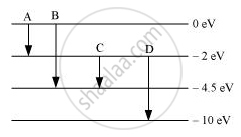
The energy levels of an atom are as shown below. Which of them will result in the transition of a photon of wavelength 275 nm?
Concept: undefined >> undefined
Which transition corresponds to emission of radiation of maximum wavelength?
Concept: undefined >> undefined
The charge on a proton is +1.6 × 10⁻¹⁹ C and that on an electron is −1.6 × 10⁻¹⁹ C. Does it mean that the electron has 3.2 × 10⁻¹⁹ C less charge than the proton?
Concept: undefined >> undefined
Can a gravitational field be added vectorially to an electric field to get a total field?
Concept: undefined >> undefined
Why does a phonograph record attract dust particles just after it is cleaned?
Concept: undefined >> undefined
In some old texts it is mentioned that 4π lines of force originate from each unit positive charge. Comment on the statement in view of the fact that 4π is not an integer.
Concept: undefined >> undefined
When the separation between two charges is increased, the electric potential energy of the charges
Concept: undefined >> undefined
The electric field at the origin is along the positive x-axis. A small circle is drawn with the centre at the origin, cutting the axes at points A, B, C and D with coordinates (a, 0), (0, a), (−a, 0), (0, −a), respectively. Out of the points on the periphery of the circle, the potential is minimum at
Concept: undefined >> undefined
If a body is charged by rubbing it, its weight
Concept: undefined >> undefined
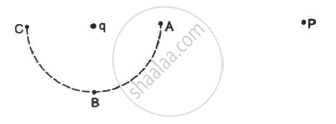
Consider the situation in the figure. The work done in taking a point charge from P to Ais WA, from P to B is WB and from P to C is WC.
Concept: undefined >> undefined
A point charge q is rotated along a circle in an electric field generated by another point charge Q. The work done by the electric field on the rotating charge in one complete revolution is
Concept: undefined >> undefined
The electric field and the electric potential at a point are E and V, respectively.
Concept: undefined >> undefined
Electric potential decreases uniformly from 120 V to 80 V, as one moves on the x-axis from x = −1 cm to x = +1 cm. The electric field at the origin
(a) must be equal to 20 Vcm−1
(b) may be equal to 20 Vcm−1
(c) may be greater than 20 Vcm−1
(d) may be less than 20 Vcm−1
Concept: undefined >> undefined
Which of the following quantities does not depend on the choice of zero potential or zero potential energy?
Concept: undefined >> undefined
