Please select a subject first
Advertisements
Advertisements
What happens when reactions:
Benzylchloride is treated with ammonia followed by the reaction with Chloromethane.
Concept: undefined >> undefined
Classify the following amine as primary, secondary or tertiary:

Concept: undefined >> undefined
Advertisements
Classify the following amine as primary, secondary or tertiary:
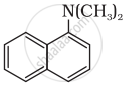
Concept: undefined >> undefined
Classify the following amine as primary, secondary or tertiary:
(C2H5)2CHNH2
Concept: undefined >> undefined
Write the IUPAC name of the following compound.

Concept: undefined >> undefined
For the reaction, \[\ce{A +2B → AB2}\], the order w.r.t. reactant A is 2 and w.r.t. reactant B. What will be change in rate of reaction if the concentration of A is doubled and B is halved?
Concept: undefined >> undefined
Account for the following:
Glucose is a reducing sugar
Concept: undefined >> undefined
Explain the observation, at the end of each period, there is a slight increase in the atomic radius of d-block elements.
Concept: undefined >> undefined
Identify the order of reaction from the following unit for its rate constant:
L mol–1 s–1
Concept: undefined >> undefined
The conversion of molecules A to B follow second order kinetics. If concentration of A is increased to three times, how will it affect the rate of formation of B?
Concept: undefined >> undefined
What are Homoleptic complexes?
Concept: undefined >> undefined
Why chelate complexes are more stable than complexes with unidentate ligands?
Concept: undefined >> undefined
Name the element of 3d series which exhibits the largest number of oxidation states. Give reason.
Concept: undefined >> undefined
What are Heteroleptic complexes?
Concept: undefined >> undefined
Give reason for the following statements:
Scandium (Z = 21) is a transition element but Zn (Z = 30) is not.
Concept: undefined >> undefined
How many ions are produced from the complex Co(NH3)6]Cl2 in solution?
Concept: undefined >> undefined
Define transition metals.
Concept: undefined >> undefined
Read the following passage and answer the questions that follow:
|
The rate of reaction is concerned with decrease in the concentration of reactants or increase in the concentration of products per unit of time. It can be expressed as instantaneous rate at a particular instant of time and average rate over a large interval of time. A number of factors such as temperature, concentration of reactants, catalyst affect the rate of reaction. Mathematical representation of rate of a reaction is given by rate law: Rate = k[A]x [B]y x and y indicate how sensitive the rate is to change in concentration of A and B. Sum of x + y gives the overall order of a reaction. |
- What is the effect of temperature on the rate constant of a reason? [1]
- For a reaction \[\ce{A + B → Product}\], the rate law is given by, Rate = k[A]2 [B]1/2. What is the order of the reaction? [1]
- How order and molecularity are different for complex reactions? [1]
- A first-order reaction has a rate constant 2 × 10⁻³ s–1. How long will 6 g of this reactant take to reduce to 2 g? [2]
OR
The half-life for radioactive decay of 14C is 6930 years. An archaeological artifact containing wood had only 75% of the 14C found in a living tree. Find the age of the sample.
[log 4 = 0.6021, log 3 = 0.4771, log 2 = 0.3010, log 10 = 1] [2]
Concept: undefined >> undefined
Among the following, which is the strongest base?
Concept: undefined >> undefined
Assertion (A) : Copper is a non-transition element.
Reason (R) : Copper has completely filled d-orbitals in its ground state.
Concept: undefined >> undefined
