Advertisements
Advertisements
प्रश्न
What are Heteroleptic complexes?
Advertisements
उत्तर
The complexes in which a central atom or metal ion is surrounded by more than one type of ligand are called heteroleptic complexes.
For example: [Co(NH3)4Cl2]+
APPEARS IN
संबंधित प्रश्न
Which of the following compounds is used as a semipermeable membrane?
(a) Potassium ferrocyanide
(b) Potassium argentocyanide
(c) Sodium meta aluminate
(d) Copper ferrocyanide
IUPAC name of the following compound is
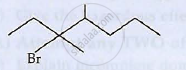
(a) 3 - Bromo- 3, 4- dimethylheptane
(b) 3, 4- dimethyl - 3- bromoheptane
(c) 5- Bromo- 4, 5- dimethylheptane
(d) 4, 5- dimethyl- 5- bromoheptane
Write applications of co-ordination compounds in medicine and electroplating.
Write the structures of compounds A, B and C in the following reactions:

Write structures of compounds A and B of the following reaction :

Metal attached with EDTA in an octahedral complex, has coordination number ______.
Glycinato ligand is ______.
Is the central metal atom in coordination complexes a Lewis acid or a Lewis base? Explain.
Explain the following, giving two examples:
Coordination number
What is meant by ambidentate ligand?
