Please select a subject first
Advertisements
Advertisements
Answer the questions based on the figure below:

- Which reaction is shown in the figure?
- Which gas is evolved in the reaction?
- Give an example of reactants that rapidly show this reaction. Give equations.
- Give an example of reactants that do not react rapidly.
- In what condition will reactants of (c) part react? Give equation.
Concept: Chemical Properties of Metal
In ______ process a layer of molten tin is deposited on metals.
Concept: Corrosion of Metals
Corrosion can be prevented by using ……………. solution.
Concept: Chemical Properties of Carbon Compounds > Oxidation
The chemical formula for rust is.............. .
Concept: Chemical Properties of Carbon Compounds > Oxidation
What is meant by rust?
Concept: Chemical Properties of Carbon Compounds > Oxidation
Write the chemical formula of rust.
Concept: Chemical Properties of Carbon Compounds > Oxidation
Give scientific reason.
It is reccommended to use air tight container for storing oil for long time.
Concept: Chemical Properties of Carbon Compounds > Oxidation
Identify from the reaction the reactants that undergo oxidation and reduction.
Fe + S → FeS
Concept: Chemical Properties of Carbon Compounds > Oxidation
Complete the following flow chart.
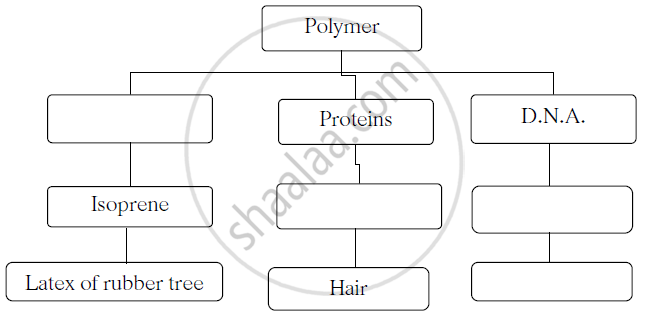
Concept: Macromolecules and Polymers
Concept: Chemical Properties of Carbon Compounds > Oxidation
Complete the correlation:
Alkene : C = C :: Alkyne: _______.
Concept: Homologous Series
Define Hydrocarbons.
Concept: Functional Groups in Carbon Compounds
The unsaturated hydrocarbons containing a carbon-carbon double bond are called _______.
Concept: Homologous Series
The general molecular formula for the homologous series of alkynes is _______.
Concept: Homologous Series
Write the molecular formula of the given compound.
Ethyl ethanoate
Concept: Functional Groups in Carbon Compounds
Cyclohexane is a branched chain type of hydrocarbon.
Concept: Functional Groups in Carbon Compounds
Distinguish between:
Saturated hydrocarbons - Unsaturated hydrocarbons
Concept: Functional Groups in Carbon Compounds
Identify the type of chemical reaction given below:
\[\ce{2Mg + O2 -> 2MgO}\]
Concept: Chemical Properties of Carbon Compounds > Oxidation
Identify saturated and unsaturated hydrocarbons from the given structural formula:
| \[\begin{array}{cc} \phantom{}\ce{H}\phantom{..}\ce{H}\phantom{}\\ \phantom{}|\phantom{...}|\phantom{}\\ \ce{H-C-C-H}\\ \phantom{}|\phantom{...}|\phantom{}\\ \phantom{}\ce{H}\phantom{..}\ce{H}\phantom{} \end{array}\] |
\[\begin{array}{cc} \phantom{..}\ce{H}\phantom{........}\ce{H}\phantom{.}\\ \phantom{.}\backslash\phantom{......}/\phantom{}\\ \ce{C = C}\\ \phantom{}/\phantom{......}\backslash\phantom{}\\ \phantom{}\ce{H}\phantom{........}\ce{H}\phantom{} \end{array}\] |
| (1) | (2) |
Concept: Hydrocarbons
Draw electron dot structure for the following:
\[\begin{array}{cc}
\phantom{}\ce{H}\phantom{..}\ce{H}\phantom{}\\
\phantom{}|\phantom{...}|\phantom{}\\
\ce{H-C-C-H}\\
\phantom{}|\phantom{...}|\phantom{}\\
\phantom{}\ce{H}\phantom{..}\ce{H}\phantom{}
\end{array}\]
Concept: Hydrocarbons
