Please select a subject first
Advertisements
Advertisements
Find the ratio of the potential differences that must be applied across the parallel and series combination of two capacitors C1 and C2 with their capacitances in the ratio 1 : 2 so that the energy stored in the two cases becomes the same.
Concept: Uniformly Charged Infinite Plane Sheet and Uniformly Charged Thin Spherical Shell (Field Inside and Outside)
Drive the expression for electric field at a point on the equatorial line of an electric dipole.
Concept: Electric Dipole
Depict the orientation of the dipole in (i) stable, (ii) unstable equilibrium in a uniform electric field.
Concept: Electric Dipole
Derive the expression for the electric potential due to an electric dipole at a point on its axial line.
Concept: Electric Dipole
Depict the equipotential surfaces due to an electric dipole.
Concept: Electric Dipole
(i)Obtain the expression for the torque `vecτ` experienced by an electric dipole of dipole moment `vecP` in a uniform electric field, `vecE` .
(ii) What will happen if the field were not uniform?
Concept: Electric Dipole
A thin conducting spherical shell of radius R has charge Q spread uniformly over its surface. Using Gauss’s law, derive an expression for an electric field at a point outside the shell.
Concept: Gauss’s Law
Draw a graph of electric field E(r) with distance r from the centre of the shell for 0 ≤ r ≤ ∞.
Concept: Gauss’s Law
(i) Find equivalent capacitance between A and B in the combination given below. Each capacitor is of 2 µF capacitance.
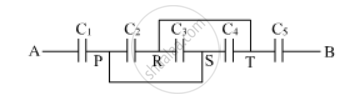
(ii) If a dc source of 7 V is connected across AB, how much charge is drawn from the source and what is the energy stored in the network?
Concept: Capacitors and Capacitance
A 12 pF capacitor is connected to a 50 V battery. How much electrostatic energy is stored in the capacitor? If another capacitor of 6 pF is connected in series with it with the same battery connected across the combination, find the charge stored and potential difference across each capacitor.
Concept: Electrostatics of Conductors
Two identical capacitors of 12 pF each are connected in series across a battery of 50 V. How much electrostatic energy is stored in the combination? If these were connected in parallel across the same battery, how much energy will be stored in the combination now?
Also find the charge drawn from the battery in each case.
Concept: Capacitors and Capacitance
A parallel-plate capacitor is charged to a potential difference V by a dc source. The capacitor is then disconnected from the source. If the distance between the plates is doubled, state with reason how the following change:
(i) electric field between the plates
(ii) capacitance, and
(iii) energy stored in the capacitor
Concept: The Parallel Plate Capacitor
Can two equi-potential surfaces intersect each other? Give reasons.
Concept: Electric Potential
Two charges −q and +q are located at points A (0, 0, −a) and B (0, 0, +a) respectively. How much work is done in moving a test charge from point P (7, 0, 0) to Q (−3, 0, 0)?
Concept: Electric Potential
Three identical capacitors C1, C2 and C3 of capacitance 6 μF each are connected to a 12 V battery as shown.
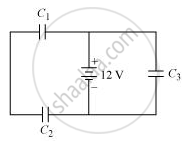
Find
(i) charge on each capacitor
(ii) equivalent capacitance of the network
(iii) energy stored in the network of capacitors
Concept: Capacitors and Capacitance
How does drift velocity of electrons in a metallic conductor vary with increase in temperature? Explain.
Concept: Drift of Electrons and the Origin of Resistivity
A cell of emf ‘E’ and internal resistance ‘r’ is connected across a variable resistor ‘R’. Plot a graph showing the variation of terminal potential ‘V’ with resistance R. Predict from the graph the condition under which ‘V’ becomes equal to ‘E’.
Concept: Cells, Emf, Internal Resistance
Derive an expression for drift velocity of free electrons in a conductor in terms of relaxation time.
Concept: Drift of Electrons and the Origin of Resistivity
Obtain the expression for the cyclotron frequency.
Concept: Cyclotron
A deuteron and a proton are accelerated by the cyclotron. Can both be accelerated with the same oscillator frequency? Give reason to justify your answer.
Concept: Cyclotron
