Advertisements
Advertisements
Define the term 'conductivity' of a metallic wire. Write its SI unit.
Concept: Specific Resistance
Write two important limitations of Rutherford's nuclear model of the atom.
Concept: Alpha-particle Scattering and Rutherford’s Nuclear Model of Atom
State two points of difference between the interference patterns obtained in Young’s double slit experiment and the diffraction pattern due to a single slit.
Concept: Diffraction of Light >> The Single Slit
Write the two processes that take place in the formation of a p-n junction.
Concept: p-n Junction
Define self-inductance of a coil.
Concept: Solenoid and the Toroid - the Solenoid
A long straight current carrying wire passes normally through the centre of circular loop. If the current through the wire increases, will there be an induced emf in the loop? Justify.
Concept: Cells, Emf, Internal Resistance
Name the junction diode whose I-V characteristics are drawn below:
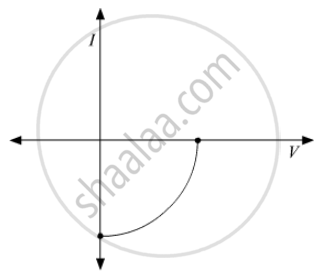
Concept: V-I Characteristics (Linear and Non-linear)
(a) drift speed
(b) current density
(c) electric current
(d) electric field
Concept: Drift of Electrons and the Origin of Resistivity
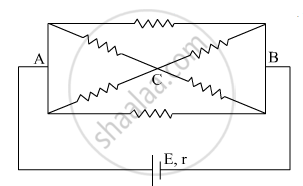
The current is drawn from a cell of emf E and internal resistance r connected to the network of resistors each of resistance r as shown in the figure. Obtain the expression for
- the current draw from the cell and
- the power consumed in the network.
Concept: Kirchhoff’s Laws
Write the expression, in a vector form, for the Lorentz magnetic force \[\vec{F}\] due to a charge moving with velocity \[\vec{V}\] in a magnetic field \[\vec{B}\]. What is the direction of the magnetic force?
Concept: Force on a Moving Charge in Uniform Magnetic and Electric Fields
At a place, the horizontal component of earth's magnetic field is B and angle of dip is 60°. What is the value of horizontal component of the earth's magnetic field at equator?
Concept: Magnetic Field on the Axis of a Circular Current Loop
Why is it necessary to introduce a radial magnetic field inside the coil of a galvanometer?
Concept: Moving Coil Galvanometer
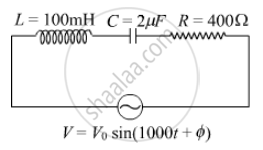
(i) Find the value of the phase difference between the current and the voltage in the series LCR circuit shown below. Which one leads in phase : current or voltage ?
(ii) Without making any other change, find the value of the additional capacitor C1, to be connected in parallel with the capacitor C, in order to make the power factor of the circuit unity.
Concept: Different Types of AC Circuits: AC Voltage Applied to a Series LCR Circuit
A power transmission line feeds input power at 2200 V to a step-down transformer with its primary windings having 300 turns. Find the number of turns in the secondary to get the power output at 220 V.
Concept: Transformers
Distinguish between unpolarized light and linearly polarized light
Concept: Plane Polarised Light
Explain two features to distinguish between the interference pattern in Young's double slit experiment with the diffraction pattern obtained due to a single slit.
Concept: Interference of Light Waves and Young’s Experiment
A monochromatic light of wavelength 500 nm is incident normally on a single slit of width 0.2 mm to produce a diffraction pattern. Find the angular width of the central maximum obtained on the screen.
Estimate the number of fringes obtained in Young's double slit experiment with fringe width 0.5 mm, which can be accommodated within the region of total angular spread of the central maximum due to single slit.
Concept: Interference of Light Waves and Young’s Experiment
Define the distance of closest approach. An α-particle of kinetic energy 'K' is bombarded on a thin gold foil. The distance of the closest approach is 'r'. What will be the distance of closest approach for an α-particle of double the kinetic energy?
Concept: Alpha-particle Scattering and Rutherford’s Nuclear Model of Atom
A radioactive nucleus 'A' undergoes a series of decays as given below:

The mass number and atomic number of A2 are 176 and 71 respectively. Determine the mass and atomic numbers of A4 and A.
Concept: Law of Radioactive Decay
