Please select a subject first
Advertisements
Advertisements
_____________ secreted by the (ii) _____________ lobe of the pituitary gland. If this hormone secretion is reduced, there is an increased production of urine. This disorder is called (iii) ____________. Sometimes excess glucose is passed with urine due to hyposecretion of another hormone called (iv) _____________ leading to the cause of a disease called (v) ______________.
Concept: Excretion
the Biological/technical term Pigment providing colour to urine.
Concept: Excretion
The Biological/technical term for The removal of nitrogenous wastes from the body
Concept: Excretion
The form in which glucose in stored in liver.
Concept: Excretion
State the exact location of the Loop of Henle.
Concept: Excretion
Give the biological/technical terms for the following:
The hormone increasing reabsorption of water by kidney tubules.
Concept: Excretion
The diagram given alongside shows a section of a human kidney. Study the diagram carefully and answer the questions that follow:
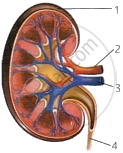
- Label the parts numbered 1 to 4.
- Why does part 2 have a striped appearance?
- What is the fluid that passes down part 4? Name the main nitrogenous waste present in it.
- Mention the structural and functional units of kidneys.
- Name the two major steps in the formation of the fluid mentioned in (c).
Concept: Excretion
The diagram given below shows the male urinogenital system of a human being. Study the diagram and answer the questions that follow:

(i) Label the parts numbered 1 to 8.
(ii) Name the corresponding structure of part (4) in female reproductive system.
(iii) What is the role of part 7?
Concept: Excretion
The given diagram represents a nephron and its blood supply. Study the diagram and answer the following questions:

(i) Label parts 1, 2, 3 and 4.
(ii) State the reason for the high hydrostatic pressure in the glomerulus.
(iii) Name the blood vessel which contains the least amount of urea in this diagram.
(iv) Name the two main stages of urine formation.
(v) Name the part of the nephron which lies in the renal medulla.
Concept: Excretion
Correct the statement by changing the underlined word.
Normal pale colour of the urine is due to the presence of the pigment Melanin.
Concept: Excretion
Blood in the renal artery or renal vein (Which one has more urea?)
Concept: Excretion
Give an appropriate biological or technical term for the following:
The process of maintaining water and salt balance in the blood.
Concept: Osmoregulation
The diagram given alongside is that of a structure present in a human kidney:
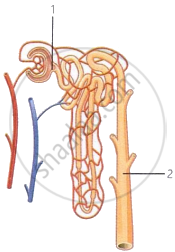
Study the same and answer the questions that follow:
- Name the structure represented in the diagram.
- What is the liquid entering part ‘1’ called?
Name two substances present in this liquid that are reabsorbed in the tubule - What is the fluid that comes to part ‘2’ called? Name the main nitrogenous waste in it.
- Mention the three main steps involved in the formation of the fluid mentioned in (c) above.
- Name the substance which may be present in the fluid in part ‘2’ if a person suffers from Diabetes mellitus
Concept: Excretion
Differentiate between the following pair on the basis of what is indicated in the bracket.
Ureter and Urethra [function]
Concept: Excretion
Define the following term:
Ultrafiltration
Concept: Function of the Kidney - “Production of Urine”
Correct and rewrite the statement by changing the biological term that is underlined for the statement:
The kidney is composed of number of neurons.
Concept: Excretion
Differentiate between Afferent arteriole and Efferent arteriole.
Concept: Function of the Kidney - “Production of Urine”
The pigment that gives colour to urine:
Concept: Urine
The pale yellow colour of normal human urine is due to the pigment ______.
Concept: Urine
