Please select a subject first
Advertisements
Advertisements
Name the following:
The main nitrogenous waste formed in the body.
Concept: Excretion
Assertion (A): We urinate more in summer.
Reason (R): Sweat glands are more active in summer.
Concept: Osmoregulation
Give one example of a diuretic substance.
Concept: Urine
Differentiate between diabetes mellitus and diabetes insipidus (hormones involved).
Concept: Urine
Mention the exact location of the Islets of Langerhans
Concept: Major Division of the Nervous System
Briefly explain the following terms : Reflex action
Concept: Reflex Action
Which of the following is not a natural reflex action?
A. Knee-jerk
B. Blinking of eyes due to strong light
C. Salivation at the sight of food
D. Sneezing when any irritant enters the nose
Concept: Reflex Action
Aqueous humour is present between the ______.
Concept: Major Division of the Nervous System
The diagram given below shows the internal structure of a spinal cord depicting a phenomena. Study the diagram and answer the questions:
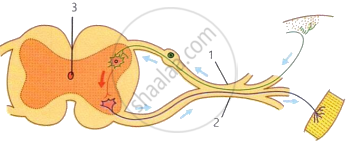
- Name the phenomenon that is depicted in the diagram. Define the phenomenon.
- Give the technical term for the point of contact between the two nerve cells.
- Name the parts numbered 1, 2 and 3.
- How does the arrangement of neurons in the spinal cord differ from that of the brain?
- Mention two ways by which the spinal cord is protected in our body.
Concept: Reflex Action
Name the following:
The layer of the eyeball that provides nourishment to the eye.
Concept: Human Nervous System
Answer the following questions briefly:
Explain how the human eye adapts itself to bright light and dim light.
Concept: Human Nervous System
Choose the correct answer.
Number of spinal nerves in human beings ______________
Concept: The Spinal Cord
Explain the Term:
Synapse
Concept: Human Nervous System
The outermost layer of meninges:
Concept: Human Nervous System
Which one of the following is not a simple reflex?
Concept: Reflex Action
From where the following nerves arise.
Auditory nerve
Concept: Reflex Arc
Stimulation of nerves of the sympathetic nervous system ______.
Concept: Human Nervous System
Arrange and rewrite the terms in the group in the correct order to be in a logical sequence beginning with the term that is underlined:
Receptor, Response, Effector, Spinal Cord.
Concept: Reflex Arc
Assertion (A): Sympathetic nervous system prepares the body for violent action against abnormal conditions.
Reason (R): Sympathetic nervous system accelerates heartbeat.
Which of the following is correct?
Concept: Human Nervous System >> Peripheral Nervous System (PNS)
Arrange and rewrite the terms in group in the correct order to be in a logical sequence, beginning with the term that is underlined:
Effector, Receptor, Motor neuron, Sensory neuron.
Concept: Reflex Arc
