Please select a subject first
Advertisements
Advertisements
Name the two types of atoms used for doping of Ge/Si.
Concept: Intrinsic Semiconductor
In an extrinsic semiconductor, the number density of holes is 4 × 10²⁰ m-3. If the number density of intrinsic carriers is 1.2 × 10¹⁵ m-3, the number density of electrons in it is ______.
Concept: Extrinsic Semiconductor
The formation of the depletion region in a p-n junction diode is due to ______.
Concept: Diode or p-n Junction
Draw an energy band diagram for a p-type semiconductor at T > 0 K.
Concept: Classification of Metals, Conductors and Semiconductors
Draw an energy band diagram for an n-type semiconductor at T > 0 K.
Concept: Classification of Metals, Conductors and Semiconductors
Draw the circuit arrangement for studying V-I characteristics of a p-n junction diode in (i) forward biasing and (ii) reverse biasing. Draw the typical V-I characteristics of a silicon diode.
Concept: Semiconductor Diode
Define modulation index.
Concept: Modulation and Its Necessity
How are side bands produced?
Concept: Modulation and Its Necessity
Draw a block diagram of a detector for AM signal and show, using necessary processes and the waveforms, how the original message signal is detected from the input AM wave.
Concept: Amplitude Modulation (AM)
Explain the process of amplitude modulation.
Concept: Amplitude Modulation (AM)
Define the term 'amplitude modulation'
Concept: Amplitude Modulation (AM)
Explain any two factors which justify the need for modulating a low frequency base-band signal.
Concept: Amplitude Modulation (AM)
Draw a schematic sketch showing how amplitude modulated signal is obtained by superposing a modulating signal over a sinusoidal carrier wave.
Concept: Amplitude Modulation (AM)
Explain the term demodulation used in a communication system.
Concept: Basic Terminology Used in Electronic Communication Systems
Block diagram of a receiver is shown in the figure:
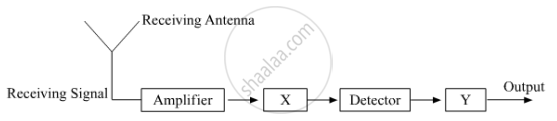
(a) Identify ‘X’ and ‘Y’.
(b) Write their functions.
Concept: Bandwidth of Signals
In the block diagram of a simple modulator for obtaining an AM signal, shown in the figure, identify the boxes A and B. Write their function.

Concept: Modulation and Its Necessity
Distinguish between ‘Analog and Digital signals’.
Concept: Bandwidth of Signals
Which one of the following is a princely state of India that initially resisted joining the Indian Union?
Concept: Integration of Princely States
In the given political map of India, four states have been marked as A, B, C, and D. Identify these states on the basis of the information given below and write their correct names in your answer book along with the respective serial number of the information used and the concerned alphabet as per the format that follows:

- The state to which Raj Kumari Amrit Kaur, Health Minister in Nehru's Cabinet, belonged.
- The state to which former Congress President. S. Nijalingappa, belonged.
- The state where Karpoori Thakur was the Chief Minister.
- The State to which the political party DMK belongs.
| S. No. of the Information used | Concerned alphabet | Name of the State |
| (i) | ______ | ______ |
| (ii) | ______ | ______ |
| (iii) | ______ | ______ |
| (iv) | ______ | ______ |
Concept: Nehru's Approach to Nation-building
Which one of the following countries was NOT a part of the Soviet Union?
Concept: Why Did the Soviet Union Disintegrate?
