CBSE Science (English Medium) कक्षा १२ Important Questions for Physics - Moving Charges and Magnetism
Advertisements
Advertisements
Chapter wise important questions with answers and solutions for Physics in CBSE Science (English Medium) कक्षा १२.
Outline the necessary steps to convert a galvanometer of resistance RG into an ammeter of a given range ?
अध्याय: [4] Moving Charges and Magnetism
Using Ampere’s circuital law, obtain the expression for the magnetic field due to a long solenoid at a point inside the solenoid on its axis ?
अध्याय: [4] Moving Charges and Magnetism
In what respect is a toroid different from a solenoid?
अध्याय: [4] Moving Charges and Magnetism
Draw and compare the pattern of the magnetic field lines in the two cases ?
अध्याय: [4] Moving Charges and Magnetism
How is the magnetic field inside a given solenoid made strong?
अध्याय: [4] Moving Charges and Magnetism
A long straight wire of a circular cross-section of radius ‘a’ carries a steady current ‘I’. The current is uniformly distributed across the cross-section. Apply Ampere’s circuital law to calculate the magnetic field at a point ‘r’ in the region for (i) r < a and (ii) r > a.
अध्याय: [4] Moving Charges and Magnetism
State the underlying principle of working of a moving coil galvanometer. Write two reasons why a galvanometer can not be used as such to measure current in a given circuit. Name any two factors on which the current sensitivity of a galvanometer depends.
अध्याय: [4] Moving Charges and Magnetism
Derive the expression for force per unit length between two long straight parallel current carrying conductors. Hence define one ampere.
अध्याय: [4] Moving Charges and Magnetism
A square loop of side 'a' carrying a current I2 is kept at distance x from an infinitely long straight wire carrying a current I1 as shown in the figure. Obtain the expression for the resultant force acting on the loop.
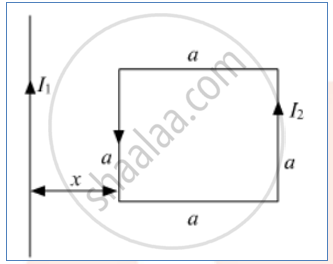
अध्याय: [4] Moving Charges and Magnetism
Explain the significance of a radial magnetic field when a current-carrying coil is kept in it.
अध्याय: [4] Moving Charges and Magnetism
Answer the following question.
Two infinitely long straight wire A1 and A2 carrying currents I and 2I flowing in the same direction are kept' distance apart. Where should a third straight wire A3 carrying current 1.5 I be placed between A1 and A2 so that it experiences no net force due to A1 and A2? Does the net force acting on A3 depend on the current flowing through it?
अध्याय: [4] Moving Charges and Magnetism
Twelve wires each having a resistance of 3 Ω are connected to form a cubical network. A battery of 10 V and negligible internal resistance is connected across the diagonally opposite corners of this network. Determine its equivalent resistance and the current along each edge of the cube.
अध्याय: [4] Moving Charges and Magnetism
A planar loop of rectangular shape is moved within the region of a uniform magnetic field acting perpendicular to its plane. What is the direction and magnitude of the current induced in it?
अध्याय: [4] Moving Charges and Magnetism
Assertion (A): On Increasing the current sensitivity of a galvanometer by increasing the number of turns may not necessarily increase its voltage sensitivity.
Reason (R): The resistance of the coil of the galvanometer increases on increasing the number of turns.
Select the most appropriate answer from the options given below:
अध्याय: [4] Moving Charges and Magnetism
Two concentric and coplanar circular loops P and Q have their radii in the ratio 2:3. Loop Q carries a current 9 A in the anticlockwise direction. For the magnetic field to be zero at the common centre, loop P must carry ______.
अध्याय: [4] Moving Charges and Magnetism
State the two Kirchhoff’s rules used in the analysis of electric circuits and explain them.
अध्याय: [4] Moving Charges and Magnetism
Derive the equation of the balanced state in a Wheatstone bridge using Kirchhoff’s laws.
अध्याय: [4] Moving Charges and Magnetism
Two long straight parallel conductors carrying currents I1 and I2 are separated by a distance d. If the currents are flowing in the same direction, show how the magnetic field produced by one exerts an attractive force on the other. Obtain the expression for this force and hence define 1 ampere.
अध्याय: [4] Moving Charges and Magnetism
Two long straight parallel current-carrying conductors are kept ‘a’ distant apart in the air. The direction of current in both the conductors is the same. Find the magnitude of force per unit length and the direction of the force between them. Hence define one ampere.
अध्याय: [4] Moving Charges and Magnetism
The given figure shows a long straight wire of a circular cross-section (radius a) carrying steady current I. The current I is uniformly distributed across this cross-section. Calculate the magnetic field in the region r < a and r > a.

